Although many people with children dread summer, dread facing and dealing with their own children on a daily basis, I welcome it.
At-home moms work as hard as anyone else during the school year and love taking a break from conducting a school; I love changing from working at a desk to working outdoors; I love having time for some fun stuff with the funnest young people I know.
In my case, I doubly welcome a few days to take on my grandchildren, in a yearly event I call “Camp Grandmother”, complete with fun activities for every day.
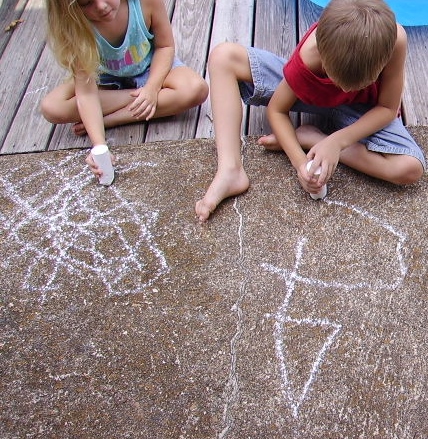
Here, two of my dearies enjoy the cool of a summer morn, in the shade on the east side of our house, making chalk art with homemade chalk their older cousins helped make last summer. (Plaster of Paris inside toilet tissue cores you’ve dipped in melted paraffin.)
Not a care in the world, hair not yet groomed, clothing so loose it falls off, they attempt a sailboat and some sort of grid work.
Takes me back . . .
Enjoy them while they are young. They are growing up right before your eyes and you will miss them, one day.
Yes, dear home educator, if your in-laws are very slow to accept your decisions, you may have a tough convincing task to attempt. You can ruin a relationship with extremely important people if you ignore the feelings of family members.
Never forget this:
No matter how right you are, you are the ones who are changing.
If there is a problem within the relationship, you are the ones through whom the problem is coming.
No matter how bizarre or painful your in-laws reactions may seem to you, you have the burden of proof.
This does not mean that you are wrong, no! If God is showing you to home school, then your decision is good and right. You can see that.
Your in-laws cannot, and maybe never will, unless someone who cares about them can help them see. This is where you may come in. They are the ones who feel bad, not you. Your patience toward them will help determine how this all turns out.
Knowing where to start can seem impossible, can it not? The best place to start any endeavor is on your knees.
Pray that God would give you the right words, springing from a right heart.
Remind yourself of the dedication your parents showed in your upbringing.
Recall that God provided for you, then, through them.
Remember His command to honor your parents.
Think how you would feel in a similar circumstance. It is not enough, in God’s eyes, to be right—you also must have a right heart attitude. (I Corinthians 13)
You must deal very gently and humbly with your in-laws. The way to do this is to enter the whole situation with thankfulness for your in-laws’ reaction. Three glorious things are happening in your life:
Your in-laws care about you and your children.
Your in-laws relate to you.
You are home schooling.
Be thankful that they care, thankful that they still relate to you, and thankful that you home school. God can give you that thankful heart and the gentle humility.
Then, keep the reality of the problem in sight. The hurt, fear, and embarrassment are real to your in-laws, and will not go away for a long time. Only gentle, humble dealings will assuage their hearts. Maybe they do not really want to hear that their hurt is needless, their fears are groundless, or their embarrassment is baseless. While we can acknowledge that such a reaction may point to selfishness, pride, and lack of trust on their part, it does not change the fact that you, the messenger of such good/bad news, are finding it ill-received. It does not change God’s command to us to honor them. Part of honoring parents is to take their discomfort seriously.
The hurt is the hardest.
They truly did the best they could do (perhaps) for you, their child, and it truly is not good enough for your children. There is no getting around that.
Nevertheless, what your parents did—shifting their responsibility to educate you onto a worldly institution—was considered the best possible thing in their day. Now days it is not. Now days, experts cite home education as the best.
So in a way, you are doing exactly what your parents did: giving the best that you can.
In your parents’ days, homebound education was for children who had rheumatic fever or some other physical difficulty. In their parents’ days, though, the best often included instruction from someone who did not have a degree and many more received their education at home.
Perhaps you can make them see that what was “best” in Great-Great-Grandma’s days is now returning to vogue.
Perhaps you can make them see your home schooling as trying to keep up with current trends.
That is what they did. Thank them for caring and for their input. Let them know that you will need a lot of input. If possible, recruit their help from the start. If they can only provide a different type of flower for botany study or a different place to picnic, they can feel less left out and more as if “we help home school our grandchildren”. Help them see how much the worldly schools have deteriorated into something that is not the same as when you were little. Remind them that the Bible and good, common, Biblical sense no longer operate in the world’s schools, making them hostile places for children.
Their fears are not imagined, either.
How can your children get jobs or go to college without a high school diploma?
It was not so very long ago when you asked the same question yourself, was it? It is a legitimate question, along with many other questions that accompany the decision to home school.
Do not fault your parents or in-laws for asking the same questions you were asking just a year ago. They care, too. They may remember a few bad grades that you accumulated during your educational quest and may even feel that you do not know as much as you think you do.
Of course, almost anyone can teach most little ones the ABC’s, degree or not. What they really are asking about is high school math, is it not?
In most states, there is no test to prove “teacher proficiency” among home school moms, thank God! We are free to fail, if we want.
The simple answer is that we care about the children in our school, do not want to fail to meet their needs, and do not want them to fail. We will be diligent and we will constantly be checking our progress and theirs. Having a solid plan for checking their progress will help smooth the road for you with them.
Their embarrassment stems from what their friends will think.
These feelings can come from the idea of the dropout or the handicapped; ideas that, right or wrong, still carry a stigma for many people. Not too long ago, anyone who did not finish school was questionable.
Of course, we know that home educated graduates are more likely than others to find employment, in many cases, but our parents do not know this, sometimes (and neither do their chums.)
If you can find one of the lovely brochures that explain the preeminence of home schooling, it might help, especially if you present it quietly and gently.
If you know of other home educators who have had wonderful results (there are many) you might help the situation by pointing to their success.
One of the best arguments that I have found, one that even convinces me when I question myself, is the very long list of former home educated who became successful, even famous people. Many authors, scientists, and statesmen had the blessed start that can only happen on Mother’s lap. Many productive, moral members of our society have obtained their backbones from walking with Dad to town or to the barns and fields and watching him deal with the people he encountered. There is nothing like the way our country began, for generating good, solid life.
If you can make your family see that, they might catch your vision.
I can not promise that it will be easy. It has not been easy for us. Probably it will take a long time. Realize that you are asking them to trust you, regardless of their feelings, and . . .
. . . trust is something that a person must earn.
You cannot require or force it in any way; you must earn it. It is possible to earn trust, though, and some have done it. Until you see the beginnings of trust in your in-laws, at least you can base your words and actions upon humility and wisdom, and not leave your family with just reasons for their opposition.
Your calm, loving re-assurances can go a long way toward helping them have peace about your decisions.
About a third of the U.S. Population is, or has been, incarcerated, or is on parole.
A third.
I listened while a prison missionary told that terrifying statistic. I watched with mouth agape, a film showing baptisms of people in handcuffs. The joy of new life in Christ was obvious on their faces.
The prisons make up the fastest-growing portion of the Church in our country, if you count conversions.
The missionary told us of inmates who had come to Christ, finished their sentences, and returned to become missionaries to prisons, themselves, leading hundreds to life in Christ.
At last, our speaker told us of one inmate, a serial killer who had finally come to life in Christ and had gone on to lead many fellow inmates to Christ. If I told you his name, you would gasp. He was one of the top-name killers in our country, not long ago.
I say “was” because he, himself, was murdered by an inmate, about 4 years ago. His story, though, has direct relevance to us.
While this man was in prison, his dad sent him some Creation science materials. Reading these papers and books led him to realize Jesus is Lord, and to give his life over to Him.
In a nationally televised interview, he said he always thought evolutionists were right, that there is no God. If we all come from slime and return to it, he reasoned, he saw no point in having laws, no way of defining right and wrong. If what we do does not matter to any higher authority, then it is of no consequence, and killing is not wrong.
Therefore, he killed.
This was correct reasoning, by the way.
The Existence of the God of Abraham, Isaac, and Jacob IS the only reason to do right; His Word, the only definition of right.
You know, Hitler thought the same way.
So did Madame guillotine.
Everyone agrees.
Think about it awhile.
Keep your babies at home. Keep them out of the prisons built for children, the miniature unarmed police states that teach evolution.
Seventh, do not stop encouraging him. Of course, you must mark wrong answers, but you must also show him what is right about his work.
Is his handwriting improving? Tell him.
Is he missing fewer math problems? Tell him.
Is his work progressing faster since he found new resolve? Tell him.
He cannot measure himself by his classmates anymore (and that is a very good thing) so your recording of his successes, however small they may seem to you, will mean much to him.
Eighth, touch him. He may be a touch-me-not, but you can pull rank.
Tell him, “You may not like lots of cuddles, but you are my child and I’d like to know whom else I can hug!”
Scientists say that loving touch works like vitamins for children and that children who receive pats and hugs are measurably smarter and healthier, even grow taller, than those who do not. His teachers probably feared that it was illegal to supply this for him, but now is different.
The home-schooled student truly does have every advantage.
These advantages are the reason we do this. As we begin to point our child in the way he should go, we can know that we are giving him the advantage that lasts forever.
Undo
Photo credit: (2008–09 Fenerbahçe S.K. season) (Photo credit: Wikipedia)
Fifth, measure what he knows. Obtain a progress test or a placement test but do not administer it to him; go over it with him. (It does not have to relate to your curriculum, if you can transfer the results.) As you learn where he needs to begin studying, record what he knows. Then, as his knowledge increases, reward what he knows.
Measure, record, and reward—keep these three processes in mind a lot, in the beginning.
Learn how he best can learn. If experience has taught him to scorn reading, give him many oral and hands-on lessons. If he dislikes fiddling with props, hand him many glorious books.
Chart where he is and where he needs to be and graph his progress as it happens.
Break down any catch-up plans into a schedule with an estimated time of completion.
Then you can say things like, “By Thanksgiving, you will know the times tables!” or, “Doing an extra page weekly will finish this unit before our trip!” or, “When you are fifteen, you will be ready to begin chemistry!” Help him see that the little bites eventually whittle the entire project into an imaginable size.
Sixth, realize one thing you both have in common: You both know that home schooling is better, in spite of any fuss he may be projecting or any fears you may be hiding.
If he has been behind, your child may have tried to save face by pretending pleasure with a poor performance that he could not improve. To succeed in the real world may have seemed impossible to him. The child who has become proud of failure is trying to invent a new social structure in which he can seem “okay”.
If your child is in this sad state, you have two big jobs:
To help him understand that home school is another reinvented social structure in which havingfailed is okay, but also in which failure will bereplaced with success; and
To guide him into learning, and showing that success. He knows you are right, but fears to believe it could be possible. Paralyzing fear will melt as soon as progress begins.
Alternately, if he has been stifled in a class that is behind him in achievement level, he may have to learn to overcome laziness with a new love for excellence. He will need your help, no matter where he was or where he needs to be. Yes, he needs you; that is why God made parents. You can inspire him with:
The idea of beginning college early, or with
Extracurricular activities for finishing early in the day.
Most importantly, in either case you must help your child see that excellence is its own reward.


![[Edinburgh from the castle, Scotland] (LOC)](https://i0.wp.com/farm4.static.flickr.com/3551/3449527773_58f9a08444.jpg "[Edinburgh from the castle, Scotland] (LOC)")

 Home's Cool!