Blog

Posted in Home School

Do You Need an All-in-One Curriculum?

Twelve years curriculum all on cd's.Every man, woman, and child in your home owns a computer. You built them yourselves. You like them. You can’t help it.

You really wish someone would put everything your children need for their entire school career on a few disks, to save you some time. After all, when you prefer life in front of your computer, you hardly feel like shopping at curriculum shows in some out of the way huge city.

Funds are tight for you, too, and you’d be willing to do more than your share to save some money. You could use a true, budget-saving curriculum that has no frills but doesn’t charge for them, either.

And you’ve noticed lately that the house seems to be shrinking and home school materials haven’t helped that problem much—you never guessed it all would take up so much space! Isn’t there some tinier, tidier version that you could stuff in a bag or something, and not have to build shelves or buy a storage hut for?

Is this the 21st century or did I imagine it!

And whose bright idea was it to make the teacher book identical to the students’! Everything takes twice the space and funds, that way, and really, if you can’t score first grade math without an answer key, well, wow.

It just seems to you all the materials you need could be in one package and that could be the end of it.

Why prolong the agony?
Why keep going back and going back, just to get what you knew you would need, anyway?
Seems like if it were all pre-packaged, it could cost even less.

Is this you?

Do you need something that saves time, money, space, and doesn’t insult you?

Is it out there?

Yes.

A great old-fashioned schoolbook type curriculum has been committed to CDs and includes everything you need from lined paper for penmanship practice, through all textbooks, all the way to every outside reading book you will ever need to educate a child, ALL ON CDs. True, you’d want to print off some of it, since it is not interactive, but it is all there, from that first kindergarten matching exercise, to the last calculus test, and all points between.

At the risk of seeming to bend the guidelines, which I am NOT, (this is only an informative blog, please!) let me suggest you scout out the Robinson Curriculum.

It may be the answer to all your needs.

Posted in Home School

Do You Need Unit Studies?

Curriculum to draw a horse while studying horses.You probably seldom saw unit studies in your collective school past, except maybe on holidays or after the first snow.

Unit Studies is a relatively new term that conveys the idea of studying only one topic at a time in every school discipline.

So, if your children wanted to study horses and you were teaching through unit studies, they would read Black Beauty or something similar.
Their English assignments would be reports or essays about horses.
Math would cover statistics about horses.
You would teach the history of horses, complete with maps.
Spelling would include equine and other “qu” words and whether racetrack and several others are closed, hyphenated, or open compounds.
Biology might cover the horse skeleton.

Get it?

And often, every student is studying the same topic, so while the high schoolers are learning to render a horse in oil paints and apply the logic of game theory, the first grader is filling a color book about horses and learning to count the pintos in a certain mixed herd.

Some people love unit studies, and I have used them a time or two, myself, enjoying the results. They really ring the bell for people who thrive on research, and I do. The consummate teacher, whose every cell longs to provide all, all, all the input from the depths of her soul, will inhale this idea with great joy.

Often, the homeschool teacher who loves unit studies has a teaching degree, or had begun to acquire one, or always wanted to be a teacher.
Perhaps she has a lot of experience in teaching maybe Sunday School or some other public place, such as job orientations at her old workplace.
Something about her life has handed her a great amount of confidence she can do a better job than any old book.

Often she has given birth to children who also enjoy much “hands-on” experience in life.
They must contemplate while they learn (unlike the ones who grab up facts and contemplate later.)
These children seem to grow taller when they have a “project” in the works, and sometimes it is an ever-expanding project.
The wise teacher of this type of learner will keep a constant supply of projects in the wings, waiting for the right moment to introduce them.

One other important aspect of teaching through unit studies is the time factor: It takes a great amount of time.

Unit studies require a life of total devotion to providing content for the students.
You have to know, months in advance, what you are doing and what you plan to be doing.
There are no textbooks already planned out for you.
There are no answer keys.
Often there is no summer vacation for you.

Thing is, you love this stuff.

Also you need to know there is no maid. Either you have to provide that, yourself, or else you have to be okay with some things undone.
If your husband freaks over a cheerio in his chair, hmm.
If a sticky floor drives you crazy, hmm.

I counseled a lady who asked me, “My husband has told me that if I will homeschool our children, he will hire me a maid. Do you think I could do it?”
I told her, “With a maid, there is much greater time to devote to the business of teaching. I would only be concerned about the children not learning to carry their own load with chores.”

She took that counsel to heart.
She has the maid.
Her children have strictly enforced chores.

And she, for some reason, chose unit studies.

Are unit studies for you? There are companies that provide grace and guidance for those who embark for this journey. Check out Konos, Sunlight, and Weaver, to see if you could love this way.

And last, but not least!

Posted in Home School

Do You Need Disposable Workbooks?

Schoolbooks sitting around look like a stack of magazines.

You’ve seen these before, too: oversized, paperbound booklets, that look almost like magazines, with 30-80 pages, for reading a small amount and writing the answers directly into the book. You either loved them as a child, or else not.

As a home-educating mom, you may just learn to love them the way your teacher did: they make learning, and thereby teaching, so much easier.

If you, Mom, as the teacher, must be gone, you must leave someone you trust in charge of your students.
This person may love your children to pieces, but not feel your drive to be a good teacher.
This person may be your husband or your mom, so firing is not a resort.

But workbooks may be.

Workbooks are inherently geared to any teacher, including the student, himself. He reads a little, answers a few questions geared to comprehension, and then repeats.

Because the coursework is so intensively interactive, the student learns more, faster, and retains it longer.
Because the student can feel the acceleration of his learning, he gains confidence.
Because the incremental teaching and much-needed confidence is built into the book, the teacher finds the student needs less direction.

Sounding good?

The Non-Standard Student.

Perhaps you already figured this, but if your child is not inherently gifted for student-hood, workbooks can carry him along until those long twelve years are finally over. Many children finish the day’s work by noon, and still learn enough to do well on exit tests.

It’s just easier. Not only for the student, but also for the teacher.

On the other hand, if your student is far, far ahead of his peers—or maybe even of his teachers—a curriculum that could test and place him where he belongs could be a tremendous asset, in many ways.

Home Business.

Finishing by noon makes time for a home business.

And finishing by noon, daily, is not such a stretch, you will learn.

Early Graduation.

Finishing by noon makes time for doing two day’s worth per day, which can create time for graduating and starting college earlier than you thought.

For some students, it can mean graduating at age 18 instead of 20, after all.

For others, it can mean graduation from college by age 18.

It’s a thought.

Learning Gaps.

If you are taking a child out of a collective school environment, you probably have little idea where he is in his learning or where he should be.

He may have learning gaps or even be behind the kids his age.

But with workbooks come . . . placements tests!

Placement tests are the tool that lets you know exactly which book to buy for your child, and why. You can have the confidence that comes with knowing this material is exactly the right level for your student; not too easy or too difficult.

The Unsure Beginner.

Of course, you also are unsure about what to do or how to do it.

(Don’t feel bad; most professional teachers who begin homeschooling feel the same!)

But with workbooks, the self-explanatory nature goes both ways—for the teacher and for the student. Since the workbooks do all the work, you, Mom, will have more time, more confidence, and more understanding of what your child needs.

And more time for folding laundry? Maybe?

Accuracy in Placement.

You know this equals accuracy in spending, which is so important during these times of economic chaos.

Especially if you begin in the middle of a school year, you can buy only what you need because workbooks cover only three weeks’ worth of studies.

You could never buy half of a regular text!

Is this all ringing true for you?

If so, you may need to change to workbook style curriculum. Classic types are: A.C.E. and Christian Light.

Check them out!

Still not getting it? Try unit studies!

Posted in Home School

Do You Need Traditional Textbooks?

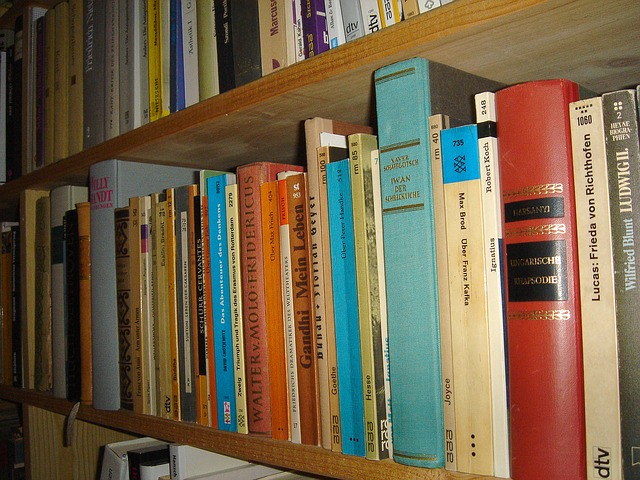
Loving the acculumlation of books!You have seen these before. You probably used them when you were a child. They are the big, hardbound books that don’t fall apart.

Traditional textbooks are good for people who:

Enjoy and trust the ways of tradition.

You learned from a book. Your husband learned from a book. Lincoln learned from a book. Washington learned from a book. Moses . . . well, Moses wrote a book, but it was a scroll, wasn’t it?

You want your children to learn the value of a book, how to take good care of it, keep it clean, not drop it in puddles. You want them to grasp it in their hands and at the same time realize its heaviness means all their education will spring from it every time they open it. Compact, tidy, fragrant from the realities of life. . . how can anyone beat a book for learning?

You know who you are.
You love the smell of a BOOK. A well-loved book is even better.
You love the way they look on the shelves.
You love the way they offer up to you the fingerprints of those who went before.
You want this love for your children, too, and know the exposure will teach them this love.

Want to reuse or several children to reuse the books.

Your household is big. Maybe not big enough to be famous, but not being famous means even less money for throw-away stuff.
You know a book will last through at least five children, and that would be a great start.
You know how to make a book jacket, and your oldest has begun learning how, too.
You know after the initial investment, you will be home free for curriculum, and that will be important.
Besides, you just like the way they smell.

Have children who are visual learners.

Your children do not need to fidget, handle, or talk in order to learn.
At an early age, they crawl up into the recliner and read themselves to sleep at nap time.
When you say, “Go play!” they go to the books.
They prefer to do science experiments by reading about it and say, “Aw, Mom, we can tell from the pictures and the questions what it will do!”
You’ve caught them writing little books, too, and drawing diagrams of the house they want to live in, someday.
They take one look at a map and know where they are on it.
The path from their eyes to their brains is short.
Lecture kills them.

You like things put away.

That all the pages of all their studies could fold up between two hard covers and slip into place on a shelf is pure bliss for you.
That today’s answers could double over and fit between those cover, too, is almost joy. That you could walk through the house without slipping on loose stuff is just too important.

Think about this style of teaching, learning, and living. Does it fit you, or describe your goal for you home school? You may need traditional textbooks. A few old-time favorites are Abeka, Bob Jones, and Rod and Staff.

Check them out.

Not quite it? Try this!

Posted in Home School

Do You Need to Choose or to Change Curriculum?

Get rid of doubt about your curriculum!Are you worried about curriculum? Worried about results?

Have you been wondering if you have (gasp!) bought the wrong curriculum?

Have you wished someone, who was NOT a salesperson, would explain all the curriculum choices to you in an unbiased way?

Are you ready for THE TRUTH about curriculum?

At this time of year, every mom wonders about her curriculum. She is not failing. She may even have forever decided which curriculum is best for her home.

Still, she wonders. Am I right? Am I just stubborn? Could our school be better? Is this a good time to switch?

I have tried all the types and have loved them all. Each type is just right for a particular set of circumstances and each type we will discuss is good. I will not tell you to use what I use, because what works for me might really dampen your homeschool.

I will help you understand what each type is like and who most benefits from it. And who, the least . . . .

(Also, do not forget you may have the perfect curriculum for your children. God can show you what is best for you.)

The following four posts will present aspects of typical curriculum and should help you as you try to figure out whether or not you need to start with something new. It should clear your mind so you can think more like a pro. As you read the descriptions, I hope you will be able to see yourself, your children, and your situation clearly.

You may decide to stay put, but you’ll know you were right in the first place. However, if you see you need to move on, it can be with renewed confidence.

Please note: this series will not include the name of every curriculum company out there. I am glad home scholars number over two million. Such a large people group, the largest school district in the country, commands a large market. This means, though, it would be impossible to know all the good resources, let alone list all the possibilities. Therefore, I will list some of the oldest and easiest to find, to give you some idea of what each category is like.

The shopping is still up to you. Go to home school conventions. Go to book sales, even used book sales. Go to curriculum shows. Ask around at your support group. And please, feel free to ask here, in the comment section. I’m always happy to help home educating moms to figure it out.

Before we go any further let me say, “All good curriculum is good. All tried and true providers are tried and true.”

Every question in your curriculum decision-making has to do with three factors:

  • What is your teaching style?
  • What are your children’s learning styles?
  • What is your home’s style?

So think about those three questions, then get on with this series. We begin with good old education tradition and move all the way to outer space!

And as always, if you cannot understand something in this post, ask in the comment box. I am happy to help home educators keep going!

Most of all, pray. God knows what you need and He knows how to show you what it is.

See ya on the next page!