Blog

Posted in Photos, Recipes

I Like Pickles! – part 2 – The Recipes!

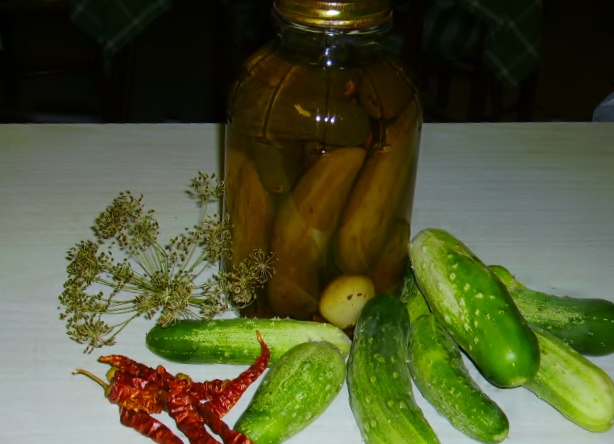
Cucumbers (specifically, Gherkins) gathered fo...
These are true Gherkins, a specific variety, but you may use any small cucumber. Mmm!

Once you have cucumbers plants zipping along, all you need is patience and a good recipe. To me, a good pickle recipe takes only one day of actual handling of the cucumbers. However, to go strictly by taste, some of the best recipes take a few days. Both types of recipe are given here.

After you have all the “baby Gherkins” you need (at the rate of eating one pint a month, twelve pints should be enough, but they are nice gifts, too) you can begin letting the cucumbers mature to the size for dills, “bread and butters”, and for use in salads.

After that you can start trying to find friends who need cucumbers.

After that you can start trying to find enemies who need cucumbers.

After that you can start a cucumber stand.

After that you can attack the row with an ax, screaming . . .

Well, twenty-five plants will be too many once you get your Gherkins, so be prepared to do the unthinkable and till that row under after a time. Tell yourself, “A weed is any plant that is growing in the wrong place.” They make good fertilizer, anyway.

One other thought about pickles. Some people pressure-can everything they put into jars. Others do not. I never recommend that practice to anyone else. I do recommend that you follow the directions on pressure or hot-water canning to the letter, always. Also, whenever a pickle recipe calls for vinegar, it means “5% acidity apple cider vinegar” unless noted otherwise. It does NOT mean “4 ½% amber-colored, distilled, apple-cider-flavored vinegar”. In other words, get the real thing. The same for salt. Do not use regular table salt, but special salt for canning or at least get un-iodized salt.

Also, think about the quality of the water you use. High quality water is better, by far. I use a pitcher type filter with good results.

Now for the recipes.

Baby Gherkins

2 gallons cold water
2 cups pickling lime
7 pounds cucumbers (about 1 gallon, but weigh them!)
2 quarts vinegar (see above, about vinegar)
1 Tbs. whole cloves
1-2 tsp. whole pickling spices
1 Tbs. canning salt
4 pounds sugar

Mix lime with 2 gallons of water. Add cucumbers. Soak 24 hours. Drain and rinse well. Cover cucumbers with clear water and soak 3 hours. Drain. Mix vinegar, spices, salt, and sugar. Bring to a boil. Pour over cucumbers and soak 12 hours. Dump all into a pan and boil hard for 35 minutes. Place into boiling hot jars. Cap with hot lids. Process for 10 minutes in a boiling water bath.

Kosher Dill Pickles

Brine:
1 cup pickling salt
3 quarts water
1 quart vinegar (see above about vinegar)

Pack cucumbers as tightly as possible into clean quart jars. Into each jar, also place:
1 clove garlic
2 heads dill (fresh) or 2 tsp. dried seed
1 cayenne pepper

Bring brine to a rolling boil. Pour brine into each jar to cover all contents. Cap with hot lids. Process in boiling water bath for 20 minutes. Allow to cure for six weeks before eating. The quantities for the brine above will make 7 to 8 quarts of pickles (or about two gallon jars, but then you cannot hot-water bath them. Many people never do and they make fine pickles.) Cucumbers may be whole, spears, chunks, or slices, but whole ones stay crisper.

Bread and Butter Pickles

8 cups sliced cucumbers*
2 cups sliced onion*
1 Tbs. canning salt
1 ¾ cups sugar
1 cup vinegar (see above about vinegar)
1 tsp. mustard seed
½ cup chopped bell pepper
1 tsp. celery seed

Stir salt into cucumbers and onions. Let soak for one hour. Heat remaining ingredients to a boil. Add cucumber mixture with all its juice. Bring to a boil again. Pack into boiling hot jars. Cap with hot lids. Process for 20 minutes in a boiling water bath. Yield: 5-6 pints. *Chop or grind to make relish instead.

Cucumber Salad

1 cup chopped cucumber
1 cup chopped tomato
1 cup chopped bell pepper
¼ cup chopped onion
1 cup Italian dressing (vinegar/oil type)

Mix and enjoy!

_________________________

photo credit: wikipedia
Posted in Blessings of Habit, Good ol' days, Health, Homemaking, Inspiring, Photos

I Like Pickles!

It was February, 15 years ago, when I began to write this, a cold misty day – my favorite weather, but I was ignoring it. My heart had attached itself to a small, glossy package of seeds entitled “Little Marvel Pea.”

Oh, how we love these, the best food every created! Each year my children searched store aisles with eager-eagle eyes and then the begging would begin and it would not end until I bought at least two packages.

That had happened in January and the seeds had sat on the table by my back door for over a month, proclaiming marvelousness each time I passed.

They are marvels because they have taught my children to love digging, planting, weeding, and sweating. Sowing and Reaping, the Parable of the Sower, and endless other lessons have been planted in young hearts because they will do anything for “Little Marvels”, briefly simmered and buttered, the earlier in the year, the better.

I’m so glad for what God can do through the simplicity of humbly acquiring real food for our tables.

I’ve been discussing pickles, though, with my friends, lately. Someone asked, “How do you make little, sweet, whole “Gherkin” pickles? My kids love them . . . ” There is such potential for blessing here.

Mom, teach those little ones also to love the simple act of acquiring them!

The answer is that first you buy cucumber seed. You will never find the right cucumbers at a farmer’s market. For the very small pickles you will need many more plants than usual because each plant sets only a few flowers a day. To get enough tiny cucumbers to bother with would take many days and the first-picked ones would wilt . . . so you need enough to be able to pick around 2 quarts at a time.

To accomplish this, plant about 25 seeds.

Now your neighbors will tell you that is too many, but they will really react when they see your whole cucumber patch in one neat row with no weeds.

Yes, plant those seeds in a row, about five inches between plants. Yes, ten to twelve feet of row would be just right. (Forget the neighbors!)

After they sprout, it is time to “subdue” them. Train each vine to follow the line of the row in which it is growing. At the far end, there will be vines trailing where none were planted, so plan a space for that. The concentration of leaves will shade out nearly all weeds and keep the soil moister and cooler. Also, the row scheme lets you walk, weed, hoe, till and harvest with ease.

Once the plants are in full production, pick them every morning. They’ll not be as uniform in size as “store bought” but will cost less. You may save them in an airtight container, refrigerated for a day, but not much longer. This will help you work around your busy summer schedule and provide for a bigger batch to work with each time you heat up your kitchen.

Recipes tomorrow.

Posted in Home School, Inspiring, Photos, Sayings, Who's the mom here?, Wisdom

Saturday Sayings – Create

English: Exterior view. Bronze tympanum, by Ol...
Bronze tympanum, by Olin L. Warner, representing Writing above main entrance doors. Library of Congress Thomas Jefferson Building, Washington, D.C.

As a writer watching my son survive college writing classes,

knowing his personality and his wrong language tendencies,

I’ve concluded that, at least sometimes,

we cushion our message in “thesaurus words” because we fear a harsh reaction.

Only a long time writer knows:

no matter how you cushion it,

harsh reactions will spring up.

When creating matters more to me than my ego,

then it improves.

__________________________

photo credit: wikipedia

Posted in Believe it or not!, Photos

Weekly Photo Challenge: Create

He said, “Figuring out what I want to do next.”
Just an artist with a louder paintbrush, he says.
Definitely too loud for a baby!
Such an adorable tot.
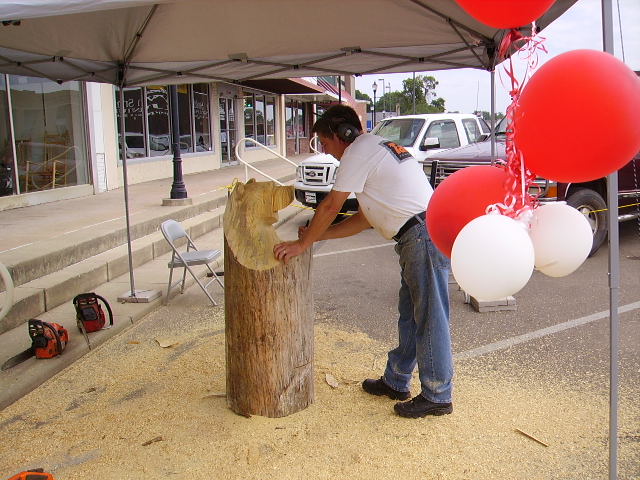
You’ll knot escape the watchful gaze of a mama bear.
“X” marks the spot for the tail, and the end of this photo tale.

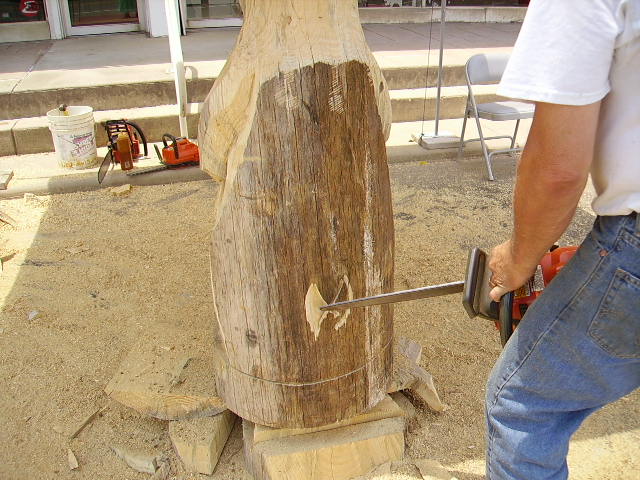
I was so excited to be able to take photos of this artist

creating this sculpture as a promotion

for the 50th anniversary of our hardware store.

Imagine my shock-surprise to find the Photo Challenge: Create!

Sometimes it helps to be somewhere, anywhere;

then you end up in the right place at the right time.

😉


Posted in Homemaking, Inspiring, Photos, Recipes

Love Frozen Over!

Save the berries!
Save the berries!

Here’s the inside scoop on really neat tricks to make you fall in love with your freezer even more:

  • When you harvest elderberries, pick the whole stem, freeze the whole stem inside a plastic bag, and remove the berries frozen. You get more juice into your recipe and less running down your elbows.
  • If you have a problem with fruit not ripening all at once, freeze the early pieces and combine them with the later harvest for your larger recipes.
  • Save juice for jellies, frozen in recipe size batches, in freezer safe cartons, until sugar is on sale. Allow 24 hours for a gallon to thaw at room temp.
  • Start a sourdough bread business, offering a discount on frozen surplus.
  • Make your own brown and serve rolls out of any favorite bread recipe by baking the rolls at 275 degrees for 40 minutes, instead of the usual directions. Cool, bag, and freeze. Or if they are individual rolls, freeze on a tray, first, then bag. Then use as needed, right from the frozen state, baking on a cookie sheet at 400 degrees for about 10 minutes.
  • Rescue cheese by grating and freezing it. Use frozen grated cheese straight from the freezer in recipes.
  • Freeze milk while on vacation. Leave 2 inches for expansion.

Okay. You know you’re here for the RECIPES!

That Exquisite Dish

1 chicken, cleaned and skinned
2 qt. Pure water
½ c. fresh sage leaves
¼ c. fresh lemon basil leaves
2 stalks celery, chunked
1 onion, chopped, divided
1 T. salt
1 cayenne pepper
2 c. brown rice
½ stick butter
½ c. whole wheat flour
salt  to taste
8 oz. mild cheddar cheese, grated
1 pt. “rotel”, mashed in juice

Simmer chicken in 2 qt. water, sage, basil, celery, ½ onion, 1 T. salt, and cayenne, until meat separates from bone. Drain, reserving broth. Refrigerate broth until fat congeals. Remove fat. De-bone chicken. Chop meat slightly, to make bite-sized pieces. Chop cooked seasoning vegetables finely.  Mix with meat. Do not mix meat until it disintegrates – just stir some.

Bring one qt. broth and rice to boil. Cover and simmer until tender.

Cook remaining onion over medium heat, in butter, until clear. Remove from heat. Add flour and stir. Mix in carefully over medium heat with wire whip, enough broth to make medium thick sauce. Add water if necessary, salt to taste.

Layer in 9×13 glass casserole as follows:
rice
chicken
sauce
cheese
Repeat.

Pour jar of mashed Rotel over all. Bake at 350 degrees until lightly browned and bubbly. Or cover tightly and freeze no more than 3 months. Uncover, place in 350 degree oven, bake until brown and bubbly, about 45 minutes.

Serves 12.

Watermelon Ice

½ leftover watermelon
1 lemon
honey
other fruit (opt.)
milk or condensed milk (opt.)

Remove seed from melon. Puree fruit in blender. Add other pureed fruits or milk if desired. Add juice of lemon. Add honey to taste. Freeze in shallow glass pan or bowl. Stir twice while freezing. Or try freezing in sealable bag, kept upright in freezer, and mashing instead of stirring. Serve as sherbet.

Frozen Dampened Laundry

1 bu. assorted shirts
1 c. powdered soap
2 tubs water, divided
1 unpredictable day
1 unbelievable week

Mix shirts, soap, and 1 tub water. Heat and stir well. Drain. Place shirts in second tub water. Stir well. Drain. Hang shirts to dry outdoors in sun. After 5 hours, condensation will form and fall from a small cloud immediately above shirts. Remove laundry when only slightly damp. Fold and roll as for French pastry, bag, and freeze. Keeps indefinitely. Calories: minus 560.

Posted in Blessings of Habit, Homemaking, Photos, Wisdom

Don’t Abuse Your Freezer!

Iced freezer, defrosting
Iced freezer

Any decent tool deserves to enjoy decent upkeep and your freezer is no exception. There is a right way to take good care of it and make it last longer.

First, you should defrost it once a year. It eventually will not work right if you do not. Even the frost-free types need an annual warming, rinsing, and drying, to get ice out of the insulation and remove frozen spills from the interior.

To defrost a deep freeze, you may want to choose a time when it is closer to empty, such as very early spring, but it does not really matter when.

Here is the procedure:

  1. Take out all the contents. Place on a table or counter the things that are okay to thaw, such as bread, flour, etc.
  2. Put everything else into a good thaw-proof place. The little freezer in your refrigerator is good. Your neighbor’s deep freeze is also good. You could use a large cooler. But if these options are not available, try this: Put all the frozen food into a laundry basket which is inside a couple of sleeping bags. No kidding, it keeps. Our family has moved frozen food that way on trips that take 10 hours. Sugared fruit might soften some, but it does that even in the freezer, sometimes.
  3. As the freezer thaws, the lid or door should be open.
  4. Please resist the temptation to chop or pry at clumps of frost.
  5. A fan blowing toward the inside of it will greatly speed thawing.
  6. The lid or door will likely be drippy, so be ready with several old towels. Better yet, take it outdoors to sit in the sun. When empty, it is not very heavy, just awkward. You’ll need help, but I have moved mine using the help of only three older children.
  7. Once the dripping stops, the freezer is probably finished thawing. Bail out any standing water. Wipe the whole freezer, inside and out, with mild soap or baking soda water. Wipe completely dry.
  8. Check for rust, inside and out, and very carefully remove rust with steel wool. Cover these spots with clear or white nail polish, or with car paint.
  9. If the box seams are caulked, check for gaps and re-caulk, if needed, with a product suitable for freezing temperatures.

Now you are ready to plug it back in and let it freeze. Once cools, reload it.

Doesn’t it hum differently, now, as if it is happier?

Another freezer care-taking chore is to keep it dusted. Wipe the exterior at least monthly, including the sides. You should also wipe off exterior dampness during humid weather. Try to keep the dust from under it, as well.

One important fact that few people know: The deep freeze resents having items sitting on it, especially insulating things such as a pretty quilt or a pile of laundry. I am not sure why, but I have heard it traps warmth near the top of the box instead of letting it escape. I suppose this means the 25 degree “warmth” cannot escape from the 18 degree box, or something. I do know placing such things on my freezer causes moisture to form on it every time.

Last, but not least, I have prepared a short list of tricks and recipes for tomorrow. See ya!

________________________

photo credit: Wikipedia