Posted in Homemaking, Recipes

Don’t Can in the Fall?

Some of the best canning I know of happens in the fall.

I love canning quick breads to use for fancy fun, such as those delicate get-togethers where our mothers used to wear white gloves and hats, where the napkins are real and the butter is whipped and the goodies are all made from scratch.

And the tea is hot, not iced, and there is no coffee.

I love to make pumpkin bread and can it for later use. It keeps for months on the shelf, in a jar, in a pantry, without preservatives. And it tastes great, even six months later.

What I LOVE, LOVE, LOVE about this bread is:

  1. The bread is round, and therefore somehow nicer for those la-dee-da gatherings or for when you just want to feel better about … things. 🙂
  2. The bread is over-the-top moist.
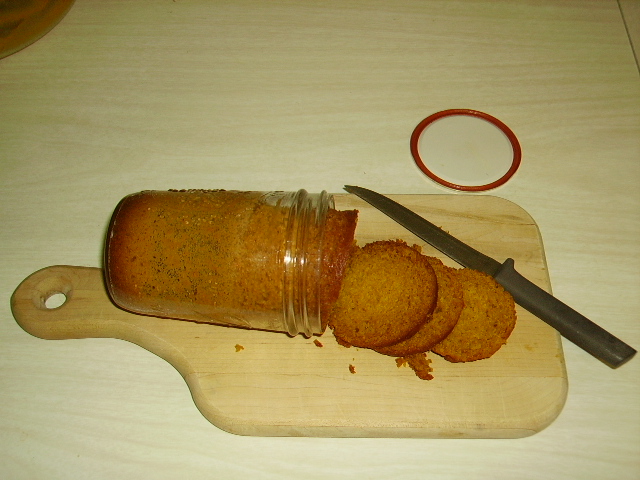
  3. The bread is super easy to slice thin and straight if you pull it out of the jar slightly and use the rim of the jar as a cutting guide.
  4. The bread makes an amazing and welcome gift.

The trick? Just follow these instructions and have fun.

You will need:

  • A good recipe for pumpkin bread. (Mine follows.)
  • All the ingredients for the recipe.
  • Six or seven straight-sided, wide-mouth, one-pint canning jars.
  • Flats and screw bands for the jars.
  • A pan of hot water for the flats.
  • Fork or magnetic flat lifter.
  • Canning funnel.
  • Sharp, non-serrated knife.
  • A sturdy, shallow pan with a rim, such as a pizza pan or jelly roll pan.
  • One damp cloth.
  • One totally dry, thick towel.
  • Plenty of pot-holders or oven mitts.
  • An oven.

You will NOT need:

  • Nuts
  • Raisins
  • Any other such lumpy things in the recipe, no matter how much you may love them in your bread, if you want it to keep a long time. If you want it for tomorrow, lumps are fine.

Instructions:

1, Collect your stuff. Set oven for 350 degrees.
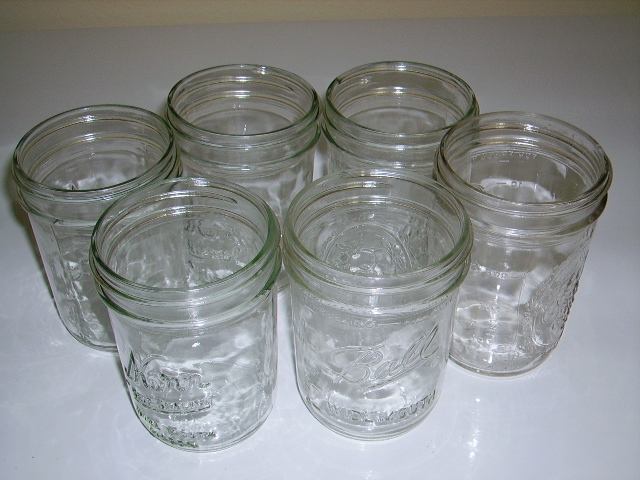
Jars like these.
Jars like these.

2. Make the batter. (Recipe follows instructions.)
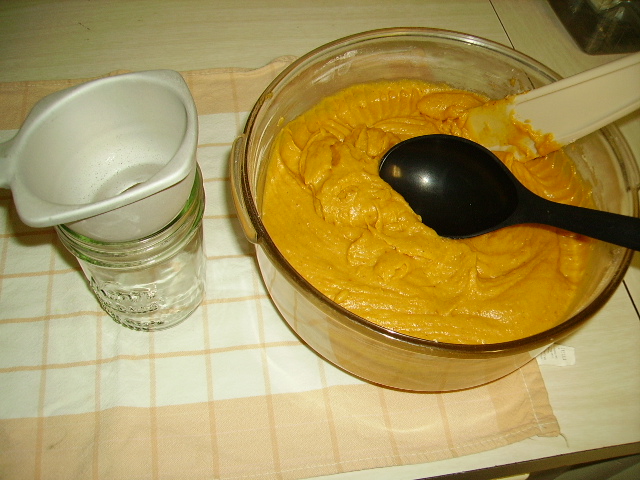
Batter is ready.
Batter is ready.

3. Load the jars about half full, or a bit more.
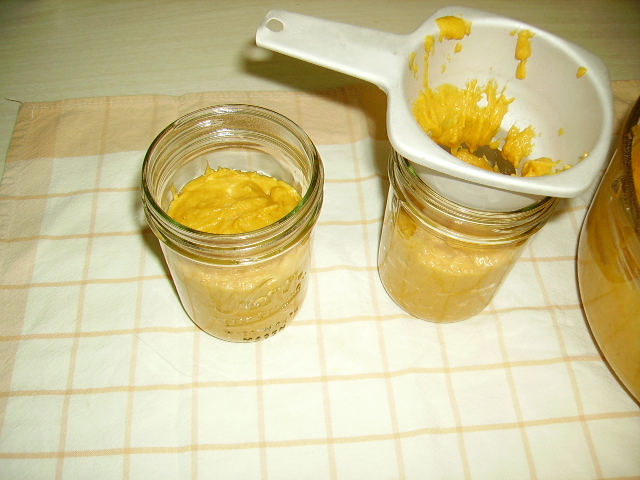
Use funnel for neatness. Neatness counts.

4. Place loaded jars on sturdy pan and very carefully set in oven for about 15 minutes or until done. Use toothpick test for doneness.
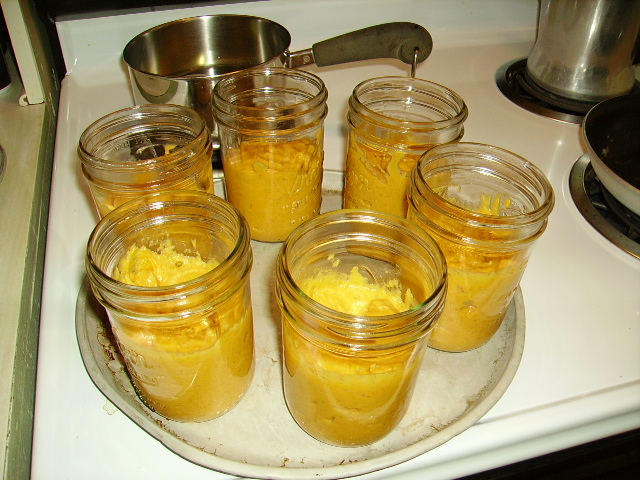
Ready to bake.
Ready to bake.

5. While bread bakes, prepare lids: Boil water and place lids in it, then remove from heat. Do not boil water with lids in the water. Have screw bands, mitts, and both towels ready.
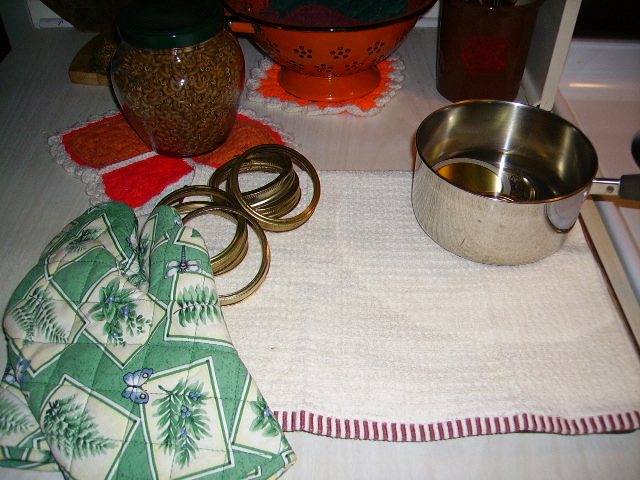
Ready to can the bread.

6. Remove one jar from oven, individually, and set on dry towel. Quickly trim bread that has risen beyond top of jar with sharp knife. Quickly wipe rim free of crumbs and grease with damp towel and add lid and screw band.

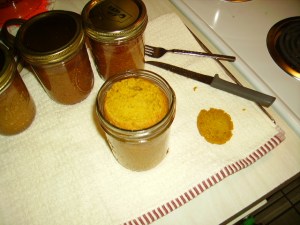
Risen too tall. Trim.
Hide trimmings in your tummy!

7. Repeat with each jar, individually. Jars should seal almost immediately.

THE END.

THE RECIPE:

Sift together into large bowl:

3 1/3 cups plain flour
2 tsp. baking soda
1 1/2 tsp. salt
1 tsp. cinnamon
1 tsp. nutmeg
3 cups sugar

Quickly add, and stir in only until dry ingredients are moistened:

4 eggs
1 1/2 cups canned pumpkin
1 cup melted butter
2/3 cup water

Proceed with instructions above to can pumpkin bread.

IMPORTANT!: Do not add nuts or raisins or any other chunks, if you want this bread to keep a long time. Chunks will not become hot enough to be sterile, in this situation. If you want to use these immediately, chunks are fine!

We are going to love fall this year!
Much later: It loosens easily and slices breezily. Mmm!

(This post listed on “My Hot Kitchen” . Lots there to drool over…)

_______________________________________________

Katharine is a retired home educating mom who writes about all things “woman”, from a Godly viewpoint, here on this site, and at The Conquering Mom.  Her writing appeared in several magazines for 15 years, and she is currently working on several books. She loves to write, speak, teach, cook, garden, spoil her hennies, and watch old movies with popcorn.
Posted in 'Tis the Season, Homemaking, Recipes, Thanksgiving

Our Thanksgiving Habit

One thing we do every year, almost as a habit, is smoke a turkey for Thanksgiving. A huge turkey.

I’ve posted about it before, but this year we will make two of them, and I got photos for ya! So here goes:

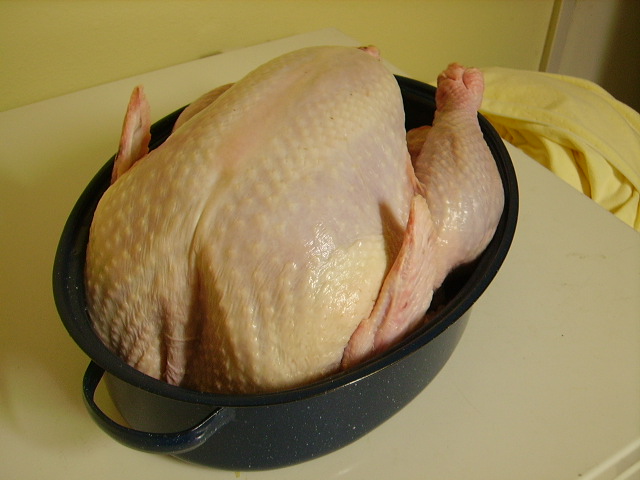
1. Thaw, trim, and rinse turkey.

Rinsed 23 lb. Turkey

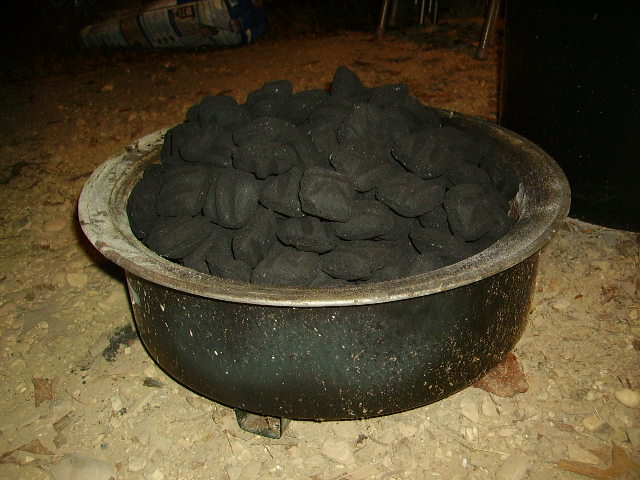
2. Pour charcoal into fuel portion of smoker.

Enough charcoal for 12 hours.

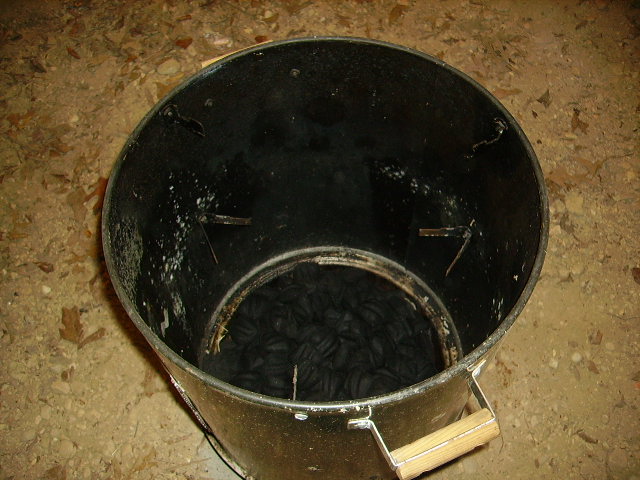
3. Set into bottom of smoker.

Charcoal in place
Charcoal in place

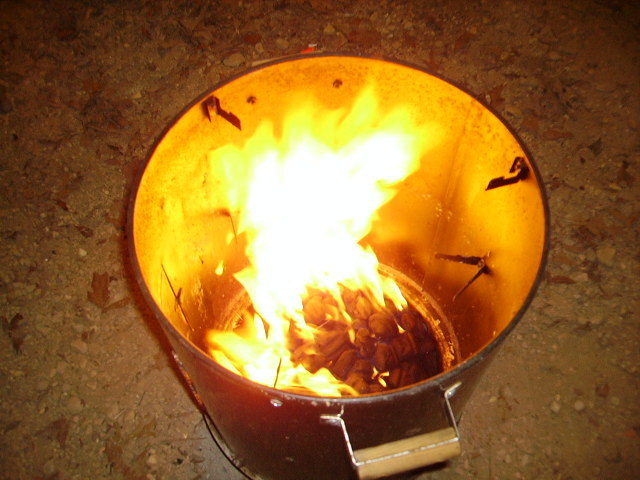
4. Do whatever you do to light charcoal.

Light charcoal
Light charcoal

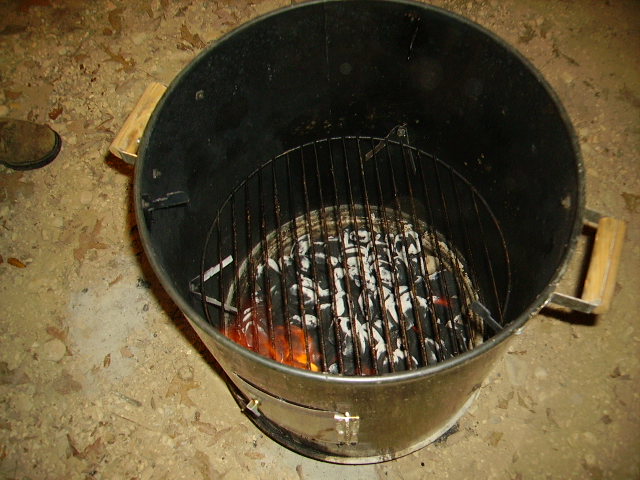
5.  Once charcoal is very hot and turning white, add grill, to sterilized it.

Burning off the grill

6. Once all flame dies down, carefully remove grill and insert empty water pan in place over (not on) charcoals, and replace grill over water pan. Carefully fill with about 1 1/4 gallons of water.

Water pan in place over charcoal and under grill

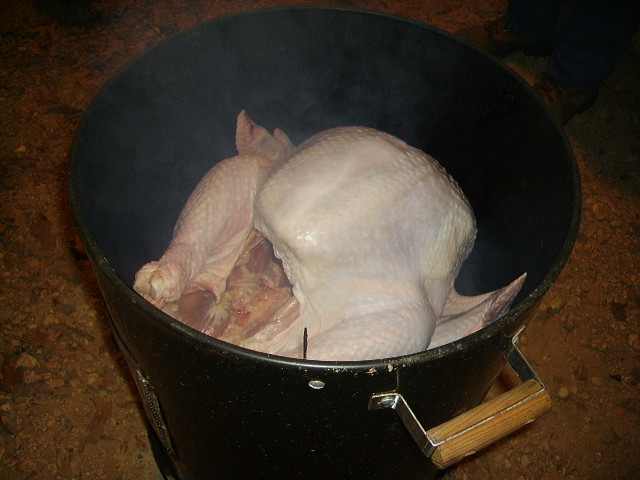
7. Place turkey on grill.

Turkey on grill in smoker

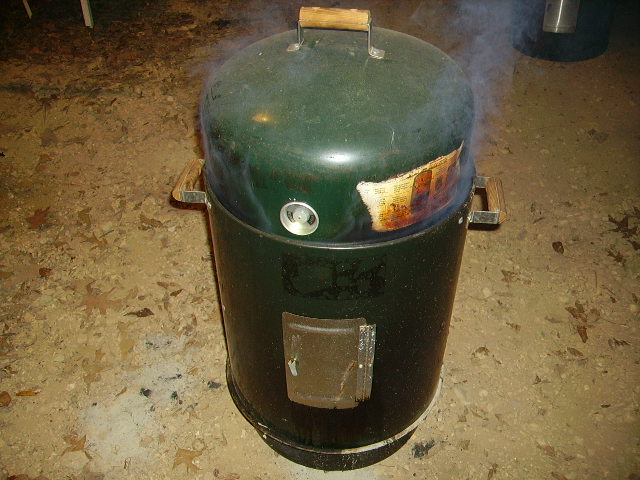
8. Close smoker and go to bed.

Good night!
Good night!

9. Do not check progress by opening smoker!

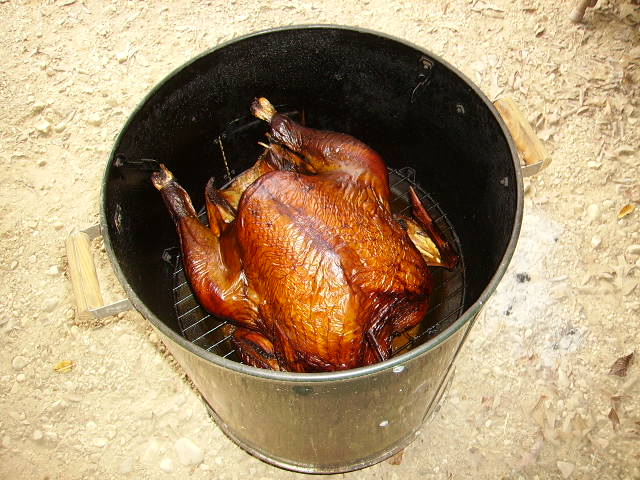
In the morning, you will have a lovely smoked turkey. The meat should be tender and pink like ham. The joints should be loose or separating. The skin should be crackling in places and dark from smoke. Mmm! Look here!

Any questions? Ask in the comments, below, and I’ll be happy to answer quickly!

Have fun!


Edit to add: Our smoker is nearly burned out. 😦 Worst part is that we canNOT find another like it. Smaller ones do not work. Electric too expensive. The company that made our smoker just does not make them anymore. Help! 😉


Posted in Blessings of Habit, Homemaking, Inspiring

Momentum – Ten Ways to Find It!

Glass marbles
Glass marbles*

I remember studying momentum in 7th grade. Who knew I’d need it someday?

That science teacher was great about showing fun examples to his bored students. For instance, when he wanted to illustrate some principle about sound waves, he picked up a yardstick and invited a student to come up to the front of the class and lean over.

Of course, it looked lots like he was about to get a good whacking.

Instead, our teacher merely whacked the table directly next to his volunteer. We all laughed. Then he explained the principle, which I do not remember. The example, yes; the purpose? Not so much. Sorry.

However, the momentum lesson, I remember.

The teacher showed a small cloth bag and asked us to guess what was in it. Of course, that was fun in itself, but then he dumped out the contents to let us see what we never expected: about 40 marble spilled out all over his desk and across the floor to all points in the room.

Lovely diversion.

Marbles ricochet, fit into small places, and are hard to see.

Hard to catch.

So we had our fun time chasing the things down and then came the lesson, which I also, for some reason, remember:

Once you get something moving, it wants to keep on moving, and if you add gravity, it just goes faster. That’s why it’s easier to go to bed after a hard day.

And it’s harder to get up before a hard day.

Today will be hard for me. Lots and lots to do. Mostly laundry awaits me, but there’s that meeting tonight, to which I must take some sort of soup and grated cheese, plus an inspirational talk. Added to that is a perfectly soggy outdoors, making wet firewood, wet trip to the chickens, and wet cat food with which to deal. (Oh, we’re happy as can be about having some rain, but it makes a wet world before it runs off.)

Sometimes, I just need some way to dump out the marble bag of my life and get it going. So this is what I do.

  1. Make a list. This only helps if you use it, but just as gravity pulling downward can add momentum, so will moving down that list.
  2. Start with a favorite task. One I love is sweeping the front porch. For you it might be cooking or wiping a mirror, but doing a fun thing first is just like dumping out that marble bag. You get things rolling with a smile.
  3. Add something “for show”.  There is nothing like making the bed or exchanging jammies for real clothes to make your eyes tell you “you are  on a roll, Girl!” whether it’s exactly true or not.
  4. Schedule a down time. Promise yourself a cup of tea or something, at 10:00, and make it stick. This will make you work harder as the hour nears, and also make you happier when it arrives. Besides, everyone on earth but you gets a break at ten, right?
  5. Change scenarios. Work indoors awhile. Work outdoors awhile. Do only one bathroom, then switch to something different before doing the next.
  6. Brainstorm ways to save labor. You own labor-saving devices, right? Think! Drop the burner bowls from your stove into that load in the dishwasher before you hit them with the steel wool. Try fluffing bed pillows in the dryer for a moment or two. Grate the cheese with the salad maker. Clean debris from a drawer or the oven or the sliding door track while you have the vacuum out for the carpet.
  7. Turn your housework time into spa time. Why not apply a mud treatment to your face and then attack some chore using the timer for both purposes? Why not do plunge moves while vacuuming? Try moving vigorously through your housework routines, thinking of extra ways to move, such as on tip-toe, or balancing on one leg. Ironing or phone time is great for adding leg exercises. Wear ankle or wrist weights while you work.
  8. Speed it up. Race the clock. Play fast music. Do two things at once. Or three. Go fast. Get that cardio rate moving right along.
  9. Avoid distractions. In our science demonstration, some of the marbles stopped cold when they slipped under tight places. I’m not sure we ever found all of them. You know Internet, TV, texting, phoning, reading the mail, etc., are what can stop us cold, sometimes. Delay gratification! You are older than two years, after all. Don’t lose your marbles over these things.
  10. Do it again, tomorrow. You will gradually get better and better at this momentum thing. You will eventually learn to time baking a pie with taking a shower or to make fewer trips to each room by planning ahead. You will one day have so much done you won’t believe it.

And the momentum that comes from THAT will take you places you never dreamed.

You go, Gal! And if you know any more such hints, SHARE!

______________________

* (Photo credit: asirap)

Posted in Home School, Homemaking, Inspiring, Who's the mom here?

A Week of Answers – Counting Blessings

Dear Katharine,

I have such a problem with my goals wandering, and with thinking that others have it easier than I do. When I look around me, I see all sorts of boosters–IN OTHER PEOPLE’S LIVES! Mine, though, looks jumbled and behind schedule and difficult, to me. How can I be sure or even know if I need to make some changes?  –Alissa

Dear Alissa,

It is easy.

First, make a list of everything that is going well, going okay, going not too bad, not as bad as it used to be, or not as bad as it could be, for you, lately.

I mean, look at your house: are the floors easy to clean? List that. Then look at your car: are the brakes decent for a change? List that, too. How about clothing: do all your boys have jeans that are long enough? List it. Try curriculum: is yours making school easier? List it. Go on to list one good thing about your schedule, your meals, your field trips, your P.E., your quiet time, and your day.

Then imagine that these things were actually happening to others, around you.

Imagine that Sue has easy clean floors, Sally has a car in good repair, Sylvia has decent jeans for all her kids, Sarah has a great curriculum, Sandy has begun having quiet time, and so forth. Wouldn’t that make you feel like they had some sort of better home school?

The grass is always greener on the other side of the fence.What you will see is plenty of reasons to think that the grass in greener on YOUR side of the fence, too., and that others could easily fall down the same slippery slope that you have, if they were looking at you and doubting themselves.

Whatever is going right, look to the Lord, not others, and count your blessings! Do this exercise every time you feel inadequate and it should help.

Then remember this little true story: A mom used to feel guilty about seeming to get the ironing done just at the last moment for someone to wear it, barely squeaking it in at the nick of time. However, one day her son had to write, in one sentence, a definition of happiness and he answered: “Happiness is a warm shirt in the morning.”

You see, children naturally love their own home, whatever that means, so smile and RELAX!

The important thing is fulfilling the command to teach your children, right? God will bless that. And if something is truly missing from your life, the above exercise will probably bring it to light.

Katharine

Posted in Homemaking, Inspiring, Recipes

Kids in the Kitchen

Children learning in kitchen

All my children are taller than I am. But when they were little, oh, did we have funny times!

One day our five-year-old came up with a great one-liner: “I know how to make brown bread–toast it!” We laughed, but he was serious. He honestly was exploring with his mind, the finer points of food preparation.

Our canning successes and failures have impressed our children. As we ate peas for supper one night long ago, the seven-year-old said, “I’m glad God made seeds because if you plant just a small pack, you get a LOT of peas to eat!” Me too, Dearie.

Our pickled peppers always received rave reviews from all the hot stuff eaters. And the muscadine jam–you’d have to taste it to believe it.

They learned so much.

When the deer got our peaches and crab apples and drought got our pears, their joy at what we had was sobered by what we lost. They couldn’t wait to start again, to do better. But in the meantime, we could open jars and remember.

One thing they loved helping with in the winter was apple leather. It is so easy to spread applesauce on a lubricated pan and set it near the fireplace to dry for a few days. How they loved making funny shapes of it with scissors! It was a favorite snack for them.

Actually, nothing beats the Winter Doldrums like the warmth and aromas of something happening in the kitchen. Whether Big Sis is rescuing some old bananas in yummy banana bread, or everyone is taking turns at the handle of the apple-slicing/coring device for apple crunch, we get miles of smiles from being close family in a simple kitchen full of love.

Kids love to cook. It’s a part of growing up.

They love to break eggs, dump ingredients, stir, set the timer, read recipes, etc. The kitchen, to them is like a big friendly science learning lab where we get to eat the experiment. Happy the child who feels welcome in the kitchen!

So is there a way a five-year-old can make brown bread? Probably not, but if you are making bread and let him count and dump in the part that makes it brown, wouldn’t he love it? How easy to launch from there into an explanation of differences in flours, complete with a microscope!

If his twelve-year-old sister does the bread making, she’ll beam when Daddy cuts himself a second slice. The seven-year-old could coat the pan with wonderful squishy grease. Teens love to rescue everyone when the hot pan is ready to exit the oven; the challenge of facing actual danger is like a tonic to them.

Are there any recipes a five-year-old can really do himself? Yes, the apple leather is one of them. He could make the butter for Big Sister’s bread: just shake 1 cup room-temperature cream in a quart jar for about 15 minutes and it makes butter. You strain off the remaining liquid for him, and let him pack it into a bowl. Or how about pie dough crackers? Hand him scraps to roll, cut, and sprinkle with milk and sugar or salt. Of course, you bake it for him.

A slightly older child can do more.

Let him slice some ice box cookies and arrange them on the cookie sheet. He can help you form the dough into the short, fat snake before you freeze it.

You might try a batch of coffee-can ice cream. Have him put a layer of ice cubes and salt into a large coffee can. Set a small, sealed coffee can ¾ full of ice cream mixture into the large can. Place ice and salt around the sides and over the top. Seal the large can and let the children roll this on the floor about 15 minutes until the ice cream sets. What fun!

When it comes to much older children, we know our future homemakers belong in the kitchen, but perhaps we’re lost about how and where to begin with them.

The first step is mentally to prepare for a mess.

Face it: you are neat and tidy in the kitchen because you learned the hard way it’s better to clean as you go. Your recipes are common to you and it’s no problem to fix a mess crisis while you cook. For the beginner, to cook IS the crisis and spills are commonplace. You can wipe up for her as she goes—an option that is good only for a while—or ask her to clean up when she’s done. We all must learn to police our own area.

So expect splatters from ceiling to floor. Grin and bear it. When my husband’s mother and I experimented with throwing pizza crust instead of rolling it, we gained a laughable moment that helped bond me to her like little else can. You want to bond with your own young chefs so they can feel loved and feel good about family life.

And don’t be surprised if your young men want to join in. I suspect when Jesus cooked fish for His disciples, it was scrumptious. And He did not learn that in the carpenter shop, either.

For beginning cooks, I like a mix.

Store bought or homemade, a mix is perfect for learning, because there is some fun measuring and beginners can concentrate on technique. Add skills gradually, layer over layer. You will know when you have come to the point where you can show her a recipe and do something else nearby. You can keep an eye on her and she can ask questions without leaving her station.

So, how old is old enough for each task?

Often I measure by height. No one should ever cook on a stove while standing on a box or chair. If you cannot reach the knobs, you are too young.

A lot has to do with motor skills. I have a cute photo of my daughter and one of her brothers when they were young—so young they sat ON the counter with the brownie bowl between them. It was their first try at egg-breaking. The egg was not exactly in the bowl. They were too young.

Invite them in, though. If you have many very little ones, start slowly, perhaps with licking the spoon. Do what you think is best for you, not forgetting the purpose: to have fun with Mom and be prepared for life.

Here are some easy or fun recipes to get you started:

No Knead Bread

2 cups white flour
1 package dry yeast
1 ¼ cup milk
½ cup butter
¼ cup sugar
1 teaspoon salt
1 egg
1 ¼ cup whole wheat flour

Mix white flour and yeast. Warm milk, butter, sugar and salt to 120 degrees. Add to flour mixture with egg. Mix on low speed of mixer for 30 seconds, then on high for 3 minutes. Stir in whole wheat flour by spoon. Let rise 1 hour. Stir. Pour into greased bread pan. Let rise 30 minutes. Bake at 375 degrees for 45 minutes. Makes 1 loaf, 12 slices. Calories: 215 per slice.

Fast Fruit Ice Cream

1 can evaporated milk (not sweetened condensed milk)
1 quart individually frozen peaches OR 5 peeled, ripe frozen bananas
sugar or honey, to taste

Place into blender, cap, and blend on high until fruit is well blended. Place into ice cold container and freeze for about 3 hours. Or eat as is for a milk shake. Serves four. Calories: about 395, using peaches and 1 cup sugar.

Play Clay

1 cup flour
½ cup salt
1 teaspoon powdered alum
2 teaspoons cooking oil
1 cup water
food color (opt.)

Place all in medium saucepan. Stir and cook on medium for 3 minutes, or until dough leaves sides of pan. It will not be too hot, only very warm. Knead. Store in covered jar, or air tight plastic bag, in refrigerator. Looks, smells, and feels just as they hoped.

Have a great weekend!


Posted in Blessings of Habit, Home School, Homemaking, Wisdom

3 Things Home-Educating Moms Don’t Know about Retirement

Woman resting

We began home educating our kiddos in the early ’80’s, when things were just beginning to fire up a bit and there was almost no homeschool support to be had, anywhere. No advice. And for SURE, no advice about retiring.

Because we spaced out our children*, mostly at roughly four-year intervals, it took me 25 years to finish the job. Then I retired.

I’d like to give you a short list of shocking things I found out about myself and the whole retirement thing. I hope to save you some grief:

1. You do NOT necessarily get more done with all the children gone.

Nope. Sorry.

I know; it was a shock to me, too. I was so sure. I had to think about it a long time before I got it.

But it’s true.

You may have thought: There will be less laundry to do and fewer mouths to feed. There will be NO mud tracked in the door. There will be no more events to chase. I’ll be FREE!!!!

Think again.

You only get more done when they are gone if you keep on doing things.

Don’t feel bad; it took me ages to get this.

I remember my thoughts that first child-free morning:

Ahh—listen to it: NOTHING! The beautiful sound of no clamor, no to-do guilt—nothing in the world stopping me from that third cup of coffee.

PEACE!

Hours later, I was still basking in it, although I had somehow extricated myself from the recliner. I roamed around the house thinking I’d just take inventory and spend a day marveling at how simple life would become, now. Mentally, I gave myself a couple of months to coast and figure out what direction my life should take. I thought longingly about several projects I could now finish.

My stomach growled.

Wow. It was past noon. Hmm.

Ah well, only one sandwich and a cup of tea would take care of all my lunchtime duties. Cleaning only one knife, one small plate, and a cup would get me up and out of the kitchen and on with life. I could even eat in the sunroom, where the recliner beckoned.

And so it went, for days. Many days.

I thought I must have been really tired, to collapse like this.

2. The needs, schedules, and opinions of your children are what get you through it all.

I began to see this when I had my own desires for something outside the four walls. Most of the world works on a schedule and you cannot go to the library to chat with the librarian if the building is locked and she’s gone home. I acquired a young child to tutor. I ran out of stockpiled food (not feeding eight anymore made bulk-buying a bit silly.) I had to organize my life, somehow! Why was I always late?

The answers lay in the fact that, in the past, I did my level best at every task I took on, kept up with the outside world, and kept a brave, cheery face about it because:

  • My children had long heard lectures from me about doing our best at all times,
  • My children needed to be places without the embarrassment of arriving late and needed to see a good example set for timeliness,
  • My children got into serious trouble if they griped or grumbled.

WHAT.

It was about the children? They were watching?

Exactly.

And now, no one was.

And the truest self-test of character is to see what you do when no one is watching.

3. Your children work hard.

Unless you’ve already died of overwork, you make your children do a few things around the house.

Mine folded half the laundry, loaded and unloaded the dishwasher, kept their own bedrooms clean, dusted and vacuumed the living areas whenever I asked, mowed, tended trash, fed pets—I know I’m forgetting something. Oh, I paid them to do windows.

If you’ve taught your children to help around the house, guess what: Your children graduate and get new jobs. They help around a different house, eventually .

Now days, I fold all the laundry and load and unload the dishwasher. Dust still falls into their bedrooms and the whole house, grass still grows, trash still piles up, and strays still adopt us.

And I still love sparkling windows.

When we first began homeschooling, I remember the serious lecture I gave my family:

“I will be like any mom who works outside the home. I will have many hours when I cannot do housework. I will need help from the whole family, the same as if we were not able to live on only my husband’s income and I was forced to supplement it by going out of the home.”

That truth remains. Just remove the many hours when I cannot do housework, and insert: me.

Me doing housework.

How can you do better?

  • Spend your last year or two seeking God about what He wants you to do in your retirement.
    Get ready for those tasks.Begin walking in them before the last child leaves, so it will be less of a transition and you’ll have your new schedule nearly in place.
  • Keep a to-do list as you always did.
    Make yourself obey it for your OWN good, to please the Lord, to do your best.
  • Work, work, work!
    As we age, we lose muscle mass. Plan on a quick burn, maybe 30 minutes of hard work, every day—the kind that makes you perspire.
    Think of mowing in summer as a lovely multi-task that keeps you out of the weight room, the tanning bed, and the sauna.
    Wrap crime-zone tape around the recliner!

Any more discoveries? Ideas? Solutions? Share! Thanks!

*Those who know me know: When I say “children” I mean anyone under age 18, and several who are 18 or above. Mostly, I just mean “my own kids, grown or not, still living under my roof”. No offense meant to any kids who think they are grownups although still dependent, nor to any 32-year-olds who act like two-year-olds! 😉

Posted in Homemaking, Recipes

How to Make Mashed Potatoes (that are not from a box)

Some things just have to be done right. Really.

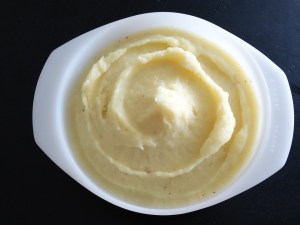
Mashed PotatoesWhen something as wonderfully delicious as mashed potatoes gets messed up, it can hurt feelings!

If you try to pick the serving spoon up out of the bowl, and you get the entire bowl of mashed potatoes with it, they’re messed up.

Sorry.

But there is a cure and you have found it, right here! Yay YOU! Read this and have lots of fun!

Mashed Potatoes

  1. Scrub well: one potato for each serving. (People often overeat this wonderful dish and leftovers are superb for many uses.)
  2. If the potatoes are not organically grown, peel them. If you do not enjoy peel in your mashed potatoes, peel them. Save the peelings for the chickens; they love ’em.
  3. Cut the potatoes into half-inch slices or one-inch cubes.
  4. Place cut potatoes into pan large enough for an inch of water over them, and also room to boil.
  5. Bring potatoes and water to a boil and add salt: For only one or two potatoes, add just a half teaspoon salt; for a big boiler full, add a tablespoon or so. Lower heat to simmer. (Just a few bubbles, not splashing around.)
  6. Simmer for about twenty minutes, at least. Test for doneness. Potatoes should be really soft and tender, to be done. If you stick a piece and it sinks down into the rest of the pieces, it’s too hard yet. If the fork goes straight into the piece or even breaks it easily, they’re done.
  7. Pour “done”potatoes and water into a colander over a large bowl. Set the cooking water aside to cool.
  8. Dump hot potato pieces into large mixer bowl and use beaters on low to break them up a lot. Then turn up speed to medium, to make them very mashed and fluffy.
  9. Add butter: If the large mixer bowl is close to full, add a whole stick of butter, at least; if you cooked only two potatoes, use less. Beat the butter in.
  10. Add milk: Do not be shy to add milk. Add it in small doses, but do add it. You do not want the potatoes to be stiff. It should be liked whipped cream or only slightly stiffer. It should not be like dried out playdough. Scrape edges into the middle to make sure all is blended well. Do not be afraid of overbeating–they need this.
  11. Turn off mixer and use spatula to smooth top of potatoes and mound them in the middle.
  12. Wipe edges of bowl clean and serve with a smile.

Variations:

  • Add garlic powder while beating.
  • Use cream instead of milk.
  • Add herbs of choice, dried and powdered, a pinch or two at a time to not overdo. Parsley is popular. Italian herbs are good. A few light flecks of something mysterious adds a lot, in this case.
  • Use cream cheese instead of butter.
  • Add chives.
  • Stir in bacon crumbles (not fake! real bacon!) with spoon, before mounding.

Leftover Mashed Potatoes

To Reheat: Place a small bit of milk in the bottom of a good pan and add cold mashed potatoes. Stir often and watch carefully while warming over medium heat. Be sure to heat through. Serve.

Potato Patties: Fry some bacon or sausage and set aside. Mix cold, leftover mashed potatoes with egg, about one egg for each cup or two of mashed potatoes. Drop by heaping tablespoon into hot pan drippings and fry until richly brown on one side; turn and fry other side.
Serve with gravy or honey. Mmm!

Potato Soup: Soften chopped onion and celery in small amount of butter, over medium heat, using a small pot. Add mashed potatoes and stir to warm. Add enough milk to make it a thin soup. Continue on medium heat until heated through and about to simmer. Serve with cheese (Swiss is a good one) and crackers.

That Cooled and Saved Potato Broth

Save in refrigerator for no more than a week. Use in recipes such as gravy, soups, and bread making. Just substitute for the liquid called for in the recipe. You will be pleased. Reduce or eliminate the salt called for in the recipe.