
Ever wonder if your child is learning disabled?
Or not?
Ever wonder if the person who diagnosed a neighbor’s child was actually qualified or certified or licensed to make such a diagnosis?
Or even cared?
Do you wonder if the difficulties your child is having are because of your teaching?
Or if you are imagining things?
The Real Need.
Only a little fine-tuning, applied to your teaching, can let you know what is going on. You can actually know. And this type of teaching is do-able only in a one-on-one teaching environment, such as a home school. Your baby is in the right place
How can you tell if your child is misdiagnosed as learning-disabled?
Of course, since I also am not a licensed learning pathologist, either, I also cannot make, nor change, a diagnosis.
However, as a mom who has taught all sorts of children for over thirty years, certified or not, licensed or not, I have learned a few facts the hard way. You can learn how to help your child, with the tricks I have picked up along the way.
And I’m eager to share with you.
Definitions are in order.
Too often, a tragically neglected fact is that many children cannot read well because they cannot see well. According to US Law #94192, a vision problem is not a learning disability:
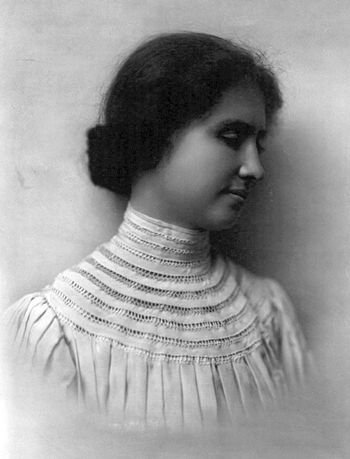
Helen Keller was NOT learning disabled!
If anyone in your family has close-up vision problems, it is important to have your child’s eyes checked. The “Big E” vision triage chart is not enough. When a child has trouble reading, you need an ophthalmologist. The nurse in your pediatrics clinic just will not do. Neither will the optometrist who measured and made your glasses. Only an ophthalmologist is an M.D., is what you need.
DO NOT assume that the non-professional learning gurus in your life have examined this essential matter. (Do not even assume this simple assumption with professionals.)
Many professionals have an attitude these days that goes something like: “That is outside of my area of expertise,” which translates: “That is not my problem.”
Surely you are aware that asking your child to read if he cannot see is asking him to do something that is physically impossible for him.
For a Lifetime.
We need to remember: Learning to read is a life-long process.
Pick up a book you read in your childhood and notice how much of the plot you missed. Of course, although you were well able to read back then, you now read with even better comprehension. You did not have phonics lessons all those years, yet you improved, just with practice.
The same is true of your child. No matter how skilled or unskilled you may think he is, he will improve with time, just by reading. An important choice you can make to help a child improve reading skills is to relax and let him read. Whether aloud or silently, whether solo or in concert with someone else, practice makes perfect.
Age Matters.
With a very young learner, the problem also could be in the realm of readiness.
I have a friend whose husband became ready to read when he was a senior in high school. He made straight “A’s” that year, after struggling and nearly failing every previous year.
Not all children wait that long, but many do not become ready until they reach puberty.
Others are ready at around age nine.
To overcome this problem in all its ramifications, it probably is best to read to your student while pointing to the print all the while.
Usually there will be some ability to find and recall words, via normal phonics methods. Knowing where to look for them in the book will help with independent study. Believe me, the non-reader sneaks peeks at books when you are not looking. The day comes when all the puzzle pieces will fall into place for him, and he senses this. Keep providing him with pieces.
Yes, it is a little harder for you, but because of this added difficulty, you can know that home is where your student belongs. Who else would care enough and have the time?
Speeding Reading Readiness.
Did you know you could provide exercises that speed the onset of readiness?
Much of simple childhood play does exactly that. Fun activities that require transferring big motion from side to side, repeatedly, are what you need.
Riding a bicycle or tricycle, skating, running, walking, and crawling are examples.
Also, aiming activities help, such as ball or ring throwing, or bowling.
You will find that most children enjoy most of these activities and will never guess at the reading help they gain. Please allow and encourage them to play big, often, and long, to the point of acquiring some ability.
While you are at it, make sure your child’s “handedness” is accurately defined and that he is preferring his dominant hand.
Glaring Problem.
Some children understand phonics and their eyes focus adequately but have another big problem commonly called “glare management”, or, more properly, “glare mismanagement”.
This obstacle is easy for even the novice teacher to identify because the child reads well for five to fifteen minutes, then begins to break down. This is a sign of eye tiredness, which can indicate a glare problem.
Sometimes, if he has the option, this child also will choose not to work or play on a computer, for the same reason.
To understand glare problems for yourself, try to find a magazine article printed in white on a black background. Just see how ready you are to skip the information on that page. Your tired eyes will tell you that you do not need to know anything that requires so much effort to absorb, although there is nothing wrong with your learning ability.
If your child’s eyes check out okay at the doctor’s, it may be time to experiment with the lighting, both of the room and of the paper.
When I have a child showing symptoms of glare problems, I immediately do two things:
First, I turn off all fluorescent lighting (and all screen lighting, such as a computer or TV might provide) and move the child near a bright window, but not in direct sun.
Second, I break reading lessons into fifteen-minute or even smaller portions.
If I see dramatic improvement in the attitude of the child and in reading comprehension, I know I have found the problem. After that, it may be enough just to continue with those two changes.
However, usually I will also experiment with colored acetate page covers. This is simply dark-colored “cellophane”, easily found at specialty gift-wrapping centers. Try several colors, and please make your color choice based upon the child’s preference and performance. Frame your child’s “color” in a simple cardboard frame, to make it sturdier, if you want, or you can order a set of these framed covers for a high price from educational sources.
For some children, it may be preferable to try to find “sunglasses” that have the right color in the lenses. If this works for you and your child, it is fine, as long as the lenses are not warped.
What else?
Your child may be able to focus well in any light but still have eye immaturity troubles, in that his eyes may jump around on the page. If a student does not need glasses, does not respond to light changes, totally grasps and applies phonics, but is still “just slow”, I recommend a mask.
A mask?
Yes, a mask, but NOT for the child. You may need to mask the reading material.
If it helps, you can easily make several, which you will likely prefer to do. Here’s how:
- Obtain a piece of white card stock, like a 3×5 note card, although bigger is better.
- Measure how tall and long is a line of print in your child’s reading material.
- With a razor, cut out a window in the middle of the card, to accommodate those dimensions.
- Allow your child to use this card to mask all but the line he is actually reading. See if it helps.
I have a friend whose teenage son could not “pass” the achievement test for homeschoolers, once required in our state. Although his math skills were great, the problems were in story form and his reading was too slow. Once he began using a page mask, they knew that it was what he needed during those tests. He “passed” after that, with a high score. Such a simple thing made all the difference for them.
Is There More? Yes.
One practice that I always recommend, even to moms whose children show no reading difficulties, is memory work.
I assume all of us are all memorizing Bible verses, but I like to include other works, too, such as favorite poems, famous speeches, the Preamble, etc. We take all those pieces with us all our lives and we are glad of it.
For the child who is not yet reading, though, for whatever reason, it becomes even more important, because the disciplined syntax and vocabulary of educated days-gone-by can become like a backbone for his verbal experience. If he cannot read zillions of great books, or, maybe even the Bible, he needs this cultural input.
A Few More Hope-Giving Words About the Bible:
More than one preacher grew up unable to read, and yet, God-called to preach. Once each of them faced God, in faith for the ability, God miraculously supplied his need to read the Bible. Incidentally, more than one of these men was unable to read any other books. God could do this miracle again, but it would not happen in the life of the child who already could read, would it? While you must keep trying, please do not ever give up hoping, either.
Stop False Assumptions.
Do not assume that your child is learning disabled based upon mere statements from past “teachers”.
If your child schools in your home, God has given him a new teacher, one who knows him better than anyone else ever could.
Make doubly sure that he is receiving what he truly needs, based on correct assessments.
You can take the simple steps above to re-evaluate and make corrections as needed.
Whatever God has for your child will be His best.



 Home's Cool!