Train up a child in the way he should go and when he is old he will not depart from it.
(Proverbs 22:6)
Now you’ve done it:
You have finally brought your baby (who happens to be fourteen years old!) home to live happily ever after with you.
You have planned and dreamed and now you are so excited.
The trouble is that now you do not know what to do with this child you hardly recognize and you have to deal with the years he has spent away from his loving home.
Is that how it is for you? How do I know? We have been there, is how. Because the laws in our state had not always protected home schooling, our oldest had spent six years in the public system and nearly two in a similar private system. He had much to unlearn, since children can acquire many ideas we do not want them to learn, and miss the important things.
Why do they pick up things we do not desire? It is because we have not been bringing them up in the ways they should go, according to God’s command. I can say that because if our children have been in any type of collective institution, then we have not been bringing them up much AT ALL.
Someone else has.
We only greeted them as they passed through our lives, doing the bidding of those who were bringing them up. It is so sad and so wrong that the wisest man ever, Solomon, himself, made a special judgment regarding such things. He knew that the real parent would really care. (1 Kings 3) Maybe that is one reason God commanded us to bring them up, not to send them away to someone else. The assumption is that we would truly care.
If we have missed this mark until now, what do we do?
How do we make it right?
Where do we start?
The first step is already done: Bringing your child home is the first step.
Something inside you is waking up and beginning to commit to caring for him more. You have made a good start, already, and do not forget it, because many would like to make you think that this excellent start is really the start of all your problems.
Actually, you already had problems; you are just now beginning to see them. Finding and facing the problems is a great first step.
Ruth, from Ruth Bailey, artist, left a comment on one of my posts, a while back, and I again have been able to catch that big “click” the moment it happened, this time for my 3400th comment.
I know, it’s been a while coming. Ruth is a great watercolorist and was in the middle of an amazing commission, that busied her until recently.
I am so glad she is back!
Since Ruth is no stranger to home educating, I asked her if there were anything she might like to write for us about art in the home school.
She has graciously provided us with some great tips I really wish I’d had 20 years ago.
I believe that teaching a child to draw should be a part of every home-school curriculum.
Drawing is well suited to the home-school curriculum since it can be taught inexpensively, in short or long time segments, requires few extra materials, and the skills can be learned by anyone with enough dexterity to write their name. Drawing uses and develops the brain in ways that reading, writing, math, social studies, and science do not. Drawing uses non-verbal thinking skills and spatial relationships, while encouraging creativity, alternative problem solving strategies, and intuitive responses. Drawing also aids in teaching math skills since it involves the complex mathematical concepts of angles, measurements, graphing, and ratios. Drawing gives children and adults another language in which to express themselves and is pleasurable and fulfilling in itself.
Coffee With My Granddaughter
Typically, young children start learning to draw by experimentation. They scribble on paper, enjoying the power of making marks. After a while they begin to assign meaning to scribbles, saying that this mark is “the dog,” or “daddy,” or “a birthday cake.” As their dexterity increases, they often adopt a symbol system, drawing stick figures, which get more complex as the child gets older. Sometimes these symbols are mimics of drawings by adults (who insist that their own drawing skills are inadequate). As children learn verbal language by example, experimentation and encouragement before learning any of the “rules,” they can learn the language of drawing in the same manner. This means giving them exposure to a variety of materials and time to explore. Paper and pencils, pens, crayons, markers, simple (non-toxic) paints, cotton swabs and food coloring, glue and bits of colored eggshells, etc. are typical household items that can be used. If a child expresses frustration or a desire to go further with drawing, I suggest enrolling the child in a class or trying out Mona Brooke’s book Drawing With Children to learn some formal drawing techniques.
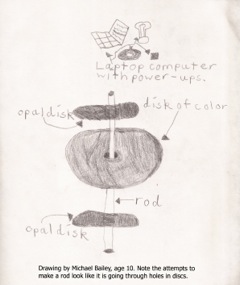
Sometime around age 10 (fourth or fifth grade), a child’s brain goes through a “growth spurt” with an increased integration across the right and left hemispheres. This growth often leads to dissatisfaction with the difference between what is observed and the symbols used in drawings. Some children break through their established symbol system and are able to create realistic drawings at this time with little or no instruction. These are the children who are labeled “gifted artistically” or “talented.” Unfortunately for the others, this is the time when a child will give up on drawing, frustrated with his inability to make the drawing look like he wants it to, and calling his own efforts “stupid.” However, realistic drawing skills can be taught, and learned (by adults as well as children). There are many classes available to teach non-drawers to draw, and many books written on the subject. One of my favorites is Betty Edward’s The New Drawing on the Right Side of the Brain. Although the exercises in this book are not difficult for a child, children in elementary school would be helped by having an adult supervise and explain the material. Going through the material together is an ideal home-school activity.
With the foundation of being able to draw realistically, a child (or an adult) can then continue the exploration and experimentation process, drawing from reality, memory, or fantasy.
I wish you many satisfying hours, teaching your child to draw, and learning to draw, yourself!
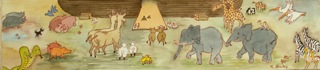
Noah’s Ark
Ruth Bailey is a home-school mom who, now that her children have all graduated from high school, fills her days with painting watercolors, sailing on the Chesapeake Bay, and traveling with her husband.
A Map of the Legality of Home schooling around the world. Based off of Image:BlankMap-World6.svg. Green is legal, yellow is legal in most political subdivisions but not all or is practiced, but legality is disputed. Red is illegal or unlawful. Orange is generally considered illegal, but untested legally.
We were homeschoolers when homeschool wasn’t cool.
We started with no support because there was no such thing as a homeschool support group. At about the same time, Home School Legal Defense Association started. They and we did not know about each other, so we also had no legal support.
Internet was only a child, then, and had not maximized its potential to help homeschoolers. Computers had no practical applications in home schools.
All, all the curriculum available to us was published for collective institutions and often, publishers refused to sell to home educators.
Back in these very good, old days, only the driven, committed, principled, loyal, persevering, stubborn, maverick, determined, motivated, obsessed, dedicated, devoted, steadfast, unswerving, faithful, home educating parents survived. We had somewhat of a reputation for being a pain, especially among status-quo legislators. Many of us could relate to the Washington/Jefferson/Adams triumvirate, always questioned by those around us and always questioning ourselves, testing ourselves, proving ourselves. Always hunted and attacked by the government that claimed to protect us. Always in semi-hiding. Always ready with an escape plan. Always losing money on this project. Always making do with do-by-self.
We faced obstacles, penalties, hindrances, impediments, barriers, hurdles, deterrents, limitations, and interference.
We were hated. We were arrested.
I guess it’s the American way.
Now that home educating is the bright star it has become, and we have retired, after a quarter century of it, people want our opinions:
What curriculum do I think is best? Pick one you like and get busy.
What is my child’s learning style? Lazy and stubborn. What about yours?
Do I homeschool during summer? All parents homeschool at all times.
Do I think you’re harming your child? Probably, but better you, than someone who doesn’t care enough to ask.
What do I do about socialization? I talk to my child; I teach my child; I read to my child; I produce siblings for him; I take him to church.
What about computers? Teach your children to read well, spell correctly, write legibly, and type accurately, and to love English, in that order, before even thinking about computers. Then, no computers allowed until high school and no Internet until the last half of the senior year.
Does all that sound harsh to you? Does it sound grumpy? You will not get a marshmallow answer from a homeschool-callused person. We did not plant our homeschool garden with a tractor, but with a shovel and a hoe. We did not have curriculum choice unless we wrote the curriculum, which we did.
I beg you, for your own and your children’s sakes: Pick one you like and get busy.
No matter which decision we make, we will teach them.
When we keep them at home to educate them, ourselves, we teach them one thing.
If we send them away to receive their education elsewhere, we teach them another, ominous thing.
When we bother to keep our children with us where we can smile at them and watch over them daily, we teach them that we value them.
When they are teens and begin seeing many childhood things from the outside, they learn how important they are to us. They learn how much we cherish them. They learn the value of a child, the value of a parent, and apply this value to their own children, to all children in general, and to themselves, someday.
If we ditch this responsibility along with our children at the front door of some worldly institution, we still teach them—that they are important to the world, which has bothered to take up our slack. They learn to measure the value of a child with the only measuring stick that we have given them and to translate this to the value of all children, foreign, handicapped, and unborn.
When we keep our children with us so that we can give them the gift of reading, just as we gave them the gift of speech years before, we teach them the importance of literacy. When we carefully couple that with reading Scripture, we teach them the reason for literacy.
When they are teens and can read like adults, they learn how important and valuable literacy is, in God’s eyes, and how blessed they are to have Scripture to read.
If we turn them loose to acquire their literacy lessons from the world’s schools, we still teach them—that we do not mind if they learn to read in order to escape reality, to investigate immorality, or to accumulate prosperity. They will read things we do not approve, indeed, do not have a chance to approve. They will not read anything Godly coming from these people who value them enough to educate them.




 Home's Cool!