Posted in Blessings of Habit, Home School, Pre-schoolers

Do Your Kids Have Habitual Blessings?

“Hey! Turn that back on!”

I heard it bounding from the hallway one day. It had happened again.

We have taught our children, from the time they were young, to turn off lights as they leave a room. Someone had turned out the light while there was someone still in that room.

It was a clear case of what I lovingly call “good habit — bad timing”.

How amazing that the brain, once trained, knows what to do on its own! Eventually we no longer have to think about what to do and how to do it. How unaware we are of how many habits scoot us along our way, every moment!

Imagine if you had to reinvent tying your shoe, each time you did it.

We can turn off a light without thinking, even without looking at the switch. We can be thinking about the next task in the next room while we finish the task in the current one.

The mind is wonderful.

Stretching OutDuring a gym class, as a teen, I heard a phrase worth remembering: “That which is used, develops; that which is not used atrophies.” At that time, I did not know the meaning of the word “atrophy”, so I guessed it meant the opposite of “develop”. Since our family has a motto of knowing, instead of guessing, it bothered me I didn’t know for sure, so when I got home that evening, I looked it up.

Think of all the habits working in this experience:
1. That phrase, repeated in every gym class so I could never forget it, reminded me of the good of learning, repetition, and training.
2. Habitual use of English caused me to guess correctly at the meaning of a word in context.
3. The habit of exercise, itself, gave me a lifelong urge to keep moving, partly spurred on by dread of atrophy.
4. Our habit of accumulating new words and facts inspired me to bother with a dictionary.
5. A family habit of returning a thing to its place enabled me to find the dictionary.
6. A habit of working alphabetically caused me to turn immediately to the front of that huge book for the word “atrophy”.

How difficult it would have been for me to benefit from the experience had I not had all those habits! It takes 21 days for a disciplined person to form a good habit. I was not a self-disciplined person by nature. Nope.

Oh, the drill, supplied by faithful adults who insisted upon good habits in me!

The sad thing is that some children who lack faithful training might be learning to hate exercise instead of fearing atrophy. We have many such children living among us, these days, lacking drill in good habits, and this loss causes many problems. They never reap normal benefits from life’s normal experiences.

They become abnormal.

Our children do not have to be among them, though. The home is the perfect environment for instilling good habits. With 180 days in an average school year, the potential for 9 good habits per child per year presents itself.

Let’s go for it!

______________________

Photo credit: Tyne & Wear Archives & Museums

Posted in Believe it or not!, Inspiring, Scripture

It Is Stupid to Hate Correction: a reblog of sorts

“To learn, you must love discipline; it is stupid to hate correction.” Proverbs 12:1 (NLT)

To learn I have to love discipline?

Who in their right mind loves discipline? I certainly don’t, but none the less, to hate correction is, as the Bible says, stupid.

Can the Bible say that? And the answer is, yes It did. I believe the Bible used such a powerful word here because it wanted to get the point across. It was meant to get our attention. . . .

Go here to read more.

This is a good article from a very good site. Enjoy!

Posted in Blessings of Habit, Good ol' days, Health, Homemaking, Inspiring, Photos, Wisdom, Womanhood

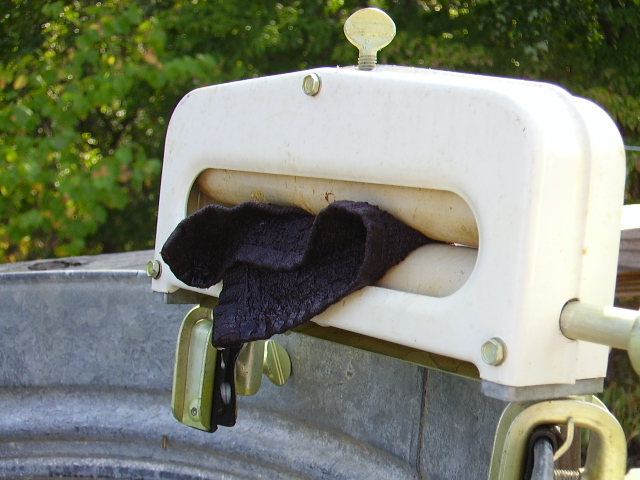
Ode to a Wringer Washer

genuine Kenmore wringer on tub
Genuine Kenmore Wringer on Tub

The second-most-viewed post on my site. I cannot figure this, but have loved seeing nearly every week, someone else coming to read this.

Have fun.

My gramma had a laundry wringer. And for a while, so did my mom. I always loved these machines that squeezed the water out of clothing so graphically and intriguingly.

click to view water running off
Click to View Water Running Off

Back then, washing used only one load of soapy water, beginning clean, with white clothing, and proceeded to gradually dirtier and darker clothing and water, until the last thing washed was the dingy dungarees worn to protect the good clothing from animal chores.

no longer dripping
No Longer Dripping

After washing came rinsing, or some said, “wrenching,” which surely they thought referred to the old way of removing extra water, by hand wringing, making the arms and hands feel nearly wrenched out of socket. My gramma put bluing in rinse water to make whites look whiter. I never could understand this substance, bluer than a computer screen, that made things white.

Gramma used homemade soap on clothes. I mean: natural lye made from last winter’s wood ash combined with natural trimmings from natural meat, and yes, she made it herself, on the wood stove in her woodshed, and stacked it everywhere in there to cure. Then she grated it for flakes. It all smelled so fresh and good.

To this day, aroma from homemade soap makes me think of birds calling and locusts scritching combined with comfy sloshy sounds of laundry done during warm laundry days. And my gramma’s voice explaining . . .

The washer, and its accompanying rinse tubs on platforms, rolled creaking out onto the bumpy concrete porch around Gramma’s woodshed. A hose ran first to fill rinse tubs, and later to empty them onto the enormous strawberry patch.

Only large pots of scalding water went into the washer, itself, and yes, heated on that wood stove. All the concrete porches got a scrub-down with used laundry water splashed on, pure and natural.

There were manual and electric versions of the wringer. My gramma had the kind she had to crank and disdained the electric, which could swallow up an arm or break off buttons. She fished clothes out with a stick; the water was that hot. My auntie had one and I didn’t like the noise of it. Besides, cranking the wringer was an honored chore because you had to be old enough to reach and strong enough turn it without let-up.

The wringer and its tray were rotatable to provide also for two tubs of rinse water. Every article of clothing went through the agitation in soapy water, wringing, pouring and dribbling, to kerplunk into the first rinse, and then into the second, before finally being wrung into a laundry basket for hanging on the line.

It seems like so much work, and it was. No wonder laundering was an event with its own day set aside. Imagine dragging all that production outdoors on a daily basis for just one load! Yet, all this was such an improvement over lugging all the laundry to a stream, or boiling it in a huge pot over an open fire.

Yes, it was good, honest work, but that woodshed and that porch were my gramma’s gym and she stayed fit, even into old age. And although she belonged to a gene pool that proved a tendency to plumpness, she always remained trim.

Unlike me.

Posted in Inspiring, Scripture, Wisdom

Sunday Scriptures – Wrong.

Guido Reni - Joseph and Potiphar's Wife - WGA19310
Guido Reni – Joseph and Potiphar’s Wife

Now Joseph was well-built and handsome, and after a while his master’s wife took notice of Joseph and said, “Come to bed with me!”

But he refused. “With me in charge,” he told her, “my master does not concern himself with anything in the house; everything he owns he has entrusted to my care. No one is greater in this house than I am. My master has withheld nothing from me except you, because you are his wife. How then could I do such a wicked thing and sin against God?” And though she spoke to Joseph day after day, he refused to go to bed with her or even be with her.

One day he went into the house to attend to his duties, and none of the household servants was inside. She caught him by his cloak and said, “Come to bed with me!” But he left his cloak in her hand and ran out of the house.

When she saw that he had left his cloak in her hand and had run out of the house, she called her household servants. “Look,” she said to them, “this Hebrew has been brought to us to make sport of us! He came in here to sleep with me, but I screamed. When he heard me scream for help, he left his cloak beside me and ran out of the house.”

She kept his cloak beside her until his master came home. Then she told him this story: “That Hebrew slave you brought us came to me to make sport of me. But as soon as I screamed for help, he left his cloak beside me and ran out of the house.”

When his master heard the story his wife told him, saying, “This is how your slave treated me,” he burned with anger. Joseph’s master took him and put him in prison, the place where the king’s prisoners were confined.

 — Genesis 39:6-20

________________________

photo credit: Wikipedia

Posted in Home School, Inspiring, Wisdom

All Children Home School: The Rest of the Story

A Map of the Legality of Home schooling around...
A Map of the Legality of Home schooling around the world. Green is legal, yellow is legal in most political subdivisions but not all or is practiced, but legality is disputed. Red is illegal or unlawful. Orange is generally considered illegal, but untested legally.

My friend’s teen children were tired.

I had always thought they were shy children because they hardly said much in church. I learned though: If anyone spoke first, these children politely carried on an adequate conversation. Then they would drop back into their tired mode, like a trance.

My friend, their mother, was tired, too. I had noticed signs of it: late (or absent), hastily coiffed, testy—all out of character for her and all beginning when school began each year. I understood it more after we had the “school” conversation. 

I think she was just using me for a sounding board, not realizing that I have feelings, too. Most people in a State school need to verbalize their convictions to home educators. They subconsciously need our quiet endurance of these conversations, I think, to help them go on.

Since I believe that, I usually do not listen altogether mutely. Usually I say things like, “I am so sorry,” or  “I know it must be a real burden,” or  “Perhaps a different teacher (grade, school, district, etc.) would make a big difference?” 

I am not being sarcastic when I say these things, although the temptation is sometimes there. No, I truly am sorry to see my friends suffer so because of their State education choices. Too, because of my own mistakes in the State systems, I know it truly is a burden.

Of course, I know a different spot within the State school system does not usually make much difference, but I also desire to help them see something: To me, their situation sounds burdensome. I hope to cause them to have second thoughts, if possible, within the context of friendship.

Therefore, I tried to listen gently to my friend’s tiring tedium of tasks. I am sure my eyes widened.

She wound up with, “but I just don’t see any other way to make sure they are doing well . . .”

I said, “Sandra, I know you are tired; anyone could see it in your eyes.” She dabbed at tears. “I don’t know what to tell you. If the teachers and the coaches will not do it, I guess you must—someone must.”

I hesitated, then went on, “The reason your children excel and the reason you are tired is that you are homeschooling.

“For most home educators, it is not so tiring, though, because they homeschool from 8:00 a.m. until early afternoon. You are homeschooling a lot, during those hours, but also during the hours from 3:00 until midnight and beyond. Add to that the fact that you are worrying, and you could not HELP but be tired. You are volunteering at the State schools, and then conducting your own homeschool afterwards.”

The things I said did not help her. She was convinced hers was the only way to send her children into law school.

The entire conversation did help me, though.

It gave me several more reasons that I would never go back into the State institutionalized education program.

You can learn from it, too, perhaps. Perhaps you can see why people should stay out of that system. 

Failing that, at least you will have a list of things you must do (should you decide to quit home schooling) to cause success in State-educated children. 

Posted in Home School, Who's the mom here?

All Children Home School: A True Story

English: Don't waste your time and do your hom...
Don’t waste your time and do your homework!

Once, a dear friend was explaining to me how the State school experience was better, and how her children were receiving the best education available.

Have you ever noticed how State institution school parents think they must educate us to this “fact” and we must bear it patiently, but the reverse seldom holds?

She was striving to explain her children’s bright future and perhaps she could not hear herself speaking. As I listened and tried to grasp what she was saying, I was astonished at the obvious conclusion.

Maybe it would be instructive to share it all with you.

Granted, her children were in the best State schools available in our small city. They were a wealthy family and had moved into a wealthy neighborhood for the expressed purpose of better State schooling.

That this fact was possible should be enough, alone, to terminate State education.

She wanted her children to be lawyers and she wanted them in the best colleges in the nation. I will also grant that she was a very dedicated mom, committed to performing whatever activity (except home schooling) necessary to raising up successful children.

She was misinformed, though, and not thinking about the entire scope of the picture.

To prove to me her commitment, she began itemizing the duties she undertook for her children’s education. This was a typical day:

  1. She drove her children to school, herself, to prevent teen driving troubles in their lives. They did not enjoy being the only ones arriving with Mom, but she was dedicated enough to insist.
  2. She was careful to deposit them at the school early, to give them free time to form friendships of their own choosing, so they would not be relying on whomever might sit nearby in class. This also allowed time for composing themselves before facing the day.
  3. She signed them up for sports, although they were not athletic, to help them overcome the sitting they must do daily, and to improve their chances for scholarships.
  4. After school, they had sport obligations, of course. She went to every practice and every game, with a video camera. She recorded every pertinent happening at these gatherings.
  5. During the day, she edited these videos, juxtaposing the skills of opponents and her child and his teammates, to show where more effort would benefit.
  6. After school, her children had oceans of homework. She was strict about it, allowing no play until all work was done. Since supper was prepared in advance, she helped with their homework, explaining things they could not get the teachers to answer adequately. She was their cheerleader, greeting them with encouraging one-liners, such as, “You can do it; one more hour ought to get it!”
  7. She showed them the sports videos, explaining her thinking in detail, so they could discuss how more effort would cause more success. Again, she cheered them on. (I do not know where their coach was.)
  8. Since homework reigned supreme in their home, except for a break for supper, the children labored until midnight or beyond, at which point Mom simply conked out. (She did ask me if I thought she was wrong to require them to continue until two a.m. or later, when she, herself, was unable to do so.)
  9. The next day they began again.

It was true that her children were doing well in school. They did not have as many friends as they might have liked, but they were receiving high grades in difficult subjects, and they were often on the first sports teams.

They were tired . . .

More tomorrow.

______________________

Photo credit: Wikipedia

Posted in Blessings of Habit, Home School, Homemaking, Inspiring

No Such Thing as a Single Income Family!

saving and spending

Someone’s gotta stay home with the kids if we homeschool. Right?

Right.

We may quibble about which parent must stay, but no doubt one simply must.

Lots of people think keeping a parent at home precludes being a two income family, but it does not. The act of staying home saves so much, we  sometimes wonder how those who work outside make any money at all.

Let’s look at how it adds up:

  1. Clothing. Stay-home clothes bought on sale cost far less than suits or uniforms bought under duress. The same is true for shoes, bags, coats, etc.
  2. Transportation. If only one parent is going out to work, only one car is necessary. Same for gas.
  3. Work. Someone has to do it. Either you clean the house or someone else gets about $1000 per year to do it. You can do your own laundry, yard work, repairs, etc., and save the prices of hiring them done. Or the price of a counselor trying to fix your brain after you try to do it all yourself . . .
  4. Cooking. A rib-eye steak costs about $5 on sale at the grocery, about $18 at a restaurant. Spaghetti dinner for 6 costs the same at home as for 1 at a restaurant. Maybe less. A homemade birthday cake costs about $7, compared to $20 from the store, and you know which tastes better! Hearty, homemade bread costs half or less of insipid store-bought. However, if you make these yummy foods to sell, you get the store price!
  5. Shopping. What? Isn’t shopping how we lose money? No, that’s random spending. Shopping is comparing prices, waiting for sales, and squeezing all the value you can from every penny. It is sticking to your list, buying in bulk, and always being ready for the surprise bargain for someone’s gift for the future. It is what you don’t have time for if you’re on your way home from the office.
  6. Sewing. While it is true, fabric prices have gone up, it is also true you can make new, lovely curtains with hardly any sewing instructions, covering that window in sale fabric for about $25 instead of $125. With only a bit more knowledge, you could make yourself a skirt or cape. Learn a tiny bit more and make simple dresses for your girls. All with the same savings rate. But if you sell, it . . .
  7. Gardening. A pint of home-canned green beans costs about ten cents for the lid and bit more for energy to run the stove. There is an initial investment, but you can re-coup the cost once you’ve canned for a year or two. And store-bought vegetables are nearly $1 per can.
  8. Crafts. A bit of yarn, a drop of glue, how surprising the fun and savings in making gifts! And the savings is phenomenal. You could develop a reputation for a certain type of gift and become known as “the afghan lady” or the “soap lady”, turning it into a business. Astronomical savings in greeting cards, alone!
  9. Last, but not least, Child Care. It’s about $18 per day per child. That does not factor in the cost of medical care for all the diseases they will pick up.

This list could go on forever, but you get the idea. If, when you are at home, you actually WORK, you are a working mom, and your rewards are good.