Blog

Posted in Home School, Inspiring, Sayings, Who's the mom here?, Wisdom

A Cure for “The Quits” – Part 1

English: The fable of the fox and grapes: a wo...

I was discussing abandoned projects and lagging schedules with a friend, one day, when the question came up: Why do we start things that we think we will finish, and then not finish them?

Well?

Why do we?

I assuredly offered a quick-fix list of answers and then several days later, I had one of those “uh-oh” moments.

I saw how well these answers applied to me and my own projects.

It then occurred to me that these answers fit many occasions, and might explain to you why you have given up, or why you feel like quitting on home schooling.

I hope it also will help you to keep on keeping on.

The first reason in my pat answer was that we lose the vision. The Word of God tells us that we perish for lack of a vision (Proverbs 29:18). That is so sad because it is so unnecessary: God can give vision to His people, and wants to do so all the time.

What does it mean to lose the vision?

An example I often think of is what the old-timers used to call a “sour-grapes” attitude. This refers to Aesop’s fable about the fox and the grapes. Basically, when the lazy fox was unable to obtain some grapes that it wanted to eat without expending some effort, it decided that the grapes must be sour, after all.

Some people do that. For instance, they tell everyone, including their children, that God has called them to homeschool. Of course, their homeschool friends are excited for them and their children are filled with nearly uncontainable excitement.

As they investigate how to carry out this calling, though, they encounter some difficulty or other, and immediately decide that God had not called them, after all.

They tell their friends to quit harassing them (their term for what we intended as shared joy) about the issue.

They tell their children to learn to think of the public schools as their friend.

So much for God’s call.

The same problem can come when we envision a beautifully harmonious setting for our home school and then realize that we are working with unskilled, unharmonious human beings.

How easily we decide that loud and wacky is wonderful!

It is “just the way we are”; forget that vision of quietness and peace, of tidy readiness. Lower the standard!

The vision has evaporated and folks will just have to accept us the way we are.

Home schoolers have rights, too, you know…

Sound familiar?

Part 2 tomorrow!

____________

photo credit: Wikipedia

Posted in Uncategorized

Grab a tissue and READ! Beautiful! This is a once-in-a-lifetime occurrence.

Ruth Bailey's avatarRuth Bailey, artist

This was one of the watercolor paintings I presented at the concert by the New Score Chamber Orchestra last night.  It is based on the composition by Frederic Glesser, Summer Nights Passing.

Before going to the concert, I had written up some comments about each of the pictures I was presenting, but there was no appropriate place to post them in the venue.  My story for this piece was as follows:

Up to now, I have only heard a recording of this piece, so I eagerly look forward to tonight’s performance of Frederic Glesser’s Summer Nights Passing.  (Live music, like art, conveys so much more than a recording or a reproduction!)  His serene melodic lines evoke for me a nostalgia which I have represented by the carefree feeling of a child on a firefly filled evening.

I did not know that Mr. Glesser had written program notes for…

View original post 367 more words

Posted in Uncategorized

Weekly Photo Challenge: MINE!!!!!

mine
At the Reception for Our Youngest and His New Bride
I am his and he is mine.

I am as tired as I look, here, but after two weeks of no rest, yet, I am beginning to feel better.

So much going on.

Bathroom repair necessitating my painting two walls.

Special events at church.

Taking a few short video courses.

Internet flailing. I think that must be an epidemic, as WordPress AND Social Triggers both have also played into my lateness, here, due to malfunctions. Ah, well.

Several large pieces of furniture vanishing when the last two left the nest, and needing replacements.

Empty rooms to spring clean. I know; it’s autumn.

And — drumroll, here — with moderate rains arriving, the blessings of mowing chores.

Still, this photo just gives me a glow. I seldom look this good, so I guess he brings out the best in me.

Posted in Blessings of Habit, Home School, Inspiring, Pre-schoolers, Who's the mom here?, Wisdom

If Only They Were Perfect — If Only WE Were!

Toothbrush, photo taken in Sweden

If a child is non-compliant on purpose, he needs far more than another reminder.

This is the hardest part: Requiring.

Children do not automatically walk in goodness, contrary to popular opinion. Some want to stay in bed in the morning. Some want to skip brushing their teeth. Some want to play during chore time. Dogs eat a lot of homework.

We know it is better for them if they have good sleep, health, and work habits. Our good plans for them must cross their wills.

That is why God put them in homes with parents. Parents can place requirements on children for their own good. This is common knowledge in all cultures, except the current permissive. People who follow the original ways of requiring children to act sensibly, have produced sensible offspring.

Stating the obvious is necessary, these days.

I believe my children will always practice brushing their teeth daily, because they are accustomed to having white, clean-feeling teeth, so brown, fuzzy teeth bother them. The same is true for bathing, eating healthful foods, and Bible reading.

Oh, they may experiment with departure from the absolute best, but they also will sense a difference, a loss, and choose the right way. For instance, my daughter became a ramen junkie during college, but the other day she said, “You know, I am just starving for a good, crisp salad.”

Yes!

They were not born this way. We required it of them.

The child who habitually eats cake and cola will not sense the ill feeling from it in adulthood.

The child who habitually reads everything but the Word will not miss the Word as an adult.

The difference between those generalities is most usually the differing requirements they faced as children.

Who wants to raise a loud, interrupting, unhealthy, illiterate adult with crumbling teeth and no knowledge of the sacred?

Draw your lines.

Repeat.

Remind.

And require your children to heed.

Help them have the excellent gift of good habits.

_____________________

photo credit: wikipedia

Posted in Blessings of Habit, Home School, Inspiring, Pre-schoolers, Who's the mom here?, Wisdom

Remind Me not to Lose My Mind

During the learning phase of acquiring new habits, reminding can be a good help for your children, or even yourself. Reminding goes beyond repetition. We reserve reminding for when we should already know a fact or skill.

Jesus did this from the cross when He called out the first line of Psalm 22, which minutely foretells the Crucifixion. Every Pharisee at the foot of the cross knew He was reminding them of the entire Psalm and its dire implications for them.

The child, who stops interrupting when Mom slightly raises her hand, is using a reminder. The stopped driver, who hears a slight horn tap and then proceeds at a green light, is using a reminder. The newcomer, who consults a photo-directory to recall a new acquaintance’s name, is using a reminder.

The word, itself, “remind,” means “pay attention, again.” We can cause our children to pay attention more often by the simple service of reminding them. Paying more attention can make the difference between knowing and doing.

During difficult memorized recitations, I have reminded my children with signed alphabet initials of tricky words or phrases. A childhood playmate received reminders from her mother in the form of having to return to the door, and open and shut it quietly, 20 times, to overcome door slamming. “Go back and walk,” is a common reminder at our house: Walk, the first time. Occasionally, even a policeman will give a warning instead of a ticket, if he judges that a reminder is enough.

Bible verses posted on the walls of our homes reminded our children of heart attitudes. Educational and health charts did the same for their earthly needs.

Reminders should be gentle because we realize anyone can forget something. Reminders can be exciting to our children, rather than dreaded, if we are willing to take the trouble to make them exciting. Our children are worth that trouble.

duck
Duck!

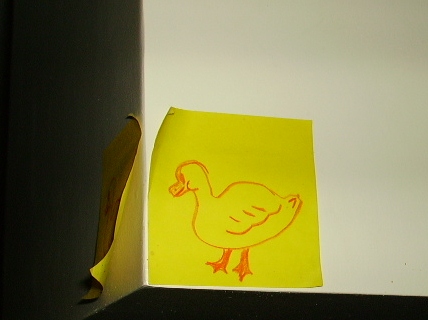
Silly faces on a small poster, can give as much reminder as a cross voice, but with more effect. A bright yellow sticky note hangs on a sharp corner of our cabinets with a drawing of an orange duck on it, to remind passers-by to “duck,” and not hit their heads on that corner. Computers remind us of our fallibility with the “Are you sure” page. The tiny poem, “Thank God for Dirty Dishes,” framed and visible near the kitchen sink, reminded a small, reluctant heart to take comfort at our house for many years.

And I must remind you to remind your children of your love for them with plenty of hugs, kisses, and favors.

More tomorrow.

Posted in Blessings of Habit, Health, Inspiring, Pre-schoolers, Who's the mom here?, Wisdom

Huh? Oh. — Repeating as a Step in Learning New Habits

(302/365) Q W E R T YBe good.

Be quiet.

Be careful.

Behave.

Brush your teeth. Pick up your toys. Clean your plate. Wash your hands. Wear a hat. Feed the dog. Wipe your feet.

Haven’t we all said all those things, and many others, a hundred times, at least?

We should train our children in every habit of good, such as obedience, kindness, and cleanliness.

This produces good adults. We could use a few more good adults.

How do we instill habits into children? The three-stage process is not so hard and begins with repetition.

I can type, from memory, a list of all the countries in Southeast Asia:

Malaysia, Laos, Burma, Kampuchea, Brunei, Vietnam, Indonesia, Singapore, Thailand, Philippines.

I can type, from memory, a list of all the English auxiliary verbs:

Is, am, are, was, were, be, being, been, shall, will, should, would, may, might, must, can, could, do, does, did, have, has, had.

Formulas for geometry, rules of the road, conjugations of foreign verbs, Bible verses, State capitals, all still reside in my attic, ready for me to climb up there and retrieve them. I learned them through repeating. They may fade as I age, but that will not mean that the repetition I used to learn them was wasted.

Repetition has saved me trips to the reference section of the library. It saves me mistakes, it helps me be a better teacher and helpful person, and it is fun. It is especially fun if after 40 years, I hop on a bike or sit at a keyboard, and every skill is still in place. It makes me very glad for asdf jkl; asdf jkl; asdf jkl; .

Repetition is a great learning tool, one that we can teach our children to enjoy, if we do not mind making a little effort at helping with it — you know, songs, games, flashcards, etc. Our children’s future successes are worth more than a little effort, on our part, and on theirs.

Repeatedly asking the same question is one effort that works. Every time we went shopping, I would ask my children what was the rule. They knew. “If anyone but Mom touches merchandise, we all have to go back to the car.” I made it stick. They knew that, too. That repetition saved many a gift store. As they aged, the question changed: “Did you bring money? No? Then you are not shopping; you are just handling things that belong to the store manager, and not to you.” I thought they’d never learn, but they did.

This policy of repeating was a big part of our learning method throughout life. What is seven times eight? When do we feed the animals, and why? How do we know a tornado may be coming? What’s the first thing to remember in case of fire? What are friends for? Who loves you? Why do you exist? How do we spot a manipulator? What should you do if someone tells you not to tell your mom or dad? What does it actually mean to acknowledge Jesus Christ? What should you look for in a possible future spouse? What should you do if you’re in trouble? Your children can learn any important thing through repetition.

Then they won’t get burnt.

More tomorrow

_____________________

Photo credit: Sarah G…

Posted in Blessings of Habit, Home School, Inspiring, Pre-schoolers, Who's the mom here?, Wisdom

The OUCH Factor — Beginning a New Habit

Foto einer Glühbirne (an),

We do well compared to guppies.

The human brain thrives on habit, grows larger on a diet of routine. The memory inside a human brain is frighteningly complex and magnificently comforting, at the same time.

Our children can reap what God intended from good habits, if, by the time our babies are crawling, they’ve had the pleasure of our instilling good habits into them.

They test us all the time. Why?

TO BE SURE. To make positively sure this boundary will hold and self is safe.

For instance, we know that because of the inherent danger, we should keep them out of the cooking area, so we train them to stay out. Eventually they learn such comfort, but sometimes this is the first clash of wills between the darling babe and the soft mom. It can seem like war, if Mom doesn’t know how to make it happen:

  1. In the beginning, you must teach the child what “hot” means. Use a hot light bulb and tell him “NO—HOT!” Act like you’re preventing him, but let him touch it briefly. Ask if he wants to repeat. If you see unwillingness, it’s a sign the child knows what you mean. If he cries, keep telling him it’s hot.
  2. Anger and yelling do not help. They hinder. Anger has a place, but not in teaching. Yelling is for long distance, loud environments, or extreme emergencies.
  3. Consistent firmness is the key. If you do not have time to be consistent, use a playpen or highchair to confine the child, or enlist a helper. “No” must mean “no”. If you are too lazy to be consistent, think about burn scars on your baby. That should help.
  4. You must not cave in to crying. Crying sometimes is good, but crying to get one’s way is bad. Do not teach the child it is good by rewarding him with his own way.
  5. Draw the line where you want, and make it stick. In our kitchen, one cabinet was permissible, but the rest of the kitchen was off limits, during cooking. At crawling age, a child can grasp this.

We know we don’t want picky eaters and do want well-balanced diets for our children, so we train them to eat. This can be another war, a bigger one, again avoidable, if Mom knows what to do.

  1. Be sure you do not serve food your husband will not eat when he is present. Save it for when he is gone. Be sure he understands this is a time of training, both in obedience and in habit, and you need his backing.
  2. Make a new rule that every person will take at least a bite of every food on the table and eat it all gone, no exceptions.
  3. Anyone who complains about one bite, gets two bites.
  4. All food must be gone, not just pushed around, before getting any seconds or any dessert.

All their lives, my children will be careful around off-limit things and unafraid of green things on the plate. It will be good.

More tomorrow.