Posted in Blessings of Habit, Home School, Inspiring, Pre-schoolers, Who's the mom here?, Wisdom

The OUCH Factor — Beginning a New Habit

Foto einer Glühbirne (an),

We do well compared to guppies.

The human brain thrives on habit, grows larger on a diet of routine. The memory inside a human brain is frighteningly complex and magnificently comforting, at the same time.

Our children can reap what God intended from good habits, if, by the time our babies are crawling, they’ve had the pleasure of our instilling good habits into them.

They test us all the time. Why?

TO BE SURE. To make positively sure this boundary will hold and self is safe.

For instance, we know that because of the inherent danger, we should keep them out of the cooking area, so we train them to stay out. Eventually they learn such comfort, but sometimes this is the first clash of wills between the darling babe and the soft mom. It can seem like war, if Mom doesn’t know how to make it happen:

  1. In the beginning, you must teach the child what “hot” means. Use a hot light bulb and tell him “NO—HOT!” Act like you’re preventing him, but let him touch it briefly. Ask if he wants to repeat. If you see unwillingness, it’s a sign the child knows what you mean. If he cries, keep telling him it’s hot.
  2. Anger and yelling do not help. They hinder. Anger has a place, but not in teaching. Yelling is for long distance, loud environments, or extreme emergencies.
  3. Consistent firmness is the key. If you do not have time to be consistent, use a playpen or highchair to confine the child, or enlist a helper. “No” must mean “no”. If you are too lazy to be consistent, think about burn scars on your baby. That should help.
  4. You must not cave in to crying. Crying sometimes is good, but crying to get one’s way is bad. Do not teach the child it is good by rewarding him with his own way.
  5. Draw the line where you want, and make it stick. In our kitchen, one cabinet was permissible, but the rest of the kitchen was off limits, during cooking. At crawling age, a child can grasp this.

We know we don’t want picky eaters and do want well-balanced diets for our children, so we train them to eat. This can be another war, a bigger one, again avoidable, if Mom knows what to do.

  1. Be sure you do not serve food your husband will not eat when he is present. Save it for when he is gone. Be sure he understands this is a time of training, both in obedience and in habit, and you need his backing.
  2. Make a new rule that every person will take at least a bite of every food on the table and eat it all gone, no exceptions.
  3. Anyone who complains about one bite, gets two bites.
  4. All food must be gone, not just pushed around, before getting any seconds or any dessert.

All their lives, my children will be careful around off-limit things and unafraid of green things on the plate. It will be good.

More tomorrow.

Posted in Blessings of Habit, Home School, Pre-schoolers

Do Your Kids Have Habitual Blessings?

“Hey! Turn that back on!”

I heard it bounding from the hallway one day. It had happened again.

We have taught our children, from the time they were young, to turn off lights as they leave a room. Someone had turned out the light while there was someone still in that room.

It was a clear case of what I lovingly call “good habit — bad timing”.

How amazing that the brain, once trained, knows what to do on its own! Eventually we no longer have to think about what to do and how to do it. How unaware we are of how many habits scoot us along our way, every moment!

Imagine if you had to reinvent tying your shoe, each time you did it.

We can turn off a light without thinking, even without looking at the switch. We can be thinking about the next task in the next room while we finish the task in the current one.

The mind is wonderful.

Stretching OutDuring a gym class, as a teen, I heard a phrase worth remembering: “That which is used, develops; that which is not used atrophies.” At that time, I did not know the meaning of the word “atrophy”, so I guessed it meant the opposite of “develop”. Since our family has a motto of knowing, instead of guessing, it bothered me I didn’t know for sure, so when I got home that evening, I looked it up.

Think of all the habits working in this experience:
1. That phrase, repeated in every gym class so I could never forget it, reminded me of the good of learning, repetition, and training.
2. Habitual use of English caused me to guess correctly at the meaning of a word in context.
3. The habit of exercise, itself, gave me a lifelong urge to keep moving, partly spurred on by dread of atrophy.
4. Our habit of accumulating new words and facts inspired me to bother with a dictionary.
5. A family habit of returning a thing to its place enabled me to find the dictionary.
6. A habit of working alphabetically caused me to turn immediately to the front of that huge book for the word “atrophy”.

How difficult it would have been for me to benefit from the experience had I not had all those habits! It takes 21 days for a disciplined person to form a good habit. I was not a self-disciplined person by nature. Nope.

Oh, the drill, supplied by faithful adults who insisted upon good habits in me!

The sad thing is that some children who lack faithful training might be learning to hate exercise instead of fearing atrophy. We have many such children living among us, these days, lacking drill in good habits, and this loss causes many problems. They never reap normal benefits from life’s normal experiences.

They become abnormal.

Our children do not have to be among them, though. The home is the perfect environment for instilling good habits. With 180 days in an average school year, the potential for 9 good habits per child per year presents itself.

Let’s go for it!

______________________

Photo credit: Tyne & Wear Archives & Museums

Posted in Blessings of Habit, Good ol' days, Health, Homemaking, Inspiring, Photos, Wisdom, Womanhood

Ode to a Wringer Washer

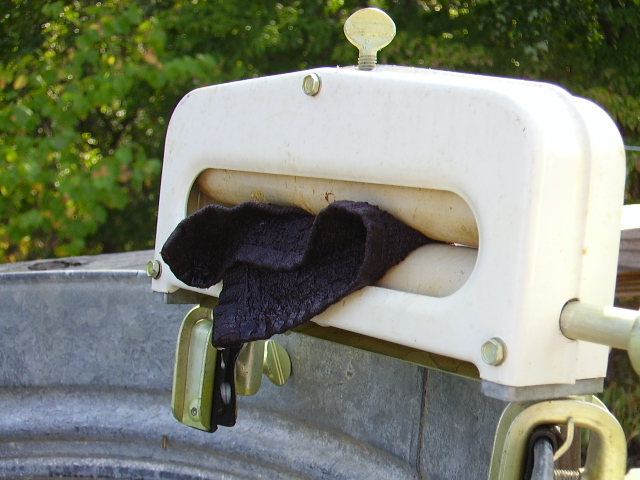
genuine Kenmore wringer on tub
Genuine Kenmore Wringer on Tub

The second-most-viewed post on my site. I cannot figure this, but have loved seeing nearly every week, someone else coming to read this.

Have fun.

My gramma had a laundry wringer. And for a while, so did my mom. I always loved these machines that squeezed the water out of clothing so graphically and intriguingly.

click to view water running off
Click to View Water Running Off

Back then, washing used only one load of soapy water, beginning clean, with white clothing, and proceeded to gradually dirtier and darker clothing and water, until the last thing washed was the dingy dungarees worn to protect the good clothing from animal chores.

no longer dripping
No Longer Dripping

After washing came rinsing, or some said, “wrenching,” which surely they thought referred to the old way of removing extra water, by hand wringing, making the arms and hands feel nearly wrenched out of socket. My gramma put bluing in rinse water to make whites look whiter. I never could understand this substance, bluer than a computer screen, that made things white.

Gramma used homemade soap on clothes. I mean: natural lye made from last winter’s wood ash combined with natural trimmings from natural meat, and yes, she made it herself, on the wood stove in her woodshed, and stacked it everywhere in there to cure. Then she grated it for flakes. It all smelled so fresh and good.

To this day, aroma from homemade soap makes me think of birds calling and locusts scritching combined with comfy sloshy sounds of laundry done during warm laundry days. And my gramma’s voice explaining . . .

The washer, and its accompanying rinse tubs on platforms, rolled creaking out onto the bumpy concrete porch around Gramma’s woodshed. A hose ran first to fill rinse tubs, and later to empty them onto the enormous strawberry patch.

Only large pots of scalding water went into the washer, itself, and yes, heated on that wood stove. All the concrete porches got a scrub-down with used laundry water splashed on, pure and natural.

There were manual and electric versions of the wringer. My gramma had the kind she had to crank and disdained the electric, which could swallow up an arm or break off buttons. She fished clothes out with a stick; the water was that hot. My auntie had one and I didn’t like the noise of it. Besides, cranking the wringer was an honored chore because you had to be old enough to reach and strong enough turn it without let-up.

The wringer and its tray were rotatable to provide also for two tubs of rinse water. Every article of clothing went through the agitation in soapy water, wringing, pouring and dribbling, to kerplunk into the first rinse, and then into the second, before finally being wrung into a laundry basket for hanging on the line.

It seems like so much work, and it was. No wonder laundering was an event with its own day set aside. Imagine dragging all that production outdoors on a daily basis for just one load! Yet, all this was such an improvement over lugging all the laundry to a stream, or boiling it in a huge pot over an open fire.

Yes, it was good, honest work, but that woodshed and that porch were my gramma’s gym and she stayed fit, even into old age. And although she belonged to a gene pool that proved a tendency to plumpness, she always remained trim.

Unlike me.

Posted in Blessings of Habit, Good ol' days, Homemaking, Inspiring, Womanhood

My Grandmother’s Quilts

This is my most visited post, so far. It amazes me that folks come here, most. Enjoy.

I just want to tell you about my grandmother, Laura, this time.

I am a grandmother, and when I was little, I always wanted to be one. When I need inspiration, I remember my grandmother, Laura. Life is so different, now, though.

I know she was elderly because she had arthritic knuckles, gray hair, and a craggy voice. She wore a dress at all times, and she wore shoes with thick, high heels that tied on, sort of like men’s dress wingbacks, perforations and all. Do they even still sell those?

She sewed all her dresses. And sometimes, as a gift, she sewed my mother a dress, too. And she sewed the first dress I ever wore when I was very tiny. I know she made these dresses, because she made a quilt for each of her grandchildren. She did not go to a store for fabric for these quilts. No, she used fabric scraps from sewing dresses. When she made my quilt, she was careful to use many scraps from my mother’s and from my dresses.

I look at the quilt she made for me and I see the dress my mother wore to church in summer. I see a dress my grandmother wore. I see my very first, ever, dress I wore when I was tiny.

I don’t know how my grandmother found the time. She babysat three children, to make an income, because she was widowed when my mother was six. She used her entire, small backyard as a strawberry patch and put up all those berries or traded them for peaches and crabapples to put up. She made her own soap on the wood stove in the woodshed for all washing needs, for clothing, dishes, and bathing. She heated with wood or coal. She did laundry in the woodshed using a wringer washer and hanging it out in summer or in the woodshed in winter, when it froze.

And she prayed. I mean, she really took time out to pray. She would tell us not to bother her while she prayed, she would go to her room and shut the door, and she would pray.

When we visited her, we played with her one box of toys, leftovers from when our aunts and uncles were little. We loved these odd toys that didn’t do anything except prop up our playtime. She let us watch while she made us rolled-out sugar cookies in shapes like stars, hearts, and flowers.  When we asked for colored sugar, she told us it tastes the same. We didn’t believe it.

One wonderful time, I got to sleep with her because I was the oldest and probably would not kick too much. I got to watch her unbraid and comb her hair, which was far beyond waist length. Seeing my grandmother in her gown in the moonlight by the window, combing amazingly long and wavy hair, made her seem to me like an angel. I was in awe.

Then she broke the spell by rebraiding her hair. She never used a rubber band, but simply pulled a strand of hair and wound the end of the braid like a fishing lure. I was filled with questions, then. Why do you braid your hair to sleep? How does it stay in place with no rubber band? I don’t remember her answers, but only my awe and her amusement.

She died about 48 years ago. I still miss her. I still want to be like her when I grow up.

My Grandmother's Quilt
My Grandmother’s Quilt

Here is the quilt she made for me. You can see light red and white tiny checked fabric on the bottom, just right of center. That was my baby dress. It had teensy rickrack on it.

Just right of that is a sort of black and pink Tattersall with pink x’s. That was my mom’s summer Sunday dress for a while. It had white lace at the neckline.

Partly out of view on the left is a white with black swirls. My grandmother wore that. There we all are, in one quilt.

Posted in Blessings of Habit, Health, Home School, Inspiring, Who's the mom here?, Wisdom

All Parents Home School – 3

Still No Escape

No matter which decision we make, we teach them.

Mussolini (left) and Hitler sent their armies ...
Hitler sent armies to North Africa into Egypt against the British

When we keep our children with us so that we can manage their social learning, we teach them that socialization can be done in right or wrong ways. Using the Ten Commandments (talk about mandates-based education!), we instruct as we model for them the only way that works: God’s way.

When they are teens and actually need to socialize, they will walk in right habits of socialization, while turning to us and ultimately, to the God Who guides us, for further instruction.

If we abandon them to learn socialization willy-nilly from the same-aged social misfits that become increasingly more abundant in this world, we still teach them—that no matter how they socialize, that is how to socialize. They will learn that whatever is socially acceptable to their peers is the social lesson for today, and to abandon any semblance to their parents in their quest for some socially “caring” model. They will learn that it is okay to have two mommies.

When we take time to reveal to our children the glories and the tragedies of the history of man, we teach them that we can and must learn from our actions. From Genesis to Revelation, we help them see that God knows the end from the beginning and always has His way.

When they are teens, and learn to care about things on the outside, they learn that today many make the mistakes that wise ones will learn from in the future.

If we trust worldly institutions to handle their history lessons, we still teach them—that the past is unimportant to us. They will not care much about history, either, and in anger, will care even less once it conflicts with God’s Word. They will believe that they came from slime and that the future is debatable, at best, and purposeless at worst and will wonder if Hitler was not right, after all.

When we continue their health classes and physical education into the rest of their childhood, we teach them that our bodies are temples for God. They learn the good stewardship that gives careful attention to the feeding and care of our bodies.

When they are teens, strong and healthy, excited about expending their energy for good purposes, they will be able to say to God, “Here am I…”

If we thrust them into worldly lessons about the body, we still teach them—that the purpose of exercise is to be famous or formidable, and that ketchup is a vegetable. They will converse casually about euthanasia, believe that hormones are insurmountable, and toil under assignments to pretend to be married or expecting. They will grow increasingly comfortable with those conversations, beliefs, and pretenses, too.

More later.

__________________

photo credit: Wikipedia

Posted in Blessings of Habit, Home School, Inspiring, Who's the mom here?, Wisdom

All Parents Home School – 2

No Escape

No matter which decision we make, we will teach them.

English: A young girl kisses a baby on the cheek.

When we keep them at home to educate them, ourselves, we teach them one thing.

If we send them away to receive their education elsewhere, we teach them another, ominous thing.

When we bother to keep our children with us where we can smile at them and watch over them daily, we teach them that we value them.

When they are teens and begin seeing many childhood things from the outside, they learn how important they are to us. They learn how much we cherish them. They learn the value of a child, the value of a parent, and apply this value to their own children, to all children in general, and to themselves, someday.

If we ditch this responsibility along with our children at the front door of some worldly institution, we still teach them—that they are important to the world, which has bothered to take up our slack. They learn to measure the value of a child with the only measuring stick that we have given them and to translate this to the value of all children, foreign, handicapped, and unborn.

When we keep our children with us so that we can give them the gift of reading, just as we gave them the gift of speech years before, we teach them the importance of literacy. When we carefully couple that with reading Scripture, we teach them the reason for literacy.

When they are teens and can read like adults, they learn how important and valuable literacy is, in God’s eyes, and how blessed they are to have Scripture to read.

If we turn them loose to acquire their literacy lessons from the world’s schools, we still teach them—that we do not mind if they learn to read in order to escape reality, to investigate immorality, or to accumulate prosperity. They will read things we do not approve, indeed, do not have a chance to approve. They will not read anything Godly coming from these people who value them enough to educate them.

More tomorrow.

(Photo credit: wikipedia)

Posted in Believe it or not!, Blessings of Habit, Wisdom

I have a confession to make . . .

 . . . I didn’t watch the Olympics.

Olympic Games 2016
Olympic Games 2016 — See what I mean!

At all.

Oh, well, one night while we enjoyed fajitas at the local restaurant, their T.V. was on and we saw a couple of guys dive.
They were good.

But . . .

. . . I felt my blood pressure rising and just decided to be cool. Why spoil a wonderfully fresh meal with nearly naked guys getting wet for fun and/or profit,
albeit very skillfully?

They say everybody who was anybody was watching. I don’t know.

WordPress says those who were not watching are rare.

I am one of the rare ones.

I was busy.

I was enjoying really good food with a really handsome guy.

Other times, I was mowing, blogging, counseling, bathing, cleaning house, sleeping, washing clothes, baking, wrapping gifts,  ironing, helping my grown son move.

Out.

I already have a life.

I already have something to do.

I also did not blog about the Olympics.

Really, some kids competed and somebody won?

Good.

Rumors that it was rigged?

Nothing new.

AS IN: THIS IS NOT NEWS.

Happens all the time.

When they killed a bunch in Germany during the Olympics, that was news.

I really never wanted to watch much, after that.

Rare.

To care.

To dare.

To admit I wasn’t there.

I don’t do football, either.

Nor baseball, unless my grandson asks.

The only sport that really interests me, anymore, is volleyball.

If I get to play.

Your serve.

___________

photo credit: hops_76