Posted in Blessings of Habit, Home School, Inspiring, Pre-schoolers, Who's the mom here?, Wisdom

Remind Me not to Lose My Mind

During the learning phase of acquiring new habits, reminding can be a good help for your children, or even yourself. Reminding goes beyond repetition. We reserve reminding for when we should already know a fact or skill.

Jesus did this from the cross when He called out the first line of Psalm 22, which minutely foretells the Crucifixion. Every Pharisee at the foot of the cross knew He was reminding them of the entire Psalm and its dire implications for them.

The child, who stops interrupting when Mom slightly raises her hand, is using a reminder. The stopped driver, who hears a slight horn tap and then proceeds at a green light, is using a reminder. The newcomer, who consults a photo-directory to recall a new acquaintance’s name, is using a reminder.

The word, itself, “remind,” means “pay attention, again.” We can cause our children to pay attention more often by the simple service of reminding them. Paying more attention can make the difference between knowing and doing.

During difficult memorized recitations, I have reminded my children with signed alphabet initials of tricky words or phrases. A childhood playmate received reminders from her mother in the form of having to return to the door, and open and shut it quietly, 20 times, to overcome door slamming. “Go back and walk,” is a common reminder at our house: Walk, the first time. Occasionally, even a policeman will give a warning instead of a ticket, if he judges that a reminder is enough.

Bible verses posted on the walls of our homes reminded our children of heart attitudes. Educational and health charts did the same for their earthly needs.

Reminders should be gentle because we realize anyone can forget something. Reminders can be exciting to our children, rather than dreaded, if we are willing to take the trouble to make them exciting. Our children are worth that trouble.
duck
Duck!

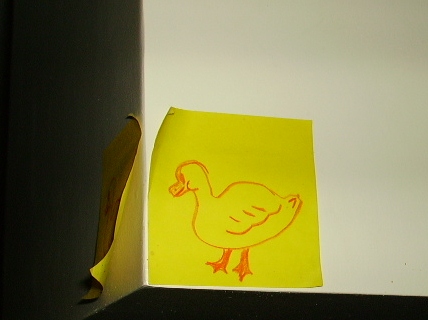
Silly faces on a small poster, can give as much reminder as a cross voice, but with more effect. A bright yellow sticky note hangs on a sharp corner of our cabinets with a drawing of an orange duck on it, to remind passers-by to “duck,” and not hit their heads on that corner. Computers remind us of our fallibility with the “Are you sure” page. The tiny poem, “Thank God for Dirty Dishes,” framed and visible near the kitchen sink, reminded a small, reluctant heart to take comfort at our house for many years.

And I must remind you to remind your children of your love for them with plenty of hugs, kisses, and favors.

More tomorrow.

Posted in Blessings of Habit, Home School, Inspiring, Pre-schoolers, Who's the mom here?, Wisdom

The OUCH Factor — Beginning a New Habit

Foto einer Glühbirne (an),

We do well compared to guppies.

The human brain thrives on habit, grows larger on a diet of routine. The memory inside a human brain is frighteningly complex and magnificently comforting, at the same time.

Our children can reap what God intended from good habits, if, by the time our babies are crawling, they’ve had the pleasure of our instilling good habits into them.

They test us all the time. Why?

TO BE SURE. To make positively sure this boundary will hold and self is safe.

For instance, we know that because of the inherent danger, we should keep them out of the cooking area, so we train them to stay out. Eventually they learn such comfort, but sometimes this is the first clash of wills between the darling babe and the soft mom. It can seem like war, if Mom doesn’t know how to make it happen:

  1. In the beginning, you must teach the child what “hot” means. Use a hot light bulb and tell him “NO—HOT!” Act like you’re preventing him, but let him touch it briefly. Ask if he wants to repeat. If you see unwillingness, it’s a sign the child knows what you mean. If he cries, keep telling him it’s hot.
  2. Anger and yelling do not help. They hinder. Anger has a place, but not in teaching. Yelling is for long distance, loud environments, or extreme emergencies.
  3. Consistent firmness is the key. If you do not have time to be consistent, use a playpen or highchair to confine the child, or enlist a helper. “No” must mean “no”. If you are too lazy to be consistent, think about burn scars on your baby. That should help.
  4. You must not cave in to crying. Crying sometimes is good, but crying to get one’s way is bad. Do not teach the child it is good by rewarding him with his own way.
  5. Draw the line where you want, and make it stick. In our kitchen, one cabinet was permissible, but the rest of the kitchen was off limits, during cooking. At crawling age, a child can grasp this.

We know we don’t want picky eaters and do want well-balanced diets for our children, so we train them to eat. This can be another war, a bigger one, again avoidable, if Mom knows what to do.

  1. Be sure you do not serve food your husband will not eat when he is present. Save it for when he is gone. Be sure he understands this is a time of training, both in obedience and in habit, and you need his backing.
  2. Make a new rule that every person will take at least a bite of every food on the table and eat it all gone, no exceptions.
  3. Anyone who complains about one bite, gets two bites.
  4. All food must be gone, not just pushed around, before getting any seconds or any dessert.

All their lives, my children will be careful around off-limit things and unafraid of green things on the plate. It will be good.

More tomorrow.

Posted in Blessings of Habit, Home School, Pre-schoolers

Do Your Kids Have Habitual Blessings?

“Hey! Turn that back on!”

I heard it bounding from the hallway one day. It had happened again.

We have taught our children, from the time they were young, to turn off lights as they leave a room. Someone had turned out the light while there was someone still in that room.

It was a clear case of what I lovingly call “good habit — bad timing”.

How amazing that the brain, once trained, knows what to do on its own! Eventually we no longer have to think about what to do and how to do it. How unaware we are of how many habits scoot us along our way, every moment!

Imagine if you had to reinvent tying your shoe, each time you did it.

We can turn off a light without thinking, even without looking at the switch. We can be thinking about the next task in the next room while we finish the task in the current one.

The mind is wonderful.

Stretching OutDuring a gym class, as a teen, I heard a phrase worth remembering: “That which is used, develops; that which is not used atrophies.” At that time, I did not know the meaning of the word “atrophy”, so I guessed it meant the opposite of “develop”. Since our family has a motto of knowing, instead of guessing, it bothered me I didn’t know for sure, so when I got home that evening, I looked it up.

Think of all the habits working in this experience:
1. That phrase, repeated in every gym class so I could never forget it, reminded me of the good of learning, repetition, and training.
2. Habitual use of English caused me to guess correctly at the meaning of a word in context.
3. The habit of exercise, itself, gave me a lifelong urge to keep moving, partly spurred on by dread of atrophy.
4. Our habit of accumulating new words and facts inspired me to bother with a dictionary.
5. A family habit of returning a thing to its place enabled me to find the dictionary.
6. A habit of working alphabetically caused me to turn immediately to the front of that huge book for the word “atrophy”.

How difficult it would have been for me to benefit from the experience had I not had all those habits! It takes 21 days for a disciplined person to form a good habit. I was not a self-disciplined person by nature. Nope.

Oh, the drill, supplied by faithful adults who insisted upon good habits in me!

The sad thing is that some children who lack faithful training might be learning to hate exercise instead of fearing atrophy. We have many such children living among us, these days, lacking drill in good habits, and this loss causes many problems. They never reap normal benefits from life’s normal experiences.

They become abnormal.

Our children do not have to be among them, though. The home is the perfect environment for instilling good habits. With 180 days in an average school year, the potential for 9 good habits per child per year presents itself.

Let’s go for it!

______________________

Photo credit: Tyne & Wear Archives & Museums

Posted in Home School, Homemaking, Inspiring, Who's the mom here?, Wives, Womanhood

Later

Okay, it’s later now.

Elijah in the wilderness, by Washington Allston

When I was raising children, my answer to the eternal question about my work phone number — you know, the question that implies you are a check-forger if you do not have a separate work phone number — was: “I am self-employed, so the phone number is the same.” Always got raised eyebrows and curious comments from that. No put-downs for being only a mom.

Nowadays, however, I give my cell number for the work number. Odd the question does not come up so often.

If they asked me, out of curiosity, what I did as a self-employed contributor to the GNP, I often said, “My husband and I manage a home and school for children who would be otherwise homeless.” Boy, did that answer cause awe!

If they asked me more, I just kept on with things like, “Well, the pay is not the greatest, but the perks go beyond money. The satisfaction level is off the charts. Knowing those blessed little ones have a happy place to call ‘home’ just makes my day, especially if they hug me or call me ‘mom’.”

I actually had named our homeschool, ages ago, so when folks asked, I just gave that old name: Cherith Christian SChool and Home. (Yes, we capitalized it wonky, so folks might think to pronounce the first word with a hard “ch”. (Cherith is the brook where Elijah found water and birds brought him food during the time of a huge drought. 1 Kings 17)

Nowadays, when someone asks my profession, I tell them I am a retired educator and textbook writer. No one usually ventures beyond that because most people know not to mess with a teacher.

But if they continue in this line, I tell them I have taught all grades and the textbooks I wrote were for high school level literature. Sometimes I insert, here, my years of magazine writing. That usually stops them. If it goes further, though, I begin discussing the scope and sequence of the literature texts, and of my favorite stories from ancient literature. (Did you know the story of Joseph in Potiphar’s house appears in the ancient Egyptian literature?!)

Or I tell them of some of the difficulties, such as translating haiku into English, which really does not work. (English poems that purport to be haiku are almost always not, actually.)

Or I explain the topics of the magazines I wrote for: child raising, education, etc.

Folks usually become overwhelmed, long before I have finished my speech, or else I end up having a great discussion with someone who actually knows this stuff and cares, which is always fun.

But, heaven help them, if they ask, “Do you work?”

I’m toying with the idea of saying, “No. I’m a big fat zero. The only thing I’ve ever accomplished is turning five illiterate humans into productive members of society.”

Just once, I’d like to see the response to that.

Posted in Home School, Homemaking, Inspiring, Sayings, Who's the mom here?, Womanhood

One Mom’s Description

Ballpoint pen writing. Streaks of ink are visi...

I couldn’t believe my eyes and my mouth hung open while I read this. Then the chuckling began and grew until I was laughing too loudly for the library. This is great!

Found on the Internet:

A woman named Emily, renewing her driver’s license at the County Clerk’s office, encountered a woman recorder demanding to know her occupation. She hesitated, uncertain how to classify herself.

“What I mean is this,” explained the recorder, “do you have a job, or are you just a . . . “

“Of course I have a job,” snapped Emily. “I’m a mom.”

“We don’t list ‘Mom’ as an occupation. ‘Housewife’ covers it,” said the recorder.

I forgot all about her story until one day I found myself in the same situation, this time at our own Town Hall. The clerk was obviously a career woman, poised, efficient, and possessed of a high-sounding title: Town Registrar.

“What is your occupation?” she probed.

What made me say it, I do not know. The words simply popped out. “I’m a Research Associate in the field of Child Development and Human Relations.”

The clerk paused, ball-point pen frozen in midair, and looked up as though she had not heard right.

I repeated the title slowly, emphasizing the most significant words.

Then I stared with wonder as my pronouncement appeared in bold, blue ink on the official questionnaire.

“Might I ask,” said the clerk with new interest, “just what you do in your field?”

Coolly, without any trace of fluster in my voice, I heard myself replying, “I manage a continuing program of research, in the laboratory and in the field (normally I would have said ‘indoors and out’.) I’m working on my Master’s, and already have four credits (all daughters.)

“Of course, the job is one of the most demanding in the humanities, (any mother care to disagree?) (any dad care to disagree?) and I often work 14 hours a day (24 is more like it.) But the job is more challenging than most careers and the rewards are more of a certain satisfaction rather than mere money.”

There was an increasing note of respect in the clerk’s voice as she completed the form, stood up, and personally ushered me to the door.

As I drove into our driveway, my glamorous new career buoying me, three of my lab assistants – ages 13, 7, and 3, approached to greet me. Upstairs I could hear our new experimental model (the 6-month-old baby,) in the child-development program, testing out a new vocal pattern. I felt I had scored a beat on bureaucracy!

And I had gone on the official records as someone more distinguished and indispensable, to many, than “just another mom.”

Motherhood – what a glorious career! And what fun to have a title on the door!

Does this make grandmothers “Senior Research Associates in the field of Child Development and Human Relations” and great-grandmothers “Executive Senior Research Associates?

I think so.

I also think it makes aunts “Associate Research Assistants”.

May the wind sing to you and the sun rise in your heart!

Please forward this to anyone you want.

And what about you? Can you make up some clever response for this age-old competition/comparison?

How do YOU answer when they want to know if you work, where, or your work phone number? Later, I will post my usual answer(s).

____________________

photo credit: Wikipedia

Posted in Home School, Inspiring, Who's the mom here?, Wisdom

All Parents Home School – 4

Mom at work

The Excuses

For what they’re worth

As for our excuses, well…

If we abandon them for a second income, we teach them that money is more important than people are.

If we abandon them for our own “career”, we teach them that motherhood is not worthy of consideration as a career.

If we abandon them for their younger siblings, we teach them that it is okay to start something, something as important as a person, and then not finish it.

If we abandon them for the sake of our sanity, we teach them that God’s grace is not sufficient.

If we abandon them—or if we home school them—we teach them. There is no way out; we have to.

We have to live with the results, too.

_________________________

photo credit: adventurejournalist

Posted in Blessings of Habit, Health, Home School, Inspiring, Who's the mom here?, Wisdom

All Parents Home School – 3

Still No Escape

No matter which decision we make, we teach them.

Mussolini (left) and Hitler sent their armies ...
Hitler sent armies to North Africa into Egypt against the British

When we keep our children with us so that we can manage their social learning, we teach them that socialization can be done in right or wrong ways. Using the Ten Commandments (talk about mandates-based education!), we instruct as we model for them the only way that works: God’s way.

When they are teens and actually need to socialize, they will walk in right habits of socialization, while turning to us and ultimately, to the God Who guides us, for further instruction.

If we abandon them to learn socialization willy-nilly from the same-aged social misfits that become increasingly more abundant in this world, we still teach them—that no matter how they socialize, that is how to socialize. They will learn that whatever is socially acceptable to their peers is the social lesson for today, and to abandon any semblance to their parents in their quest for some socially “caring” model. They will learn that it is okay to have two mommies.

When we take time to reveal to our children the glories and the tragedies of the history of man, we teach them that we can and must learn from our actions. From Genesis to Revelation, we help them see that God knows the end from the beginning and always has His way.

When they are teens, and learn to care about things on the outside, they learn that today many make the mistakes that wise ones will learn from in the future.

If we trust worldly institutions to handle their history lessons, we still teach them—that the past is unimportant to us. They will not care much about history, either, and in anger, will care even less once it conflicts with God’s Word. They will believe that they came from slime and that the future is debatable, at best, and purposeless at worst and will wonder if Hitler was not right, after all.

When we continue their health classes and physical education into the rest of their childhood, we teach them that our bodies are temples for God. They learn the good stewardship that gives careful attention to the feeding and care of our bodies.

When they are teens, strong and healthy, excited about expending their energy for good purposes, they will be able to say to God, “Here am I…”

If we thrust them into worldly lessons about the body, we still teach them—that the purpose of exercise is to be famous or formidable, and that ketchup is a vegetable. They will converse casually about euthanasia, believe that hormones are insurmountable, and toil under assignments to pretend to be married or expecting. They will grow increasingly comfortable with those conversations, beliefs, and pretenses, too.

More later.

__________________

photo credit: Wikipedia