Good News for the Romeikes, for a Change


English: The Fall of the Berlin Wall, 1989. Th...
The Fall of the Berlin Wall, 1989. The photo shows a part of a public photo documentation wall at Former Check Point Charlie, Berlin. The photo documentation is permanently placed in the public.


A startling change in events for this poor beleaguered family is on the horizon. Read about it here.


I find this encouraging.


Hope you do, too.


Posted in Home School, Inspiring, Wisdom

Overheard – Patience in Affliction

Be patient, then, brothers, until the Lord’s coming. See how the farmer waits for the land to yield its valuable crop and how patient he is for the autumn and spring rains. You too, be patient and stand firm, because the Lord’s coming is near. James 5:7b-8

The farmer waits. Crops must germinate, grow, ripen. So must your life. Wait.Faking patience. Our own thinking tells us, of course, the lack of affliction causes us to act patient.

That is true.

And as long as all we are concerned with is acting the part, a lack of affliction will suffice.

True patience. The Word of God has a different take on it.

God says we need affliction, troubles, problems, even suffering, in order to learn true patience.

Fake patience will evaporate in any trial. And trials will come.

You know it, too: No pain, no gain, right?

James uses the farmer to illustrate the necessity of waiting and the reward for patience.

When a farmer plants his seeds, he knows that he will have to work and wait before he will see the fruit of his labor. First he tills the ground. Then he plants seed and prays for rain. In a few days he sees something coming up through the ground.

What would you think of a farmer who harvested his crop after those few days’ growth? Would he have anything worth eating or selling?

No, he needs to wait more, be patient more. He wants a strong, mature crop. That takes time. He has to work—tilling, weeding, irrigating—and wait until the process is complete. If he harvests too early, he will ruin it.

Parents must be patient too.

The first nine months seem to go forever. It’s a difficult wait, but a good chance to do the work of accumulating baby supplies. The next few hours of working and waiting for delivery to be over can seem like forever, too. We do warp time, don’t we!

But immediately after that all waiting is over, right? Wrong.

It’s time for a different time warp.

Parents work for years, caring for a child and instilling in him the training, discipline and encouragement he needs to mature enough to survive on his own.

Sometimes it seems like one step forward and two steps back. After all, they DO say we spend two years teaching a child to walk and talk, and the rest of their lives teaching them to sit down and hush. Heh heh.

It’s that way for every parent. Do not think for one minute that if you ditch your child, you will relieve yourself of the waiting, of the work of learning patience. You don’t really know patience unless you’ve waited for a prodigal.

Yes, child-rearing takes patience. In the same way, our Father is patiently training, disciplining, encouraging, and maturing us—through our afflictions—to be more like Jesus.

Perseverance must finish its work so that you may be mature and complete, not lacking anything. James 1:4

As we anticipate the rewards of patience, we can endure whatever happens in our lives. We can cope when we remember that heaven is forever and earth is passing. When the ground is shaking all around us and we are tempted to despair, we know God loves us and is with us. We can be patient because we know Jesus will come again and all bad things in life will finally be set right.

We do not merit any blessing from God, regardless of our personal right-doings. All blessings come from God’s mercy, and without God’s mercy and compassion toward us, we would be at Satan’s pleasure all the time and life on earth would be like Hell.

As it clearly is, for some people.

Same for our children. We love them and show them compassion, supplying their every need, for no reason other than our loving mercy. When we do not, their lives are like hell.

Never forget that.

If we want the blessing of whole adult offspring, we must humble ourselves and patiently endure the working and waiting.

The masses…

As a farmer waits for germination, growth, and ripening, so we must wait for our lives to show progress.

Most people today are characterized by impatience and love of ease. They are motivated by immediate and shallow rewards. They seem unwilling to work and wait. They are lured by lottery, credit card debt, and get-rich-quick schemes. They look to preachers who will feed this attitude, teaching Godliness as a means of gain. They have itching ears.

Quitting seems easier.

We should work and wait for the autumn rains. Really.

Don’t quit.

Especially do not quit on your family.

Posted in Home School, Inspiring, Pre-schoolers, Scripture, Wisdom

Overheard: Filling Your Bucket

The preacher said:

Let’s think about a bucket, some rocks, and some sand.

Let’s say the rocks illustrate our priorities, our bucket list, and the bucket represents our life. The sand represents all of the other things in life that we have to do.

What happens if we put the sand in the bucket first?

We cannot fit all the rocks in, can we?

Our priorities find themselves crowded out.

However, if we put the rocks in the bucket first, the sand sifts around the rocks. They fill in the cracks or the time we have left after our priorities are accomplished.

A woman in a traditional Icelandic costume tea...
A woman in a traditional Icelandic costume teaches a child to read. (Photo credit: Wikipedia)

Let’s apply that to our “how-to” ideas about home schooling, shall we?

Our priority must be that each human being on this earth should learn to read. Why? Because of Habakkuk 2:2 “[…]the Lord replied: ‘Write down the revelation and make it plain on tablets so that whoever reads it may run with it. […]’”

It is recorded forever in the Word of God, that He expects reading to happen. The very fact that He inspired men to write to us, logically leads to His expectations that we read.

Learning to read does not always happen in some educational settings. The child who is slow to read might never learn in some settings.

We, however, in our own homes, have the privilege of customizing the curriculum to fit the child who needs his schoolwork to come at him from a unique angle. We can drill one phonic concept for two days, if needed. We can read while pointing to allow “sight reading” to materialize. We can try glare management, page masking, and many other techniques, at will. No matter how good a teacher might be, she can hardly do this when she is dealing with 20 new readers at once, can she?

So we prioritize reading.

As the student ages, the obvious may surface, that the child is unable to learn to read. “Unable” is not the same as slow. After a couple of years, if reading is not happening at all, no matter what, then it is time to dump the bucket out and rearrange priorities. The new priority is to make sure literate content reaches this child’s mind through whatever means it takes.

Any writing can be found or created in the audio format.

It becomes the teacher’s duty, then, to provide this input. Although this is a big job, it is not too difficult for one mom with one child, but imagine a teacher of 20 handling it. It’s unfair to her, right?She wants a life, right? But you can do it. In fact, these helps become your priority: They are your life. So at this age, we insert any learning that is age-appropriate, especially Bible, math, and science, always in the audio format. Often, this is how our greatest minds have emerged to benefit mankind. Often, those not programmed to read well, find far more capacity in other disciplines than a good reader does. Although we never stop trying to impress reading skills upon our students, and although they may learn to read as adults, we insist they learn the essentials through whatever means necessary, always looking for that one thing that will be the spark for your own child’s chance at brilliance.

Make a list. Prioritize the big rocks to go into the bucket first.

Yes, you can make a child live happily ever after. That’s a good goal for a life, don’t you think?

Posted in Home School, Inspiring, Who's the mom here?, Womanhood

Remembering a Missing Friend

Remember this?

A dear friend of mine died during elective surgery, 12 years ago.

English: Flower arrangement for funeral Dansk:...
Flower arrangement for funeral (Photo credit: Wikipedia)

A home-educating mom, she left behind two young children and their faithful dad. Last time I saw them, the kids were doing fine. Actually, they were not so young anymore, then, one in high school and the other in college. They showed many signs of good parenting. It made me glad for the memory of their mother, my friend.

She had always been so heart-felt. She and I could talk about any serious subject and seemingly always understand each other before we had completed a sentence. When a subject was especially deep or important to her, she would become misty-eyed as she spoke. That happens to me, too, and often did when we conversed. We both understood that about each other.

This seriousness in her shows in her children. Oh, they laugh. In fact, their beautiful smiles erupt at any chance, and they see the humor in life’s oddities, all the time.

They are not silly, though. They are something more like blossoming or fruitful. They have combined the gentle rain their dad always supplied into their lives with the sunlight their mother always added. They have become strong, tall trees and have dedicated their lives to doing right. It makes me glad for the memory of their mother, my friend.

Somewhere out there exists a video of her delivering an impromptu speech about her strong convictions on homeschooling. She is near tears as she speaks for the record, as I was every time I viewed it. She pleaded with parents to take their children seriously.

This distillation of her heartbeat riveted me to my seat on every viewing. She was younger than I was, then, far younger than I am now, yet her bold insistence on protecting and preparing children imparted strength to my backbone. Only a hardhearted person could walk away from the truth she expressed without pondering, at least, if there might not somehow be more…

She makes me want more, every time I remember her. More grace. More energy. More conviction. More boldness. More follow-through. More prayer. More tears when I talk.

More blossoms and fruit on my trees.

More sun and rain on my trees.

More.

Posted in Believe it or not!, Home School, Who's the mom here?

Please Follow This and Act. Thanks.

Location of Uberlingen
Location of Uberlingen*

In January of 2008, the Jugendamt (Germany’s youth welfare office) and police officials surrounded the Gorber family’s Uberlingen home in a surprise raid. Mr. Gorber was away from home at the time of the raid, visiting his wife at a local hospital where she had been admitted, due to complications from her pregnancy with their ninth child. Despite the children’s repeated protests, all but the oldest son, age 21, and a daughter, age 20, were taken into custody by the authorities.

The siblings reported that the 7-year-old was gripped around the waist by a youth home music teacher, dragged kicking and screaming across the courtyard, and thrown into a van. The terrified 3-year-old clung to his 20-year-old sister so tightly that even the police and Jugendamt official could not separate them. Both had to be taken to the youth home, where at last the little fellow’s strength gave out and he was taken into custody. [ . . . ]

Read more here.

[ . . . ] This is especially out of the ordinary when nearly all other western European democracies allow for homeschooling by either constitution, law, or practice. Even formerly communist eastern European countries are loosening up their laws and regulations to allow homeschoolers freedom. Far from escaping the rigidly uniformitarian ideas about society that prevailed in Hitler’s Germany, today’s authorities seem to be perpetuating it through their treatment of German homeschoolers. [ . . . ]

Read more here.

The article behind the links, here, will lead you to what we can do. Your signature is needed. Go there. Thanks.

*photo: Wikipedia

Posted in Guest Post, Home School, Inspiring

Great Guest Post! – Why Teach Your Child to Draw?

Ruth, from Ruth Bailey, artist, left a comment on one of my posts, a while back, and I again have been able to catch that big “click” the moment it happened, this time for my 3400th comment.

I know, it’s been a while coming. Ruth is a great watercolorist and was in the middle of an amazing commission, that busied her until recently.

I am so glad she is back!

Since Ruth is no stranger to home educating, I asked her if there were anything she might like to write for us about art in the home school.

She has graciously provided us with some great tips I really wish I’d had 20 years ago.

Read, enjoy, and learn! And please go look at her gentle but brilliant art

Why Teach Your Child to Draw?

I believe that teaching a child to draw should be a part of every home-school curriculum.

Drawing is well suited to the home-school curriculum since it can be taught inexpensively, in short or long time segments, requires few extra materials, and the skills can be learned by anyone with enough dexterity to write their name.  Drawing uses and develops the brain in ways that reading, writing, math, social studies, and science do not. Drawing uses non-verbal thinking skills and spatial relationships, while encouraging creativity, alternative problem solving strategies, and intuitive responses.  Drawing also aids in teaching math skills since it involves the complex mathematical concepts of angles, measurements, graphing, and ratios.  Drawing gives children and adults another language in which to express themselves and is pleasurable and fulfilling in itself.

Coffee With My Granddaughter

Typically, young children start learning to draw by experimentation.  They scribble on paper, enjoying the power of making marks.  After a while they begin to assign meaning to scribbles, saying that this mark is “the dog,” or “daddy,” or “a birthday cake.”  As their dexterity increases, they often adopt a symbol system, drawing stick figures, which get more complex as the child gets older.  Sometimes these symbols are mimics of drawings by adults (who insist that their own drawing skills are inadequate).  As children learn verbal language by example, experimentation and encouragement before learning any of the “rules,” they can learn the language of drawing in the same manner.  This means giving them exposure to a variety of materials and time to explore.  Paper and pencils, pens, crayons, markers, simple (non-toxic) paints, cotton swabs and food coloring, glue and bits of colored eggshells, etc. are typical household items that can be used.  If a child expresses frustration or a desire to go further with drawing, I suggest enrolling the child in a class or trying out Mona Brooke’s book Drawing With Children to learn some formal drawing techniques.

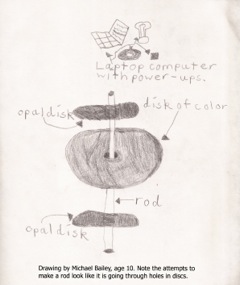
Michael's Picture

Sometime around age 10 (fourth or fifth grade), a child’s brain goes through a “growth spurt” with an increased integration across the right and left hemispheres.  This growth often leads to dissatisfaction with the difference between what is observed and the symbols used in drawings.  Some children break through their established symbol system and are able to create realistic drawings at this time with little or no instruction.  These are the children who are labeled “gifted artistically” or “talented.” Unfortunately for the others, this is the time when a child will give up on drawing, frustrated with his inability to make the drawing look like he wants it to, and calling his own efforts “stupid.” However, realistic drawing skills can be taught, and learned (by adults as well as children).  There are many classes available to teach non-drawers to draw, and many books written on the subject.  One of my favorites is Betty Edward’s  The New Drawing on the Right Side of the Brain.  Although the exercises in this book are not difficult for a child, children in elementary school would be helped by having an adult supervise and explain the material.  Going through the material together is an ideal home-school activity.

With the foundation of being able to draw realistically, a child (or an adult) can then continue the exploration and experimentation process, drawing from reality, memory, or fantasy.

I wish you many satisfying hours, teaching your child to draw, and learning to draw, yourself!

Noah's Ark
Noah’s Ark

Ruth Bailey is a home-school mom who, now that her children have all graduated from high school, fills her days with painting watercolors, sailing on the Chesapeake Bay, and traveling with her husband.

You will love it at Ruth’s! Go there!

And check out one of my favorites of her many posts here!