 You know one.
Or you’ve seen one.
Maybe you have one, or even were one.
It’s such a challenge to the mom, to get good, health-giving food down into picky tummies.
You wonder if this child will be damaged by such a bland diet as potatoes and milk, the only two foods he really likes.
You wonder, also; over and over—what to do, what to do.
So, here we go, The Answers You Need:
1. Is this child around four years old?
The child walking through his fourth year is typically not growing much. You know: growth spurts. We think he’s not growing because he refuses to eat, but it’s the other way around. The fourth year is tough on kids. They don’t grow, they suffer emotional fears and imagined rejections. And someone is always chasing them with more food!
The solution I’ve found very helpful is to put only one bite of everything offered at the meal on the child’s plate, and require cleaning his plate. After that allow whatever seconds he prefers. Also, keep the drink cup out of reach to be handed to him for sips, to prevent what my mom used to call “drinking your meal”.
In this way,
—the tiny bit he does eat will have some balance to it
—drinks will be used to fill gaps in the tummy after a bit of yummy solids are in place, first.
2. Is this child lacking vitamins?
Well, of course, probably, right? The thing you might not know, though, Mom, is that as a child’s digestion slows, so does the amount of nutrients in his body. But then, oh bummers, there are certain nutrients which actually boost a person’s appetite. So we find it a vicious cycle that not eating diminishes nutrition, which diminishes appetite.
The obvious solution, once you think of it, is some fun, mild vitamin made especially for kids. I’d hop on that at once, if I had a low volume/picky eater.
3. Next, have you spoiled his appetite?
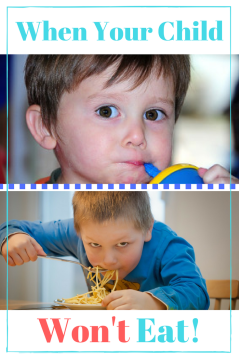 Ooh, I do not like this question, either! However, when hunger strikes, a child can be so dramatic and we let the drama push us around. We hand off a graham cracker or something to pacify this emotional child, which makes him not hungry at mealtime, which makes him hungry before the next meal, which . . .
Solution? Okay, so just don’t allow snacking. My mom used to tell me that her mom used to tell her to take a big drink of water and put out the fire. This dilutes stomach acid, truly quenching that burning feeling we so glibly call “starving!”. So the child is hydrated but still able to summon hunger when the meal is served.
4. No offense, but really, is the food good?
If it’s not home cookin’, that could be half the problem. All that stuff we buy in a box and nuke, like Jane Jetson, isn’t really food. Oh, it says on the label that it’s food, but if we read closely, we see that probably all the non-pronounceables in the package also add some sort of flavor. The microwave definitely does something to texture, believe me. We’ve been lied to, but children are experts at sniffing out fakes . . .
For a lovely solution, try cooking, once, to see if that fixes the problem. Add a pinch of salt, and maybe a slight slick of real butter. You might be surprised!
5. Even better yet, teach your child to cook.
Cooking the food transfers pride of ownership and true appreciation to the child’s heart. I remember when our daughter prepared her first, ever, entire meal. We sat down to eat and she told me, “Now I know, Mom, why at every meal you always say, ‘It feels so good to sit down.'” Ah, the sweet sound of appreciation! And attention to the duty of complimenting the cook by eating!
Letting the child cook or even help cook is its own solution.
6. Meal planning!
The child who is taught, not only to cook, but also to meal-plan with good nutrition education in mind, will become more adventurous in food choices and acceptance, by nature. An amazing government document entitled Nutritive Value of Food is available as a pdf and allows easy research for a balanced diet, including recommended daily minimums.
I have found it a constant. It is such a joy that when a child discovers, for himself, that a food has nutritive value. He becomes more dedicated to liking it. Yes, that slight attitude change can make that much difference, enough to be a solution to it all.
Okay, there you have it!
I’ve tried all six of these tacks with my little (and not-so-little) picky ones and they all have learned to cook real food and to love when someone else does. They like almost all foods and even know how to take the “one bite” (from when they were four, haha) to show politeness. Hope you find something in this to help you down the road to raising better eaters, too!
Oh, and please add to these ideas for all of us, in the comments below, if you want! Thanks!

 What you will see is plenty of reasons to think that the grass in greener on YOUR side of the fence, too., and that others could easily fall down the same slippery slope that you have, if they were looking at you and doubting themselves.

 This week we will study from the questions of others, what to do, how to do it, and why. Hope you enjoy this and learn lots from it. The first letter is from a woman who was so scared, she set up a new email account so she could be anonymous. I’ll call her “Jane”.

 I managed a house full of boys most of my life. With one girlie sandwiched in between them all.


 Home's Cool!