Just read a darling story about a guy who was, like me, a writer, but, who, not like me, had one published book under his belt and another on the way. He wrote of his old publisher doing something really unethical on the new book, and of having to insist it be recalled while he apologized to a certain famous person.
The famous person wrote him back with words of forgiveness.
His point was that it was wrong to have worried about this blunder, to have recalled the book, and to have written the apology.
I disagree.
While it is, truly, wrong to worry, it also is truly wrong to allow people to walk all over you and to let the mistakes you have allowed to damage others.
A Little Sweat Is Right and Good
The recall was right. The apology was right. The forgiveness was an act of mercy, which I do applaud, but the assessment of the whole ordeal was wrong.
It is right to attempt to undo a wrong. It is right to apologize. It is right to let those who would use you and put you in a bad light know you will not sit down for it.
I don’t know where this author went with the final outcome. I mean, did he use the same publisher, again? I don’t know. Did his relationship with the famous person grow and bloom or wither and die? I don’t know.
But I do know that, aside from the worry, he did the right thing.
And I might have worried a bit, too. Or at least prayed.
Which brings us to college debt forgiveness.
I am thinking I’ve lately read a wonderful solution to this lovely problem.
Folks may be thinking: what problem? There’s a problem? All these kids are getting out from under the huge burdens they were carrying from college. That’s a problem?
Yes.
It’s a problem to any parent who watches a CORRECTLY brought up kid paying down debt, working and going hungry during their college years, in order to make a debt-free life for himself.
It’s a problem when a parent’s coffers are dwindling from having kids in college, while taxes go up to pay for other kids’ college debt and half of them are not even in college.
Yes, it’s too expensive. They knew that going in.
Yes, debt is a heavy burden. They needed to learn that before they got out.
Yes, I think forgiveness is primo.
I just think it’s not about debt, it’s not about the price of college, and it’s not really about forgiveness.
Not about Debt?
You see, there will still be debt. Yep, it’s been passed around to us, who paid our own down, already. We’re all now in debt because today’s youth is stupid. YOU, dear reader, are in debt now, instead of them. Fine solution, I’d say.
Not about the High Cost?
The price of college is not going anywhere, and especially not going anywhere lower. If there is debt forgiveness legislated into our possibilities, then why lower the cost, hmm? Also, one huge factor many refuse to address in this equation is the fact that many families of high school grads did count the cost when they enrolled their children in a college, and then after they were locked in, the cost was raised. A contract was entered, a verbal agreement to a certain price, and then the rug was pulled. That can be so crippling.
Last, but not least, it’s not about forgiveness.
What is forgiveness?
I can start by saying what it is not. It is not saying, “Oh, it’s okay.” It is not okay with me, at all. My money is going to pay for someone else’s flagrancy, with no assurance it will not be repeated soon. I was not even asked and given the opportunity to forgive. I was only notified I’d be the one paying for someone else’s “feelings” of forgiveness. How can that be forgiveness?
Forgiveness is not “excuses”, either. Sure kids are financially ignorant. Sure they need cash to buy their new music, etc., so why save any to spend on school. Sure (Oh, MY!) they didn’t know they’d have to pay it back. Sure they … name your excuse. They couldn’t help it. Sure. I believe that. That is not forgiveness. Is not even a CALL for forgiveness. It’s just a statement of several tiring facts. Facts of life that no one knows are not forgiveness, not a sign of it, even. They’re just a long list of what’s wrong, here.
Forgiveness is not trusting. Hoo, boy, don’t get me started. If trusting is forgiveness, then I’m the one that is being forgiven because we’re all trusting I’ll pay for the crazy. If I will, then I’m the crazy one, I think. But since forgiveness does not include trusting, I TRUST we’ll NOT trust these kids to try again, to accrue more debt again, for them to trust we’ll pay again?
I’d love to help you pay your debts, really I would, but I think they’d rather I be in debt, myself instead. Sorry.
Found an amazingly helpful post today at one of the curriculum providers we discuss on this site!
I totally wish we’d known all this about two months ago!
Hope you enjoy!
“Because printing is central to the use of the Robinson Curriculum I know a lot of you have questions as to which printer would be best. The good news is that technology is now delivering the ideal printers at a lower cost than ever before. Someone said that the power of the press is for those who own one – and have something worthwhile to print! Your computer, one of these printers, and the Robinson Curriculum give you that power.”
If a child continuously needs reminders, “forgets” on purpose, he needs more than another reminder.
He needs requirements.
Children do not automatically walk in goodness, contrary to popular opinion.
Some want to stay in bed in the morning.
Some want to skip brushing their teeth.
Some want to play during chore time.
Dogs eat a lot of homework. We know it is better for them if they have good sleep, cleanliness, and work habits. Our good plans for them cross their wills. That is why God put them in homes with parents.
Parents can place requirements on children for their own good. This is common knowledge in all cultures, except the permissive. People who follow the original ways of requiring children to act sensibly, have produced sensible offspring.
Stating the obvious is necessary, these days. I believe my children will always practice brushing their teeth daily, because they are accustomed to having white, clean-feeling teeth, so brown, fuzzy teeth bother them. The same is true for bathing, eating healthful foods, and Bible reading. Oh, they may experiment with departure from the absolute best, but they also will sense a difference, a loss, and choose the right way.
They are not born this way. We require it of them.
The child who habitually eats cake and cola will not sense the ill feeling from it in adulthood. The child who habitually reads anything but the Word will not miss the Word as an adult. The difference between those generalities is most usually the differing requirements they faced as children.
Who wants to raise a loud, interrupting, unhealthy, illiterate adult with crumbling teeth and no knowledge of the sacred? Draw your lines and require your children to heed them. Help them have the excellent gift of good habits.
During the learning phase of acquiring new habits, reminding can be a good help for your children, or even yourself. Reminding goes beyond repetition. We reserve reminding for when we forget to think and should already know a fact or skill.
Jesus did this from the cross when He called out the first line of Psalm 22, which minutely foretells the Crucifixion. Every Pharisee at the foot of the cross knew He was reminding them to think of the entire Psalm and its implications.
My God, my God, why hast thou forsaken me? why art thou so far from helping me, and from the words of my roaring? . . . But I am a worm, and no man; a reproach of men, and despised of the people. All they that see me laugh me to scorn: they shoot out the lip, they shake the head, saying, He trusted on the Lord that he would deliver him: let him deliver him, seeing he delighted in him. . . . I am poured out like water, and all my bones are out of joint: my heart is like wax; it is melted in the midst of my bowels. My strength is dried up like a potsherd; and my tongue cleaveth to my jaws; and thou hast brought me into the dust of death. For dogs have compassed me: the assembly of the wicked have inclosed me: they pierced my hands and my feet. I may tell all my bones: they look and stare upon me. They part my garments among them, and cast lots upon my vesture.From Psalm 22
It had to make them think.
The child, who stops interrupting when Mom slightly raises her hand, is using a reminder. The stopped driver, who hears a slight horn tap and then proceeds at a green light, is using a reminder. The newcomer, who consults a photo-directory to recall a new acquaintance’s name, is using a reminder.
The word, itself, “remind,” means “pay attention, again.” We can cause our children to pay attention more often by the simple service of reminding them. Paying more attention can make the difference between knowing and doing.
During difficult memorized recitations, I have reminded my children with signed alphabet initials of tricky words or phrases.
A childhood playmate received reminders from her mother in the form of having to return to the door, and open and shut it quietly, 20 times, to overcome door slamming.
“Go back and walk,” is a common reminder at our house: Walk, the first time.
Occasionally, even a policeman will give a warning instead of a ticket, if he judges that reminder is enough.
Bible verses posted on the walls of our homes remind our children of heart attitudes. Educational and health charts do the same for their earthly needs.
Reminders should be gentle because we realize anyone can forget something.
We can make reminders exciting to our children, rather than dreaded, if we are willing to take the trouble to make them exciting. Our children are worth that trouble.
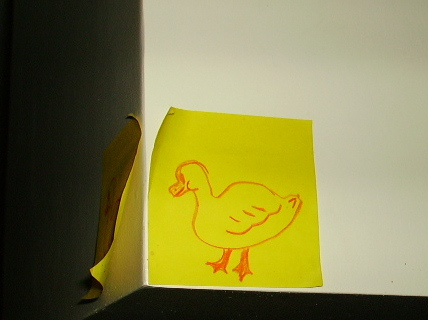
Silly faces on a small poster, can give as much reminder as a cross voice, but with more effect. A bright yellow sticky note hangs on a sharp corner of our cabinets with a drawing of an orange duck on it, to remind passers-by to “duck,” and not hit their heads on that corner.
The tiny poem, “Thank God for Dirty Dishes”, framed and visible near the kitchen sink, caused comfort in a small, reluctant heart at our house for many years.
The doormat with the motto, “Wipe your paws” is a fun way to help them remember.
And I must remind you to remind your children of your love for them with plenty of hugs, kisses, and favors. ❤
Not so very long ago, (about thirty years, or so) we began homeschooling in the middle of the school year.
It can be tough.
Or it can be total joy.
Or it can be both.
I’m here to encourage you: You can do this. You can make it a beautiful combination of toughness and joy.
How it is with your child’s new school!
I can show you how.
What follows are links to a five-part series of actual steps you can take to maximize your experience, and your student’s experience, as you wander through this new land called “Homeschool”.
For better or worse (It’s better, I promise!) you are now the 100% proud owner of a somewhat used child. Here’s how to spruce up your new acquisition and enjoy a great start-up and lots of remaining miles!
When you have a couple of weeks behind you, start taking a closer look and planning for the entire journey. No sense in running out of gas or getting lost. It’s time for detailing and getting a map.
Changing the oil; getting the junk out of the radiator, and a decent set of tires can make all the difference in the world! You’ll go further and be more sure of arriving at all!
Those who get the most out of any trip are those who invest their entire beings into it. Is it time for you to make a major investment of your whole heart?
As an old song goes, the very beginning is a “very good place to start”.
Once my husband and I saw the need to educate our children at home, though, we began in the middle. We were not wise enough to see the need at the very beginning of that school year. Soon after that, we became too desperate to wait for another beginning.
We were what I like to call “middlers”.
After counseling several moms who have made this choice, I would like to share a good way to succeed at it. First, let’s look at the dilemma—how we felt (and how I have found that most people feel) in this predicament:
Scared. God says, “Fear not,” but we fear anyway. When you begin in the middle, you have greater temptation to fear. Often you have not deliberated, planned, and shopped for an entire summer. You fear that you are panicking, rejecting the status quo. Rather than simply not showing up, as most new home schoolers do, you must face irate professionals who think you are stealing their children, or worse, their money. This can be scary.
Uninformed. Some worldly systems neglect to tell you many significant things. You perhaps do not know what your child has studied and more importantly, how well he actually did. You may not understand achievement tests. Sometimes it is to the teacher’s advantage to keep parents at a distance. Other times, it just happens. How can you know what has been happening when you were not there? They taught, but did your child learn?
Without vision. All you know is that the current arrangement is not satisfactory and that you must devise a new strategy. You simply do not know what it is, yet. Perhaps you feel the Lord will lead, but perhaps He is waiting for you to take that first step…. How can you know?
Wounded. Usually, the decision to begin in the middle springs from hurtful happenings. Your child was failing, the teacher was angry, the other students were cruel, or whatever. Do not deceive yourself into thinking that such enormous circumstances have not touched you personally. What is more crucial, do not think they have not touched your child. Such situations can hurt a lot, and they can hurt a long time.
Distracted. It may feel like a thousand voices are shouting at you, now. Your families, your “teachers”, your neighbors, and maybe even your friends are telling you something, and usually it is not something helpful. Total strangers will feel compelled to voice an opinion. You may so tire of it, that even favorable opinion can irritate. It can be difficult to concentrate with so many voices sounding at once.
Strapped. You promised you would do whatever it takes to help your child, and if you were working outside the home then, you face reduced income and a slight increase in expenses (curriculum) now. If your salary caused you to inflate previous spending, you are wondering where the money will come from. To remain constant in your commitment, you have to think about expenses.
Unsure. You cannot fathom how anyone can stand in front of a child, especially his own, and say the words to make learning happen. You do not know where to start, what to write on the blackboard, when to have recess, how to shoot a basket—it can seem ridiculous, if you list it all. You do not even know how much of this you need to know.
Is this you? Cheer up; there is an easy way to solve these problems and to begin with an impressive steadiness. I always counsel someone in your position to do the same thing, because it works better than anything else can. In fact, your position is the easiest to recommend for, because there really is only one way that works well.
What makes sense is to use curriculum that is ideal for beginning in the middle. You must look for a curriculum that consists totally of workbooks prepared to be consumed at the rate of one per subject per every three weeks, or so. Very importantly, this curriculum must have a placement test. Several curriculum companies provide what I am suggesting, what home educators call “consumable curriculum”. (The child writes in the text, consuming it.) You will learn to choose your curriculum for yourself, someday, but you will be thankful if you begin with this.
Let me explain how well consumable curriculum can serve you.
First, you will gain courage when you look at the materials consumable curriculum provides. The three-week increments make it seem more attainable. You will realize that there is little for you to do, few ways to fail. Your children will relax with this material, for the same reason, and will approve your decision.
Since you have little familiarity with your child’s education, the placement test is your friend. A few sample questions are geared to the scope and sequence of the curriculum in the subjects of math and reading. After administering this test, you will have the joy of handing your child exactly the materials he needs for success in your new school. If he needs catch-up work, begin with one or two workbooks for problem areas. Then you are free to proceed where he is ready to work. If he is substantially behind in one subject, you can place him where he can achieve learning, and work extra in that area. If he is ahead, you can place him where he can finally feel a challenge. You both will love the smooth transition and instant success.
Vision will come immediately. It will be with great relief that you let the course work be your lesson plan. You will see more success than you dreamed you could generate, and it will be its own reward. You will see school through different eyes once you have tasted the joys of watching your child learn. As I said, shop around later, this summer, after that first half-year sample. For now, this will be all the vision you will need.
Because of past stress, you will not need the burden of determining your child’s needs and how to provide them. Perhaps you will feel a need to spend your weekends writing your own curriculum, someday. If so, this is your ticket to that day, and you both will benefit from resting wounded hearts along the way. For now, though, you both will need a time to coast, a time of getting to know each other. Learning must happen, but it does, with consumable curriculum. Consumable types just happen to be easiest for the mom. Children are relieved at the simple format, too.
These curriculum companies also provide encouragement, send you inspiring newsletters without cost, and provide toll-free numbers. You will have access to new voices, voices that help, encourage, and direct. These professional educators strive to serve the home school mom. Their attitude is that the only time a question is dumb is when it is unspoken. They love to help and they believe in home schooling, or they would take other jobs.
Yes, it costs just a bit more overall, to order consumable curriculum piecemeal. Still, a half-year of this type should cost far less than a full year of any other. (You cannot buy halves of hardbound texts.) I do not need to tell you that a half-year of consumable type costs much less than the wrong level of any other.
If you live in a big town, you probably can access consumable curriculum companies at a Christian bookstore. In very large cities, you may be able to locate a store entirely devoted to home schools. In these cases, you may go to the store every three weeks, and purchase only what you need next, saving even more.
If you are still unsure, consider this: If your child is reading, he can teach himself with this type of curriculum. This does not mean that you may leave him home alone, or that it is good to ignore him. What you will find, however, is that when you skip the lecture and the blackboard, your student finishes faster. The material is arranged so that the child reads a little and then answers questions. Only when he cannot understand, should you explain. The child is free to learn without suffering unending lecture, you are free to do a little housework, real learning happens, and you hardly had to do a thing. Are you surer, now?
O.k., let’s talk about the down side. You knew this was coming. I want to be fair and make certain you know what to expect.
The only problem I ever had with consumable curriculum, after trying two major providers, was the cost. The embarrassing thing about this is that it is so easy to make it reusable—have your children write the answers on another paper, instead of writing in the booklets. I feel silly never to have thought of it. Still, with six children, I did not feel we could afford to buy all their books all over each year. That may be a big consideration for you, too, but an easy one to overcome.
Some home school moms suspect all that filling-in-the-blank will lead to students not knowing how to write essays. If so, I do not know of it. My oldest received all his home education from consumable curriculum, and proceeded to “CLEP” English I. It did not seem to have hurt him. If I were worried about it, though, I would assign some extra essay work, a simple solution, again.
The only other hindrance that I can imagine with consumable curriculum is if your child does not read well. This is a two-fold problem involving both placement and performance, but do not fault the curriculum; it would be a problem whatever curriculum you choose.
The placement tests might not be entirely accurate with the slow-to-read child. I would administer the test, nevertheless, because it is not expensive and would give me better understanding of my child’s learning. Then I would use the results to help me examine the texts, as I selected the material I wanted to try. Consumable curriculum is so wonderful for this project, in that it allows you to buy very little, as a trial.
In the case of the slow or non-reader, leaving the child to read and answer questions himself will not work. To solve this problem, I would help the child read the material, to improve his reading level. Failing that I would read it to him, making sure that he paid attention and grasped the material. For an older child, I might read it onto a tape, to give him some control over his situation. I might use all three techniques. It would not be easy, but didn’t you bring him home because it was too hard for others?
You can do it, dear Middler, no matter how scared, uninformed, confused, wounded, distracted, strapped, and unsure you are. All you need is the curriculum designed with you in mind. I did it, and so have others just like you and me.
Go ahead and start in the middle to make a new beginning.







 Home's Cool!
