Posted in Blessings of Habit, Home School, Inspiring, Pre-schoolers, Who's the mom here?, Wisdom

Homeschooling the Four-year-old

The Screeching Halt

fourAll the training, learning, sharing, exploring, and other amiable activities of life seem to come almost to a standstill for the “four”.

This poor child stops growing for a while, around this age, and hence, nearly stops eating. Many foods become distasteful to him and his health becomes fragile.

I think all children nearly stall out as they near the four-year gate and pass through it.

Oh, but Only on the Outside

Stalled out and fragile or not, he is still alive. From within his new inactivity shell, the “four” becomes more observant. He notices that all newly-won liberties come with new dangers, new pain. Unfamiliar and misunderstood surroundings again scare him. The “four” can suddenly and seemingly inexplicably fear nearly anything: the vacuum, the dog, the dark, the lightning, or the wading pool are typical candidates for his seeming irrationality.

The Ball Is in Mom’s Court

It is a call for patience.The child who has learned Bible verses fears speaking above a mumble. The child who loves to hear stories fears Sunday School. The child who once jumped into the playdate holds back. The child who used to sparkle has fizzled out.

What can Mother do? She can tenderly understand, gently guide, and cheerfully go with the child into any fearful situation.

Her reaction to everything is important. If she inadvertently jumps at the sound of unexpected thunder, she should laugh and exclaim how surprised she was and lead him out onto the porch with her, to watch the wind and clouds.

She should sit in the wading pool with the poor dear, helping him obtain some enjoyment, overcome some fears.

She should catch lightning bugs and hold them for her little “four” to see that not all bugs bite.

She should mercifully seek ways to pull him out of himself.

Ah, but…

Mom’s aim should be to teach “Fear not.” (Luke 2:10 KJV) In fact, she should gently and gradually disengage him from behind her skirt and make at least a show of fearlessness an unavoidable requirement.

How many of us could use this teaching about courage, if only we could return to our four-year-old selves! The child who learns to fear God instead of the things God has made will go farther, faster than others will. This function of obedience to God is a concept the “four” can understand by now.

In fact, this teaching, this requiring fearlessness, can quickly lead to real trust in God’s almighty hand. As the “four” learns to categorize his fears according to the Word of God, he sometimes can see he needs God’s ability enlivening his inability.

Those who have applied careful methods all along should watch for this window. If Mother knows the child and carefully watches, she can boost the faith of the four-year-old. Many Saints have first prayed on an altar improvised of Mother’s lap. The “four” so taught always understands, “What time I am afraid, I will trust in thee.” (Psalm 56:3 KJV)

What a glorious tradition!

The rest of us had to learn later. After walking in fear. After the Lord’s discipline regarding it.

Posted in Blessings of Habit, Home School, Inspiring, Pre-schoolers, Who's the mom here?, Wisdom

Homeschooling the Three-year-old

Beginning the Downhill. Yes.

threeIf we tame the “two”, we enjoy good harvest, for a while.

The well-taught “three” is the amiable toddler, the cherub of our dreams. Beginning to acquire so much, so fast, often the homeschooled “three” can learn to recite little poems, count to three, and build three-block towers.

Expanding Reach

He allows other adults in the circle of self. The “three” masters a few small, polite manners. He has learned to love doing good because Mother has been diligently rewarding good deeds. He likes other children who are his size, welcomes them in his world, and sharing becomes a new game.

Smiling

Although close watching and explicitly careful training continue paramount, the “three” at least does not cry for Mother if she steps out to sweep the front porch. The contentment, which can reign in this young life, is a beautiful reward for the previous months of faithfulness Mother invested.

Learning!

The learning needs of the “three” involve third elements. The two hands can now manage the addition of a simple tool, such as a large crayon, blunt scissors, or a glue stick. These two hands also can manage play clay, chalk, large-sized math manipulatives, and many other of the more simple learning tools such as an abacus.

Some “threes” are beginning to recognize and develop basic comprehension of letters and words. This child loves to watch you draw pictures, loves help with cutting and pasting a “beautiful picture for Daddy”, and loves word games with concepts such as opposites.

The “three” is continually branching out beyond the diaper, beyond the crib, beyond Mother’s arms, and beyond the single ambition of self-gratification. He no longer feels the need for all that sameness.

His small world fascinates him. He wants to learn to name colors and shapes, to build a letter “A” from cookie dough, and to progress beyond walking to running or jumping or tricycling. It is a good age to teach acceptance of all foods. It is a good age to teach simple jokes.

It is a good age. Everyone likes him and wants to tweak his curls, and for once, it is okay with him, too.

Caution

Because the “three” is sleeping less and likes his world more, a lot of noticing and imitating happens in this small life. Being careful what we do becomes very important. Some things we do, such as plugging in an electrical apparatus, are dangerous for a three-year-old to copy.

No matter how we watch, there may be disastrous outcomes from even the appropriate activities of this age. We want him eventually to learn to climb stairs, for instance, but we want him to learn caution, too, a delicate balance that can easily go awry. “Do-by-self” must learn to give way to help. Our constant supervision becomes, if possible, even more necessary. Once he learns to run, the front yard becomes a minefield…

Lessons

It is at this age Mother realizes the traditional temptation to smother and the need to let go a little. Mother must know the child, by now, and also know and heed the still, small voice of the Lord.

Also at this age the child learns to “love thy neighbour as thyself.” (Matthew 22:39 KJV) Practicing manners, moments with little friends, and sharing games are the methods that will teach this all important concept, if Mother only watches and is careful to impose them in a timely way.

How we wish more of the people around us had the advantage of a Mother’s tender and persistent homeschooling at this age!

More tomorrow.


Posted in Blessings of Habit, Home School, Inspiring, Pre-schoolers, Who's the mom here?, Wisdom

The Two-Year-Old

Teaching to Master Self

TwoAfter nine to twelve months, the “one” begins to venture abroad, outside of himself.

He identifies the “Mother” part of self as a significant other.

Self’s hands and knees can accomplish almost as much as Mother’s legs, making her less necessary.

Self begins to make decisions, some met with the reproof of slight pain coming unmistakably from no less than Dear Mother.

Self’s toys,pushed off the high chair, stop mysteriously reappearing.

Having only one flavor of nourishment becomes passe.

Eventually, self turns two.

Can you believe I’m not rolling my eyeballs as I think about this age? Some call it the “Terrible Twos”. I have noticed these people, quite often, also complain about the “Terrible Threes” and the “Terrible Fours”.

I suspect the terrible part of it is that the parents have not been meeting needs and blame all on the poor babe. This is not the tradition we want to adopt.

What is going on in the mind of this child and what are we teaching him?

Personhood.

The “two” is simply perfecting self.

Hours of playing peek-a-boo have taught that Mother is someone else, but is always near.

Attendance at Mother’s outings takes him places he either likes or dislikes.

Little spanks teach that Mother can inflict some of the pains of life, but she also comforts even these.

Introduction of solid food reveals that Mother knows more about nourishment than she originally admitted.

Us Two and No More.

Mother’s job is now easier at night, but much more taxing in the day. The homeschooling tasks have changed from teaching the babe that life is good, to teaching the toddler to fit into this life. For a while, then, it is only “Me and Mother”. Daddy and all others are suddenly banished. For a short while.

Yes! Or, no!

The “two” develops preferences.

Knowing which noises are his own and how to project his voice in a way that causes effects, he branches out into speech.

Gaining mastery of his own legs, he walks wherever he pleases.

Discovering that many things have flavors besides milk, and finding his mouth, he puts almost everything there.

In essence, this “two” has finally found the real self and found that Mother is another one, that he and she are two.

Having learned he has two hands, the “two” wants two cookies and sometimes can count that far. The “two” can easily begin a second language. This child also discovers sometimes there are two choices and sometimes the choice is his. Newly recognizing there are two answers to many questions, for a while, the “two” is confused about the appropriateness of the word “no”.

The Taming of the Two

It is the grace of God that teaches us “denying ungodliness and worldly lusts…” (Titus 2:11-12 KJV), a most important lesson. Again, we see how delaying a basic homeschool lesson can produce disastrously harmful results to spirit, soul, and body, in the future.

We could say that after having found himself, the two now needs to learn in infinitesimal increments, to deny himself and submit to authority. I need not tell you what is missing in the lives of our ever-increasing population of adult two-year-olds, who seem to need to learn the proper times to “just say no”. Some never learn it until they get to prison. Some never learn it at all.

More tomorrow.

Posted in Blessings of Habit, Home School, Inspiring, Pre-schoolers, Who's the mom here?, Wisdom

Homeschooling the Infant

Want to begin homeschooling your child at birth? Good for you!

Want to know how? Of course you do!

The newborn requires continual care to survive, and although each human is different, each newborn has a viewpoint that corresponds roughly to his age, which, for this article, is any age up to and around age one. If we teach to their needs and viewpoint, we CAN homeschool them.

They have so much to learn!

New babies do not even comprehend that Mother is someone else, but thinks of her as an extension of their environment. This outlook causes infants to trust completely in Mother’s presence. After all, for the first nine months, she never went anywhere, right?

Be there.

To capture this moment in a baby’s life, and make it teachable, Mother needs do only one thing, and it is to be constantly attentive to her baby.

This huge task needs little explanation. It is such a universal tradition, a photo of any mother tending her infant is understandable to any person, worldwide. Whether we call it a crèche, a nativity, or a manger scene, all those paintings of Mary and Jesus speak of the same tasks to all mothers and to all people. I know you know!

  • To the infant, all time is one, so during napping and feeding he finds a clock of little relevance.
  • To the infant, all nourishment is one, so in the sad instance of a mother’s death, goat or cow milk or formula, etc., can substitute as long as that one mouth receives that one drink to relieve that one tummy ache.
  • To the infant, all good sounds are one, so hummed lullabies suffice at first and any voice can soothe. All bad sounds, even the babe’s own cries, can distress, so sometimes he’s crying because he’s in a room where someone is crying; he doesn’t know that someone is himself.
  • To the infant, all pain, even self-inflicted, is indistinguishable, so he is unable to learn from experience, wanting to nurse even for teething, which makes gums feel worse.
  • To the infant, at first, all humans are one, so others can occasionally help with many of the care-taking chores without disturbing him too much.

Be constant.

Mother must not be gone for too long, though, because the infant is inputting at all times.

What does he pick up on his tiny radar screen? The infant, so frail, who can do little more than simply exist, must learn existence is a good thing, for he will be one with it as long as he lives. The infant must learn Mother is a good and dependable thing, since Mother, indiscernible from self, is everything there is.

Of course, sometimes guessing what he needs is impossible, but what he most needs is for Mother to be there. Guessing.

In this way he learns to turn to Mother in all distress, instantly hushing at even her smell or the sound of her bare footsteps on the carpet or a certain squeak in the floor. He learns trust and mercy. He learns the safety of motherly love and the cushion of family. He learns the peace that cohabitates with constancy.

Be good.

When we cause relationship and make it fun, we teach him: All is well.

This is his homeschool and we must make it good for him. How?

We can play simple, repeating games, the same way each time, such as pat-a-cake.

We can talk a lot, sing a lot, and laugh a lot.

We can gradually create schedules.

We can provide proper feeding, exercise, and fresh air.

These are the traditional lessons of infancy.

The reward?

Many elements of good character missing from our society today come from missing the infancy of a generation ago. Left in bed to cry all the time with no stimuli or else wagged to and fro, fed any “milk” at any temperature, plucked up during naps, deposited into noisy rooms and drugged to sleep, thrust into freezing or burning car seats, passed from person to person to person–they did not learn that all is well.

These infants hardly knew how to be “one”, how to have a self. Not knowing how to trust a Mother–or even which mother to trust–they grew up unable to understand this blessing: “But Jerusalem which is above is free, which is the mother of us all” (Galatians 4:26) They grew up not knowing the blessing from doing good, the peace of dependable habits, or the trust and respect owed to the family.

They comprehend neither how to turn to the Church when they are in need, nor how to participate in building a good Church, nor the simple importance of a good family.

The neglect of the infant’s basic, traditional, home-school needs is tantamount to neglecting not only the physical and emotional, but also the future spiritual safety and provision of this dear babe.

They learn to make their mark, though.

They turn two. Heh heh.

More tomorrow.

Posted in Blessings of Habit, Good ol' days, Home School, Homemaking, Inspiring, Recipes, Wisdom, Wives

My Favorite Tips

Save Trips to the Store and Save Money

I cannot overemphasize how we wives need to stick together and help each other.

Candle in the window
Candle in the window (Photo credit: Paul Bowman)

Used to be, home schoolers were odd because they homeschooled.

Now days, it’s just rare to find a mom at home, at all. Like it or not, we live in what amounts to the wilderness days, when women kept homemade candles glowing in windows just to cheer each other at night. How kind we used to be, reminding each other, when the coyotes were howling, that someone else was braving it through that lonely existence, too!

The duty of visiting each other and showing hospitality actually had meaning and value, then. Nowadays, we cannot justify visiting unless someone is homebound. Isn’t that us? How else can we keep home, unless we are home? So here I come, through the wilderness, visiting you with news of tips I’ve learned along the way.

It beats gossip.

Out of laundry detergent? Use about 1/8 cup hand-dishwashing liquid in a full load of laundry. This cleans well, but is not quite as easy on clothing as laundry detergent, so do buy the right stuff when you get the chance. It’s great, though, for those days when all the jeans are muddy and you’re out of detergent. Do not use with bleach, however.

For cleaner clothes and less wear on the washer and use of electricity, wash with the lid open (top loaders, only!) on a shorter, gentler cycle. After it agitates, it will soak. Later, re-run the agitation cycle for a few moments with the lid closed. The cycle will complete as usual and the new level of clean will surprise you.

Rather than waste money on aerosol cans of starch, try starching in the washer. Place all starch items together, for this short time, unless they are terrible bleeders. (Do not put your husband’s white shirts with your new red doily, etc.) Fill with warm water, less than usual for that size load. For medium water level, prepare starch thus: Bring one quart water to boil. Thoroughly stir ½ cup cornstarch into 2 cups cold water. Slowly pour this into the boiling water, whisking constantly. Remove from heat. Pour into washer and agitate on gentle cycle. Drain and spin on gentle cycle that does not add much water to the spin. The idea is to eliminate dripping and still leave a goodly amount of starch in the clothing. Drip dry—no dryer, please. Iron using steam and a spray bottle of water to dampen as you go. Starch makes important clothing nice and crisp. I absolutely love what it does for rayon. Sometimes starched clothing fares so well, it is wearable for two days. Collars and yokes pick up less body oil, too, if starched.

Baking soda really does almost anything. I hate to sound like our favorite matron of homemaking, but just try some, in a paste, on your toaster, to see. I even clean ovens with it. I used to think this advice was too hoaky, but it’s for real. Baking soda works just like scouring powder, but is gentler on the item you clean and tougher, if possible, on grunge. I was so shocked when I first learned this. I used to think, “Yeah. Right!” But no more.

To remove permanent ink try hair spray. Rub and launder. If it doesn’t work, hardly anything else will. To remove wax from fabric try ammonia. Get the worst out first, with heating or scraping. It may take a while, but it will dissolve.

More tomorrow. 🙂

Enhanced by Zemanta
Posted in Blessings of Habit, Homemaking, Inspiring, Scripture, Wisdom, Wives

Gramma’s Wisdom – Spring Cleaning

Spring cleaning toolsThey tell me old timers used to practice Spring-cleaning every year. My mother did. For a long while, I felt guilty when I failed even to nod in that direction. Now I realize why they did it and why they had the energy.

And what a blessing it was, in disguise.

They had to. Winter warmth cost them more than just the husband’s fuel bill. The fuel deposits carried an extra annual cost for the wife: Spring-cleaning. Smoke from wood or coal settled ash onto every surface, even walls, curtains, and ceiling. Humid breezes from spring’s open windows melded with this deposit, forming mold. It was clean or die, and they knew it. Hence the motivation to have some energy.

I recently heard from some beautiful elderly women who remember their grandmothers’ Spring-cleaning. Drafting every member of the family and any neighbors who wanted to trade services, they ordered every piece of furniture outdoors. I know why. Every piece needed cleaning, fore and aft, inside and out, yes.

However, the carpet, itself, also had to make that trip outdoors for a good scrubbing and sunning, and to grant that sub-floor its own turn with the soap and scrub brush.

Everything, everything, in the house was clean as new, only one week later.

Usually they worked together, neighbors helping each other by turns, just as the men often did the harvest. Spring-cleaning and the harvest were equally essential to life, and they knew it. God had told them in Leviticus 14, and, of course, lately we’ve learned He was right, that a moldy house is bad, but back then they didn’t have any better sense than to believe God.

Well, of course, that was the right thing to do, but to believe Him so much that they would act on it by actually removing mold or even the potential for mold, was their only recourse, lacking today’s science.

Well, of course, today’s science isn’t so advanced if they actually already knew these things back in our great-great-great-grandmothers’ days, but it just proves that those verses actually were right.

I mean, to invest an entire week of hard work into believing that a few Bible verses might be right, was the best they could do. They had no way of knowing the dangers of mold or the importance of washing things

Oh.

I think I’ll go dust for a while. ‘Bye, now.

_________________

Katharine is a retired home educating mom who writes about all things “woman”, from a Godly viewpoint, here on this site, and at The Conquering Mom.  Her writing appeared in several magazines for 15 years, and she is currently working on several books. She loves to write, speak, teach, cook, garden, spoil her hennies, and watch old movies with popcorn.

Posted in Blessings of Habit, Coffee-ism, Inspiring, Wisdom, Wives, Womanhood

Gramma’s Wisdom – Are We Disposable?


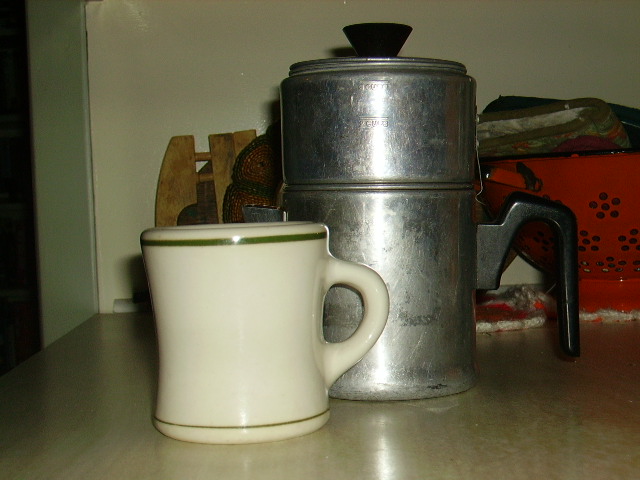
Today while I was tidying the kitchen, I made fresh coffee in my favorite two-cup pot. It’s an old-time drip-through I found at a garage sale, stocky and leaky, but it makes the best couple o’ cups around.

It made me think of me. Not as shiny as I used to be, out of order, and never did produce a lot in the first place—did I disparage myself for a minute?

Yes, until I realized something: I love that old pot.

I’ve loved coffee since I was so young I had to beg for sips. I knew it was good for us then, before the scientists did. I’ve had every sort of coffee brewing experience on earth, I think. I’ve bought and pitched overpriced, electric, coffee-making gizmos until I was ashamed. I’ve brewed it through paper towels in emergencies and even had the old kind with raw egg and shell stirred in the bottom.

I collect coffeepots just because they once belonged to someone whom I know I would have loved: a coffee-ist. I own the carafe my mother first used in her married life. I own a two-gallon, granite-ware coffeepot for over the campfire. I own a cute percolator from my paternal grandparents’ estate. I’ve scouted out the glass parts from several identical glass percolators, a full set with parts to spare. My husband even brings them home from antique stores to surprise me. The day my sister-in-law introduced me to the two-cup, drip-through oldie in her kitchen, however, was the day I began the real search.

When I finally found it, my feelings were hurt—someone had used “my” darling pot for straining drippings from grease, and it wasn’t even for sale; he had planned to throw it out. I actually had to ask him to sell it to me and he valued it at only fifty cents. I lovingly sudsed and scrubbed it until it no longer stank like grease and then my kitchen filled with the wondrous aroma of pure Colombian dark roast.

Bliss.

Nowadays, after my husband and I share our morning pot and he leaves for the woods with his thermos full, I draw out the favored one. The ritual never changes: rinsed pot, filtered water, fresh grounds, a dish underneath for leaks, a comfortable mug, and me. My satisfaction level knows no limit during this hour.

And I think. While I spent my life as a grease catcher, about to be thrown away, my Lord searched until He found me. His love for His rummage-sale find has transformed me into the small one He most loves to spend time with, alone.

I leak but He loves me.

Nothing else in this world matters so to me, except that He is searching for you, too.

Don’t let them throw you away.

_______________

Katharine is a retired, home-educating wife and mom who writes about all things “woman”, from a Godly viewpoint, here on this site, and at The Conquering Mom.  Her writing appeared in several magazines for 15 years, and she is currently working on several books. She loves to write, speak, teach, cook, garden, spoil her hennies, and watch old movies with popcorn.