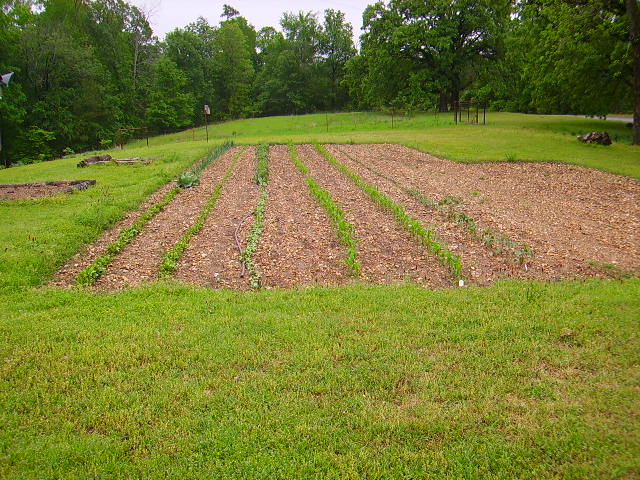
Once there was a LOT of crimson clover growing here, but we tilled it under. That part was easy because we planted a ground cover that was easy to use this way, on purpose. Imagine. It nourishes and improves the soil, lending its life to the new growth to come, but we do not need it overshadowing what is going on, now. In the past the ground cover guarded the soil from weed overgrowth and dehydration. Now that job will belong to us.
Also, we tilled in some vicious weeds–Bermuda Grass–not wanted here, not stealing nutrients from our little babies. It was unable to do much destruction over the winter. Now that the summer is coming, it will try to take over. We will be vigilant about this unwanted growth, which is still present in the form of root pieces hiding amongst the fresh, lovely soil, waiting for the chance to pop up, unbidden, strong, and destructive.
Change will come to this garden.
Brand New Growth
New growth. It’s taking the place of ground cover and weeds, which are not needed, now.
Have you ever studied how sugars give us quick energy? I did, in 7th grade, which happened several decades ago, for me.
Several decades.
I had to memorize the benefits of various components of normal foods and other things we might eat that are not normal foods, to pass a homemaking test.
Back then, almost all girls studied homemaking. We each wanted to make a home — to turn a house that housed two strangers into a safe and welcoming nest for two who acted as one entity — and to welcome the regular appearance of new, tiny, perfect strangers joining the melee.
Things changed. Boys who desired to be professional chefs felt they should take homemaking. Girls who wanted to know how to fix their own stopped sinks felt they should take shop. Besides, the gender mix was fun. But I digress.
While learning to make a home, we learned good nutrition. All the diets recommending eliminating carbs to lose weight find their basis in pure science, quoted in our homemaking textbooks from the late sixties, and it was old news even then.
You cannot have bonbons unless you get a-movin’. Or else, you will grow fat.
They taught us. We learned it and passed tests. Sugars are for quick energy. Consume sugars and you must burn them or else you will grow fat.
We also learned:
Too much sugar consumption could lead to diabetes. Fact.
Honey, although it can have a similar effect, is not as bad. Fact.
Protein is for long-lasting energy. Fact.
Salad before a meal improves digestion. Fact.
Educated people knew these nutrition facts back then. So before a basketball game, players received instructions to eat protein and sugar. Coaches often kept Snickers and other rich candies on hand to rejuvenate a team member, if needed. Players often had a double cheeseburger for lunch and a double chocolate malted for a pre-game treat. Cheerleaders ate like that, too. Such athletic types could actually feel the added boost, they told us.
We envied them.
Today I do not. Today I work from several more facts, not known to science back then:
All these facts, in famous research, such as the Nurses’ Study, form the basis for much of the health protocol at the Mayo Clinic and for Dr. Atkins’ work, not to mention the “come latelies” such as “South Beach” and “Lose the Wheat Lose the Weight”.
But one more fact that spurs this post, a fact no one could have possibly known before: I woke up with a sore throat today. A bit achy and too tired for cheerleading, I’ve decided to post about good healthuntil I again possess it.
Laundry is hung to dry above an Italian street. (Photo credit: Wikipedia)
I’ve known for ages that the older ways were kinder on clothing, on the environment, and on the utilities bill, but I just recently found the exact dollar amount.
They say, if I dry my laundry the old-fashioned way, I save about $100.00 every year. I’ve been doing this for many, many years. It’s more like $4,300, really. And it takes only a few moments per day, really hardly any longer than just loading the dryer.
But that’s not all.
No, if we dry our clothes on a line or rack, we extend the life of the clothing about 50%. Of course, we may not make good use of the savings if we are enslaved to the changing of the styles, but for many of us, that represents another huge saving.
But that’s not all.
Clothing dried on a rack come “out of the dryer” pre-folded! How cool is that? I literally take towels and wash cloths off the rack and put them away, as is. T-shirts require only one more fold. Everything is already smoothed, stacks better, and just is twice as easy to put away.
Drying clothes (Photo credit: Wikipedia)
But that’s not all.
How would you like to add to last Wednesday’s health tricks? Drying laundry indoors humidifies the air in the winter, causing the body to fight off upper respiratory problems more efficiently. The result is fewer colds. That’s what they say, and I think I can tell that is happening for us. We’re “weller” without the cost or the mess of a humidifier.
But that’s not all.
Quality of life seems to skyrocket. Towels are more absorbent when they are not gummed up with fabric softener. A rack-dried towel, fresh from the closet, gives a marvelous back-scratching. Cotton t-shirts feel more honestly real when you put them on, and smell better, too, especially if they’ve been line-dried outdoors. We never encounter static cling.
But that’s not all.
If you have never gone to bed between freshly laundered, line-dried sheets, you just come on over to my house, dear, and let me introduce you to some real sleep. Sheets that you can feel, that stay tucked in, and that smell like angel wings — you won’t know what hit you ’til mornin’ honey!
Joi and her husband were poor. He was a sacker in a small grocery while she raised their four children in a two-bedroom house and they both worked on college degrees at the same time.
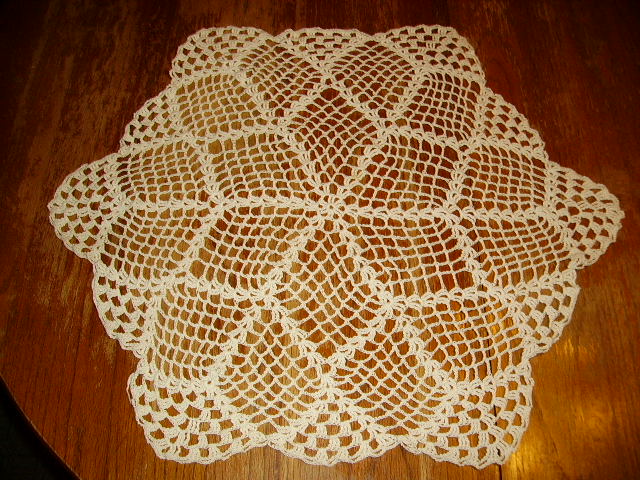
Although we were good friends, Joi was a constant source of inadequacy in me. Her scratch cooking, home canning, crocheted doilies, and hand-sewn quilts, all worked on my sense of accomplishment. She would even blend soy beans in her blender for soy milk.
And then turned it into ice cream.
How did she always fill the gaps among their possessions with cheer? How did she know all about healthful eating before the age of computers? How did she know about herbal healing before the herbal renaissance? How play piano beautifully? I would never catch up!
The day came when Joi and her husband completed their degrees and moved to the land of employment. I lost touch with her, but not exactly; I still can feel Joi’s cheer in my life.
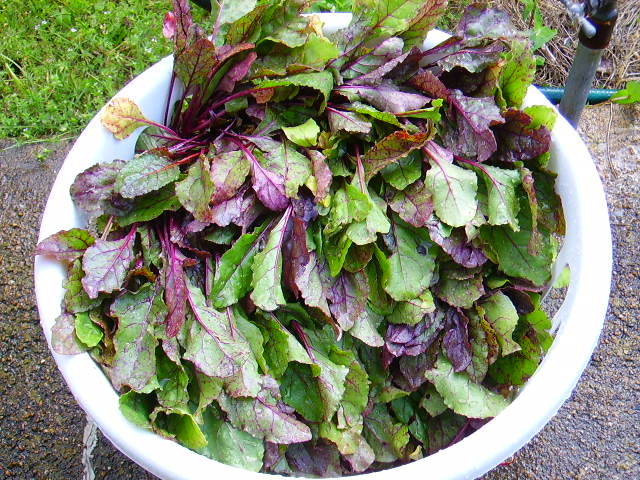
One time, for my birthday, she brought me a huge surprise. Simple and cherishable, just like Joi, the gift brought me happiness, that day. Enveloped in kitchen linens was an enormous steaming loaf of bread. You’ve never seen one that big. I was so excited. With it was a bag of spinach from her own garden, immaculately cleaned.
What fun we had loving that sweet gift to pieces, literally! These delicious additions to my birthday supper may seem like an odd gift to you, but Joi knew what it would mean to us, and we saw the love in it.
If I had washed and washed a big bag of spinach and then given it away I’d be missing it. But Joi just smiled her cheery best. If I’d had the aromas of homemade bread floating through my house, for naught, if I’d known that bread was going to someone else’s house, I’d have handed it over very longingly, not cheerily like Joi.
An aerial view over the north part of the Grand Canyon.
Most of us entertain a combination of all four of the “quit” reasons I gave my friend that day.
From the core of our beings, we know that the home is where our beloved children belong, but we forget, we tire, we listen to others. If we keep fighting, we succeed, but too often, we quit. Quitting is not the way of God’s people. We must press on. We must realize that any prize that includes the rescue of our children from hell is worth any effort.
Many do not realize that it takes only a tiny bit of quitting to quit entirely, because the rest is downhill. It is like walking along the edge of the Grand Canyon, where unwavering commitment to careful success is of utmost importance: One slip can spell disaster, two slips most certainly can spell disaster, and few if any have survived three slips. The difference is that we know certain death lies at the bottom of the Grand Canyon, but we do not see that danger for our children in our wavering commitments to home schooling. We absolutely must develop a strategy for the times when we are tempted to take that slippery, deadly road of ease.
What should such a plan look like? Why, it must lead in the exact opposite direction from the bottom, just as you would lift a child who was slipping down a great gulf, of course! Therefore, any plan must include the following four aspects:
Keep the vision constantly before you. Pray that God will renew your vision for your children, in your heart. Make a list of all the reasons He gives you to home school, and READ it. Add to it often. Decide, forever, that home schooling is good. Read good home school magazines. Read good home school books. Read good homekeeping blogs. (Oh. I guess you already are doing that!) Remember all the upright people that home schooling has contributed to this world. Read the scientific statistics that prove the benefits of home schooling. Find a good support group and be involved in it, making good home school friends. Connect with Home School Legal Defense Association for wonderful confidence boosters. Wake up!
Determine that any cost is nothing compared to the glory that will be revealed in the end. Eighty-five percent of the children who attend worldly schools grow to deny their parents’ faith. That does not happen with home school. What are a few moments of sleep compared to their lives in heaven and a “well done” from our Lord? What is a new car? What is a worldly friendship? What is a college education? What is a second income? What, on this earth, is worth the loss of even one of your children? Pay up!
Commit yourself to your children, as unto the Lord. People hear calls to all sorts of missions, all the time. Churches have “charge conferences” to determine what each one’s job should be. Tithes and other resources are pledged all the time. You have been called to your children, just because you bore them. They are your charge. Pledge your life, before God, to be what they need, so they can grow up right in this wrong world. Join up!
Do not slink back and let the enemy succeed with you and your children. Your enemy is looking around for whomever he can devour, just like a roaring lion. Learn to recognize his roaring for what it is. Set your face like a flint. Grit your teeth. Exert yourself. Protect and defend your children, as any good parent should. Provide for them. Pray for them, for yourself, and for all home schoolers. Stand up!
The wedding wowed us all, and my son, no doubt, rejoices, now. We’ll talk about that later, I’m sure.
But what I realize suddenly, is that for the last 42 years, I have been co-existing with my kids. That thought barely fits inside my head. Just barely. For 42 years, I’ve had kids in my corner — whether pre-borns, school-aged, or 20-somethings, they were my kids and they were here.
Gradually, almost imperceptibly they have sought their niches and moved on to life as they envisioned it.
I wonder if they envisioned it accurately, any better than I did. I mean, I always wanted six children, but I never, even once, thought I would live with kids for 42 years. It makes me laugh because it sounds like I ran an orphanage. Often I jokingly said of my profession, that I helped my husband manage a home for children who would otherwise be homeless. I believed that, even while I laughed about it. I joke about someone else doing their laundry for a change, and I believe that, too, as I laugh.
The time arrives when all that work is over and I enjoy reaping grandkids and such. I re-arrange furniture in empty bedrooms, glad for the space, glad for a chance to access the under-bed areas with a broom and mop, daring not to allow the mixed emotions a venue, terrified of second thoughts, unable to admit missed chances, refusing to ponder the distance to check on these kids, allowing only the happy-thoughts.
I did it. They are raised and gone. Their rooms are again mine. I can have a sewing room and an office.
Such are the dreams of the everyday housewife
You see everywhere any time of the day
An everyday housewife
Who gave up the good life
For me.
However the writer of this song assumes the wife longs for the good ol’ pre-marriage days, it fails to realize what it juxtaposes:
Wrinkles vs. young men’s ridicule — give me wrinkles, any day.
Apron vs. dancing men waiting in line for her — really; that’s the good life.
Closet vs. photos, and dried flower crumbling — actually, I have many, many photos and flowers, none crumbling, and I could use another closet.
Housedress vs. mind-blowing gowns — the way I dress in the house is far more sensible and comfortable and desirable and if gowns are the “good life”, I’d give them up in a heartbeat for what I’d really like.
I’d really like to ride that “housewife” ride all over again.
The second-most-viewed post on my site. I cannot figure this, but have loved seeing nearly every week, someone else coming to read this.
Have fun.
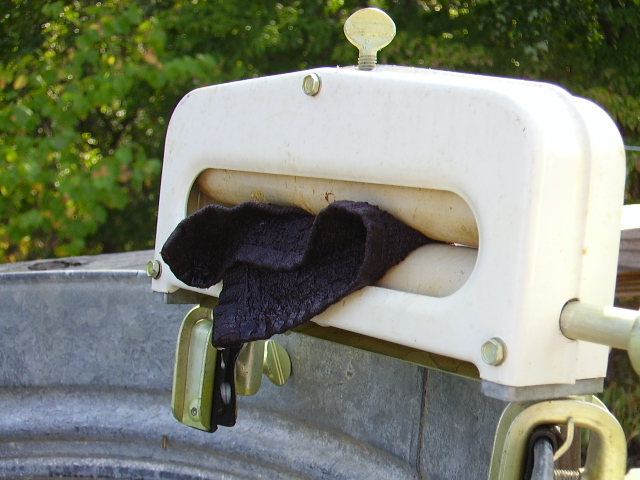
My gramma had a laundry wringer. And for a while, so did my mom. I always loved these machines that squeezed the water out of clothing so graphically and intriguingly.
Click to View Water Running Off
Back then, washing used only one load of soapy water, beginning clean, with white clothing, and proceeded to gradually dirtier and darker clothing and water, until the last thing washed was the dingy dungarees worn to protect the good clothing from animal chores.
No Longer Dripping
After washing came rinsing, or some said, “wrenching,” which surely they thought referred to the old way of removing extra water, by hand wringing, making the arms and hands feel nearly wrenched out of socket. My gramma put bluing in rinse water to make whites look whiter. I never could understand this substance, bluer than a computer screen, that made things white.
Gramma used homemade soap on clothes. I mean: natural lye made from last winter’s wood ash combined with natural trimmings from natural meat, and yes, she made it herself, on the wood stove in her woodshed, and stacked it everywhere in there to cure. Then she grated it for flakes. It all smelled so fresh and good.
To this day, aroma from homemade soap makes me think of birds calling and locusts scritching combined with comfy sloshy sounds of laundry done during warm laundry days. And my gramma’s voice explaining . . .
The washer, and its accompanying rinse tubs on platforms, rolled creaking out onto the bumpy concrete porch around Gramma’s woodshed. A hose ran first to fill rinse tubs, and later to empty them onto the enormous strawberry patch.
Only large pots of scalding water went into the washer, itself, and yes, heated on that wood stove. All the concrete porches got a scrub-down with used laundry water splashed on, pure and natural.
There were manual and electric versions of the wringer. My gramma had the kind she had to crank and disdained the electric, which could swallow up an arm or break off buttons. She fished clothes out with a stick; the water was that hot. My auntie had one and I didn’t like the noise of it. Besides, cranking the wringer was an honored chore because you had to be old enough to reach and strong enough turn it without let-up.
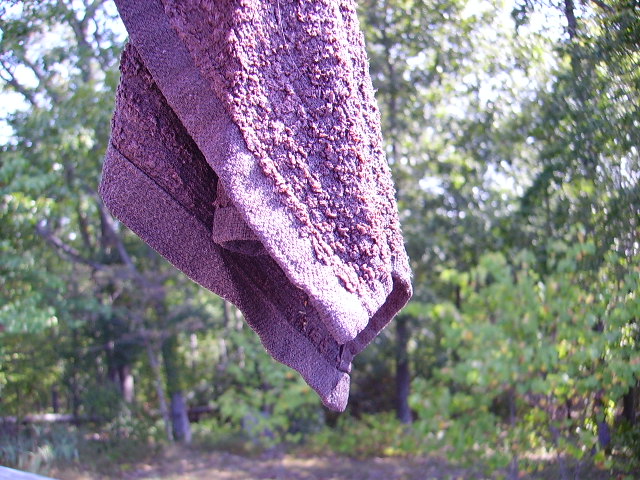
The wringer and its tray were rotatable to provide also for two tubs of rinse water. Every article of clothing went through the agitation in soapy water, wringing, pouring and dribbling, to kerplunk into the first rinse, and then into the second, before finally being wrung into a laundry basket for hanging on the line.
It seems like so much work, and it was. No wonder laundering was an event with its own day set aside. Imagine dragging all that production outdoors on a daily basis for just one load! Yet, all this was such an improvement over lugging all the laundry to a stream, or boiling it in a huge pot over an open fire.
Yes, it was good, honest work, but that woodshed and that porch were my gramma’s gym and she stayed fit, even into old age. And although she belonged to a gene pool that proved a tendency to plumpness, she always remained trim.










 Home's Cool!