Adult male brown recluse spider anterior dorsal view. (Photo credit: Wikipedia)
You do not want your children to be bitten by a black widowor a brown recluse. Period.
So you must take every everything out of bookcases and toy boxes, from behind freezers and washers and dryers, and turn everything upside down looking for the black widow’s distinctive web. It is strong, as if made of nylon, even making noise when you rip it, and crazy, as if the weaver were drunk.
I’ll emphasize the strength of the widow web by saying I recently tried to pick up one spray bottle sitting next to another and got both. Between them in all that web, was a widow. I’m glad she had died, first, but I wonder where her egg sac is. Brrr. Probably up inside my deep freeze, which I cannot turn upside down by myself. Yikes.
Female black widow spider guarding an egg case – Species Latrodectus mactans (Photo credit: Wikipedia)
However, if you do find a widow egg sac, it will be tan, about the hue of khaki fabric, but maybe lighter, and roughly teardrop-shaped. See this photo and notice the aimless design in the supporting webwork.
What you need to be most concerned about, though, is the bookcase where children’s books are kept, and the toy boxes. Black widows prefer wooden places. And undisturbed places. Well, just read that link, above, to get the whole scope.
Oh, and the brown recluse is not much of a web maker and loves to hide between papers, so it’s time to get those newspapers and magazine corralled before the kids decide to do it for you . . .
2. What about mold?
All winter you’ve been heating your house, and not dusting as much as is wise, right? Don’t worry, winter doldrums get us all. But now is the time to fix all that. When you open the windows to let in the lovely, balmy breezes of Spring, you’ll also let in something you haven’t experienced in a while: humidity!
Humidity works with dust to make a moldy life for us all. There will even be moldy dust on your window screens, themselves, and in the windowsills. You should at least clean the screens and sills when you get ready to open up to the warmth out there, but if it’s all taken apart, might as well get the glass, too, and have everything sparkly.
Sometimes I wait with it, though, until the worst of the pollen has subsided, since we won’t have windows open much during that time, anyway. I can clean pollen off the screens and sills when I get the rest, that way. Saves work.
I choose a hot, windy day for the job, and use a pan of hot water with about a teaspoon of dish soap in it, and a toilet scrub brush (that I keep just for windows) . Remove the screen and lay it on a deck or sidewalk for support. Hose it, then scrub and rinse. Stand it up to dry while you do the window the same. Then dry the window; I use an old bath towel. I know it leaves a tad of lint, but it’s faster that paper toweling and is free. Once all windows are done, begin replacing screens. It should only take about one morning to do this job.
3. Looks.
You and your family deserve to see the place shiny at least once a year. Go for it. You will be glad. It boosts everyone’s morale and causes all sorts of happy feelings in your heart.
For “spring-cleaning-without-spring-cleaning” how-to’s, start here. Have fun!
View of the deck through branches of a small maple.
All the beauty of an ice storm comes with a price: We lose electricity.
So after we had a nice* game of Scrabble-by-candlelight, we ate a great chili dinner by the same romantic candlelight, chili which I’d cooked on our wood stove.
Then I did dishes by candlelight.
Am seriously considering doing dishes by candlelight all the time. So romantic… 😉
Okay, I’ve been working more on being organized because I got a good start when I froze leftover turkey from the holiday, in approximately one-pound packages.
I hope you did not throw yours out or force your family to eat turkey until it was coming out of their ears!
Anyway, I’ve had three pounds of frozen turkey to look at in the freezer and have been dreaming until I just could not STAND it anymore!
So I made turkey minestrone. Sort of. Except I am not sure what that is and I did not have eggs to make noodles with (after making two cakes in a row. Well, really four, if you count mistakes…)
Anyway, the more I thought about turkey minestrone, the better it smelled, in my imagination. Nothing like it to get the cooking juices flowing!
So, here is the final product, in all its glory, followed by a recipe, of sorts, because I actually just dumped whatever sounded good, and I truly don’t know what minestrone IS! 🙂
I am sure if you think and add what you like in a soup, yours will be just as yum as mine!
Turkey Minestrone
4 Tbsp. bacon grease or olive oil
2 c. sliced mushrooms
1 c. onion, chopped small
1 c. celery, chopped
1 c. carrot, sliced
1/2 c. chopped parsley
Any or all of the following, to taste: rosemary, oregano, sage, lemon grass, basil.
1 jalapeno pepper and brewing bag for easy removal
1 clove garlic, pressed (or more!)
2-3 t. salt
1 t. black pepper
2 gal. filtered water
1-2 lb. of frozen turkey, cut bite-sized
1 can cut green beans
1 can cannellini beans
1 c. raw brown rice
In a large, non-stick pan, fry all raw vegetables and herbs until caramelized, on medium-high heat, stirring often and watching carefully. Take care not to break the pepper. Vegetables should be browned, some, and somewhat soft. Pan drippings should be a golden-rosy brown.
Retrieve the pepper and place inside bag. Set aside.
Pour some of the water into the hot pan to loosen all the drippings and create a rich broth. Pour entire contents of pan into a large stock pot (12 quart or more). Scrape pan well, to get all the goodie.
Add the rest of the ingredients, including bagged pepper, and bring to boil. Simmer, stirring constantly, for at least an hour. Enjoy with cornbread, sour cream, cheddar cheese, etc.
As an old song goes, the very beginning is a “very good place to start”.
Once my husband and I saw the need to educate our children at home, though, we began in the middle. We were not wise enough to see the need at the very beginning of that school year. Soon after that, we became too desperate to wait for another beginning.
We were what I like to call “middlers”.
After counseling several moms who have made this choice, I would like to share a good way to succeed at it. First, let’s look at the dilemma—how we felt (and how I have found that most people feel) in this predicament:
Scared. God says, “Fear not,” but we fear anyway. When you begin in the middle, you have greater temptation to fear. Often you have not deliberated, planned, and shopped for an entire summer. You fear that you are panicking, rejecting the status quo. Rather than simply not showing up, as most new home schoolers do, you must face irate professionals who think you are stealing their children, or worse, their money. This can be scary.
Uninformed. Some worldly systems neglect to tell you many significant things. You perhaps do not know what your child has studied and more importantly, how well he actually did. You may not understand achievement tests. Sometimes it is to the teacher’s advantage to keep parents at a distance. Other times, it just happens. How can you know what has been happening when you were not there? They taught, but did your child learn?
Without vision. All you know is that the current arrangement is not satisfactory and that you must devise a new strategy. You simply do not know what it is, yet. Perhaps you feel the Lord will lead, but perhaps He is waiting for you to take that first step…. How can you know?
Wounded. Usually, the decision to begin in the middle springs from hurtful happenings. Your child was failing, the teacher was angry, the other students were cruel, or whatever. Do not deceive yourself into thinking that such enormous circumstances have not touched you personally. What is more crucial, do not think they have not touched your child. Such situations can hurt a lot, and they can hurt a long time.
Distracted. It may feel like a thousand voices are shouting at you, now. Your families, your “teachers”, your neighbors, and maybe even your friends are telling you something, and usually it is not something helpful. Total strangers will feel compelled to voice an opinion. You may so tire of it, that even favorable opinion can irritate. It can be difficult to concentrate with so many voices sounding at once.
Strapped. You promised you would do whatever it takes to help your child, and if you were working outside the home then, you face reduced income and a slight increase in expenses (curriculum) now. If your salary caused you to inflate previous spending, you are wondering where the money will come from. To remain constant in your commitment, you have to think about expenses.
Unsure. You cannot fathom how anyone can stand in front of a child, especially his own, and say the words to make learning happen. You do not know where to start, what to write on the blackboard, when to have recess, how to shoot a basket—it can seem ridiculous, if you list it all. You do not even know how much of this you need to know.
Is this you? Cheer up; there is an easy way to solve these problems and to begin with an impressive steadiness. I always counsel someone in your position to do the same thing, because it works better than anything else can. In fact, your position is the easiest to recommend for, because there really is only one way that works well.
What makes sense is to use curriculum that is ideal for beginning in the middle. You must look for a curriculum that consists totally of workbooks prepared to be consumed at the rate of one per subject per every three weeks, or so. Very importantly, this curriculum must have a placement test. Several curriculum companies provide what I am suggesting, what home educators call “consumable curriculum”. (The child writes in the text, consuming it.) You will learn to choose your curriculum for yourself, someday, but you will be thankful if you begin with this.
Let me explain how well consumable curriculum can serve you.
First, you will gain courage when you look at the materials consumable curriculum provides. The three-week increments make it seem more attainable. You will realize that there is little for you to do, few ways to fail. Your children will relax with this material, for the same reason, and will approve your decision.
Since you have little familiarity with your child’s education, the placement test is your friend. A few sample questions are geared to the scope and sequence of the curriculum in the subjects of math and reading. After administering this test, you will have the joy of handing your child exactly the materials he needs for success in your new school. If he needs catch-up work, begin with one or two workbooks for problem areas. Then you are free to proceed where he is ready to work. If he is substantially behind in one subject, you can place him where he can achieve learning, and work extra in that area. If he is ahead, you can place him where he can finally feel a challenge. You both will love the smooth transition and instant success.
Vision will come immediately. It will be with great relief that you let the course work be your lesson plan. You will see more success than you dreamed you could generate, and it will be its own reward. You will see school through different eyes once you have tasted the joys of watching your child learn. As I said, shop around later, this summer, after that first half-year sample. For now, this will be all the vision you will need.
Because of past stress, you will not need the burden of determining your child’s needs and how to provide them. Perhaps you will feel a need to spend your weekends writing your own curriculum, someday. If so, this is your ticket to that day, and you both will benefit from resting wounded hearts along the way. For now, though, you both will need a time to coast, a time of getting to know each other. Learning must happen, but it does, with consumable curriculum. Consumable types just happen to be easiest for the mom. Children are relieved at the simple format, too.
These curriculum companies also provide encouragement, send you inspiring newsletters without cost, and provide toll-free numbers. You will have access to new voices, voices that help, encourage, and direct. These professional educators strive to serve the home school mom. Their attitude is that the only time a question is dumb is when it is unspoken. They love to help and they believe in home schooling, or they would take other jobs.
Yes, it costs just a bit more overall, to order consumable curriculum piecemeal. Still, a half-year of this type should cost far less than a full year of any other. (You cannot buy halves of hardbound texts.) I do not need to tell you that a half-year of consumable type costs much less than the wrong level of any other.
If you live in a big town, you probably can access consumable curriculum companies at a Christian bookstore. In very large cities, you may be able to locate a store entirely devoted to home schools. In these cases, you may go to the store every three weeks, and purchase only what you need next, saving even more.
If you are still unsure, consider this: If your child is reading, he can teach himself with this type of curriculum. This does not mean that you may leave him home alone, or that it is good to ignore him. What you will find, however, is that when you skip the lecture and the blackboard, your student finishes faster. The material is arranged so that the child reads a little and then answers questions. Only when he cannot understand, should you explain. The child is free to learn without suffering unending lecture, you are free to do a little housework, real learning happens, and you hardly had to do a thing. Are you surer, now?
O.k., let’s talk about the down side. You knew this was coming. I want to be fair and make certain you know what to expect.
The only problem I ever had with consumable curriculum, after trying two major providers, was the cost. The embarrassing thing about this is that it is so easy to make it reusable—have your children write the answers on another paper, instead of writing in the booklets. I feel silly never to have thought of it. Still, with six children, I did not feel we could afford to buy all their books all over each year. That may be a big consideration for you, too, but an easy one to overcome.
Some home school moms suspect all that filling-in-the-blank will lead to students not knowing how to write essays. If so, I do not know of it. My oldest received all his home education from consumable curriculum, and proceeded to “CLEP” English I. It did not seem to have hurt him. If I were worried about it, though, I would assign some extra essay work, a simple solution, again.
The only other hindrance that I can imagine with consumable curriculum is if your child does not read well. This is a two-fold problem involving both placement and performance, but do not fault the curriculum; it would be a problem whatever curriculum you choose.
The placement tests might not be entirely accurate with the slow-to-read child. I would administer the test, nevertheless, because it is not expensive and would give me better understanding of my child’s learning. Then I would use the results to help me examine the texts, as I selected the material I wanted to try. Consumable curriculum is so wonderful for this project, in that it allows you to buy very little, as a trial.
In the case of the slow or non-reader, leaving the child to read and answer questions himself will not work. To solve this problem, I would help the child read the material, to improve his reading level. Failing that I would read it to him, making sure that he paid attention and grasped the material. For an older child, I might read it onto a tape, to give him some control over his situation. I might use all three techniques. It would not be easy, but didn’t you bring him home because it was too hard for others?
You can do it, dear Middler, no matter how scared, uninformed, confused, wounded, distracted, strapped, and unsure you are. All you need is the curriculum designed with you in mind. I did it, and so have others just like you and me.
Go ahead and start in the middle to make a new beginning.
Lush Green Fallow Field, Darrington. Green, blue, red, wonderfully summery, rural colors. Dewy morning, overcast sky. Had wanted to take this picture on a bright, sunny day, but the dew gave the field a beautiful sparkle (Photo credit: Wikipedia)
Today I break the mold.
I have created a hot post!
You can find it here! It’s a poem and still life of some hot stuff. Pay special attention to the contents of the little bottle. Ha.
You know, it’s not that I don’t love you all. It’s not that I don’t love thinking, writing, and typing.
I’ll tell you what it is:
It is that almost all summer long, the outdoors has seemed like I should either have Spring Fever, or some kind of lovely Fall Melancholy.
I mean, the beautiful sky is raining and covered in a beautiful gray overcast, right now, as I type. It actually was almost cold last night.
My favorite weather, really.
Makes me poetic.
Anyway, the lovely ladies I agreed to write for scheduled me lo-o-ong ago, and we all assumed, for some reason, that when I posted in late July, the weather would be hot-hot-hot in the Deep South.
Hence the topic.
But it’s so lovely out, I just feel like sitting on the porch and looking at it.
Ever been there? Know how to get out of it? Help! Comment! Share!


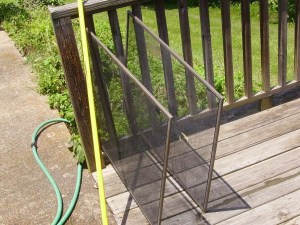 I choose a hot, windy day for the job, and use a pan of hot water with about a teaspoon of dish soap in it, and a toilet scrub brush (that I keep just for windows) . Remove the screen and lay it on a deck or sidewalk for support. Hose it, then scrub and rinse. Stand it up to dry while you do the window the same. Then dry the window; I use an old bath towel. I know it leaves a tad of lint, but it’s faster that paper toweling and is free. Once all windows are done, begin replacing screens. It should only take about one morning to do this job.








 Home's Cool!