Posted in Believe it or not!, Husbands, Inspiring, Wisdom, Wives

All My Men Have Been Good to Me – Husband

They hoped he wouldn’t love me, but he did. They predicted we wouldn’t last, but we did. Vietnam tried to separate us, but it didn’t. They said we’d never get anywhere, but we did.

And at least half of it was due to the only man who would give up his seat to me, forty-something years ago.

We were hardly more than children, but love and stubbornness led the way. Milestone after milestone whizzed by until it seemed there was no stopping us.

Bumps in the road gave us strength, new direction, and adaptability, a great combination.

Now, six children homeschooled and raised up and out of the home, mostly it’s just us. And that was really all I needed in the first place—all the rest was frosting.

Buying and selling houses and cars, fixing broken things, building what we lacked, sweating at laboring, always taking the frugal route, he provided, always provided, so I would not have to leave our nest, was free to tend our babes in peace, not harried. I love the life I acquired with this man who spent himself so willingly for my freedom.  

Then there is the wisdom. They say still waters run deep, and for him, it is true. When he spoke, the words were worth listening. When he spoke, other women feared.

And patience. Married to a woman who “needs a mute button”, he always listened, always listens. Always knows the answers to my confusions,

Let the world belittle marriage and commitment! Let them rant against fidelity and sanctity! Let them screw their brows into frowns and suspicions! Let them pretend they are happy without loyalty and truthfulness! Let them blow!

I cannot hear it.

I have spent my whole life with my best friend and would that I had another life to do it all again.
Posted in Blessings of Habit, Good ol' days, Inspiring, Wisdom

All My Men Have Been Good to Me: Grandpa

My grandpa used to gather us kids around to play a mouse game with us. He somehow folded his handkerchief into a cylinder shape with a tail and would hold it in his hand and stroke it like a pet mouse. Then he would talk us into petting it, too. Suddenly it would jump up his arm while he acted surprised and we nearly jumped out of our skins, although we knew what was coming, each time. It was the only kid entertainment at their stuffy parsonage, and we loved it, couldn’t wait to go there and beg to play the mouse game. Oh, the giggles!

Imagine my awe and shock when my mother revealed to me the truth: my grandpa never did like children much. Imagine!—Oh, just imagine!—What dedication to doing right prevailed in this man who did not like little children yet took them into his arms and blessed them with a silly game!

Outside of that game, our activities with him were on adult level. He lived in St. Louis, and took us often to Shaw’s Garden and the Climatron. Anyone who has ever been there knows a child can be totally impressed with such a ho-hum-sounding activity. I was. I loved it there; the waterfalls that ended in fish-filled pools with floating lava rock amazed me. That the birds could live there for our enjoyment, that we could climb stairs to be near the treetops, that the birds were used to us, was unbelievable. I grew up to be an amateur botanist and birder.

After retiring from parish life, he took a simpler job as proofreader at a large publishing company. Twice he took me there to see the processes, every step conducted in house, in the good ol’ days. I remember a long set of cover-less books aligned side-by-side with an enormous screw clamp, waiting for their corporate edges to be gilded. I grew up to be a writer.

Grandpa also had a pump organ and played very well. He would not let us play on it unless we could pump it ourselves and knew an actual song to play for him. My brother was better at that, but when Grandpa took us to the big, old church that had a real pipe organ, when the organist was practicing, it was sublime. I soaked in it and grew up to prefer richly chorded classical organ music.

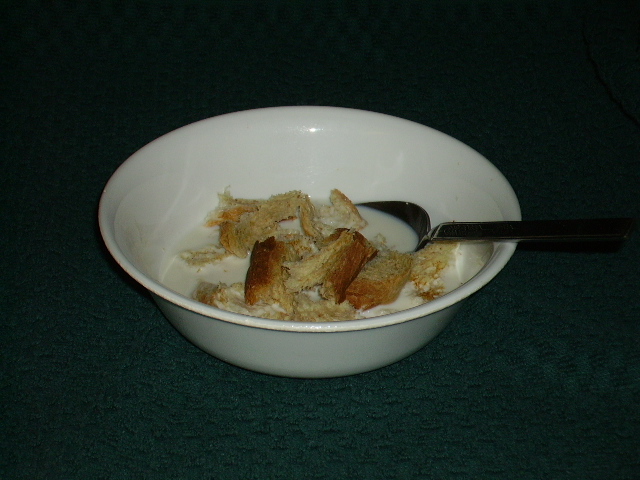
One activity bonded me to my grandpa more than any other thing: milk toast.

milktoast
Buttered or Not–Mmm!

For the uninitiated, that is a bowl of torn-up toast, doused in milk, to eat with a spoon like cereal. A-a-ah!

I liked milk toast and none others of Grandpa’s fourteen grandchildren did, that I know of. He liked to eat a bowl of it every night before bed and if we were there, he would make me one, too. We sat together at their antique oak dining table that was covered in hand-made lace, old man and little girl, happy as coons in corn, eating a meal he prepared just for me.

Posted in Blessings of Habit, Good ol' days, Inspiring, Wisdom

An Odd Egg

What a difference in these two eggs! Each appeared during this flip-flop season we call “spring”.

odd eggs
Odd Eggs

Spring is such a time of turmoil in our area—flower and leaf buds popping out everywhere, new birth, chickens beginning the new laying season, tornadoes—I wonder how we survive it.

Spring’s natural beauty forces us to love her. The amazing fragrances and forms of blooming things, the pearlescence of eggshells and the fragility of baby chicks, the mew of kittens, the peeping of hidden frogs, all work on us, draw us to that perennial love affair with spring.

So we roll up our sleeves, kick off our shoes, and pull our hair up into ponytails to catch the sun on our skin. We pull weeds, freshen flags, mow too soon, plant too soon—anything to be outdoors, to come inside smelling like spring. We paint lawn furniture, divide potted plants, and attend herbal festivals, filling our lives with projects to prepare us for spring.

But no-yolk and double-yolk eggs most remind me of spring. My dad had a collection of odd eggshells that appeared on the same day as tornadoes. He always said the tornado scared the hens and caused them to lay odd eggs. I think he believed that. Maybe it is true. He labeled each shell with the date of its corresponding tornado and displayed them on egg cups, for which they were far too large or far too small. He always loved curiously humorous events.

He’s been gone, now, about 12 years. So much has changed. I doubt he ever guessed I’d be telling the whole world about his eggshell collection, one day. I doubt he ever guessed what an impact he had, in the daily humor of life.

But I do not doubt he lived life, squeezed everything he could out of it, love it, with one hand held palm-upward, trusting, waiting for some blessing to fall into it, be it only an odd eggshell.

And he was not disappointed.

Posted in Home School, Inspiring, Pre-schoolers, Sayings, Who's the mom here?, Wisdom

Why Do People Put Their Children in Schools? Part – 3 – Can We Fix the Schools?

From all the research that has been done, I think we might, might, might be able to make some progress solving the problems in governmental institutionalization of our children. It would take drastic change, though.

No matter what you are thinking, I meant more drastic than that.

English: Jewish Children with their Teacher in...
English: Jewish Children with their Teacher in Samarkand. Early color photograph from Russia, created by Sergei Mikhailovich Prokudin-Gorskii as part of his work to document the Russian Empire from 1909 to 1915. (Photo credit: Wikipedia)

Most classrooms have far too many children in them.

Instead, each classroom would have to reduce to only around 5 children per adult. Many homes have something like that, and national research shows it is the best way to learn. It certainly would be more natural. Some high school children might make do with 10 to 12 per adult, if they were mature .

It’s how the ancient Greeks taught.

Most classrooms have all same-age children in them.

Bizarre! Instead, each child should be allowed to receive the gift of relationships with vastly different-aged others. Most homes have that and the learning potential is expanded when the students are of differing levels of learning. Especially the older ones would learn, truly learn the subjects if they were, in this more organic approach, occasionally in positions to help teach.

We do learn most when we teach, right?

Most classrooms labor under the false assumption that touch, being sexual and subject to lawsuit, should be prohibited.

Instead, we all should acknowledge what we instinctively know, and has been proven, that hugs and pats and other touch, including light corporal punishment, are part of socializing and leaving them out is wrong. Most homes have touch. Remember, orphans who are never touched die, whereas touched children are healthier and grow taller.

To protect the child from the occasional bad teacher, and the teacher from the occasional bad parent, of course video cameras in every room and every hall would be essential. That way, any teacher or child who doesn’t care about God, could realize that Big Brother is also up there.

We have the space, really. We are closing schools every day because we’ve aborted zillions of the children who could have filled them.

We do not have enough teachers, but how quickly they would come if they learned we’d solved the discipline problems, wouldn’t they!

It would take a large staff of volunteers, but what better place to volunteer! Lots of families have become single-income these days, so one spouse must be somewhat free. Then that parent could discover the joy of watching or even helping his or her own child learn things of great value, even about volunteerism. It would be a whole lot like home schooling, and might even get the better results of homeschooling, but would happen at the school.

Or, we could just send them all home, which would be lots more cost effective.

Enhanced by Zemanta
Posted in Home School, Inspiring, Pre-schoolers, Who's the mom here?, Wisdom

Why Do People Put Their Children in Schools? Part – 2 – The Solution

Reasons for being at homeChildren need to be in homes.

Arresting thought, isn’t it.

If there exists any type of divine design, then for argument’s sake, we must think that children were put into homes for a reason.

But even those who cannot swallow the idea of a God must consider why all creatures seem to have evolved to higher and higher plains while passing through a home- or family-type stage, and the higher the plain, the longer the prerequisite familial stage, with homo-sapiens needing a family for the longest time of all.

It is worth a thought.

Many who have given it a thought have withdrawn their children from the bedlam outside the home. Then—surprise!—their children begin auto-correcting their psyches, learning more, retaining more, doing more with it, and growing up to be more productive.

I am not making this up. It is heavily-researched scientific fact that no thinking person should ignore, especially if that person cares about children, about the state of his country, or about the future at all.

And before we continue, we must define a home: a set of parents who function adequately, with each other and with their children, as mom and dad. To use a broken, dysfunctional, or abusive home as a reason for schools is as fair as using a broken, dysfunctional, or abusive school as a reason for home schools.

But bad schools are not the reason to homeschool.

CHILDREN are the reason to homeschool.

If you have them, you should.

Today’s children are being destroyed in schools. They were not made to be in schools and do not thrive there. They are tormented daily, growing warped personalities we see depicted in the worst national headlines.

And they’re not allowed to pray

Putting children into a school is asking them to pass the socializing test before ever receiving any instruction, correction,or reinforcements about HOW to socialize. They encounter children even less trained than they are, with no chance of escape from this zoo.

Sink-or-swim is often a great way to drown a kid.

The typical classroom is sink-or-swim. When drowning, it is natural for the inexperienced to attempt survival by pushing down on other swimmers.

Just natural.

Empathy is the natural product of a home education. Each older child who cherishes the home’s newest infant later has patience with that same child doing wrong, cares if that sibling falls down, laughs with—not at—that little one.

Resilience is another natural product of a home education. Encouraging, even requiring social resilience, leads to practice in resilience. The old “get back on the horse” motto prevails and in time, becomes instilled. As the child matures, he develops the ability to keep going, no matter what, if only someone has taught him how.

Confidence is another natural product of a home education, and it is born of hope. A child who is dumped at the door of an antagonistic, institutionalized experience has no hope. A child who has a mommy who will keep everyone on a good social plane while they learn, just because she loves them, has hope and learns confidence.

Tomorrow, part 3 about how to fix the schools. See ya’!

Posted in Good ol' days, Pre-schoolers, Who's the mom here?, Wisdom

Why do people put children in schools? Part 1

Tired and angry child.

People forget children are not adults. Adults can handle many things children cannot. The adult thinks to himself, “Oh, it won’t be that bad.” But he forgets. Time has a way of rewriting our memories.

We project ourselves onto our children and think of how great it would be to be surrounded with 25 five-year-olds every day for nine months. We think as an adult who has authority and could quell any problem with a child. We forget a child has no such ability and does not even know what to do, let alone how.

Or we look at other kids or our own childhood and think, “They did okay. I did okay. Troubles make you stronger, after all.” That is true to an extent. When air blows over a plant, it does make it stronger, unless it is a tornado.

If we look deeper, though, we realize those who did well in school were taught how, as were most of their peers. In my day, kids were polite. It was considered a huge breach of civilized behavior to forget to say “please.” The child who did this was ostracized. Now it is a joke. It is a different world. It is truly bad.

Bad has always been a possibility, though, in schools. Some were blown away by the tornadoes of troubles they faced. Einstein, Edison, Disraeli, and T. Roosevelt all did poorly in the institutions of their days—very poorly.

If we actually were to place ourselves in our children’s shoes, we would think twice, and that would be good.

Think: if everyone at your workplace were mean to you, had better stuff than you, outperformed you, or got chosen before you.

How well could you cope with that?

Would you change jobs?

They say in those circumstances, a person should change jobs. However, children in those circumstances cannot change jobs. Their job must always remain to go to the school of someone else’s determining. Period.

If you did stay in that job, though, would you seek comfort from family or friends? Sure you would, and you should!

The child, though, often finds his family does not believe how bad it is, as discussed above, or does not understand the enormity of it. And his friends! They are all at the school, all in the same boat! How can they help? The child and all his friends are in a social drain that leaves them socially depleted by day’s end. And then he usually has more school to do at home.

You know how you would resent having to bring work home. Daily. Hours and hours of it.

Yet, you have freedom to leave your job if you want, even to take vacation whenever you want. The child is required by law to remain in his torture chamber for 12 years, at least. No wonder they think of suicide.

We will discuss the solution to this ongoing problem tomorrow. See ya!