Blog
One Good Pie!
As Promised:
Pie, Recipe, and Photo!
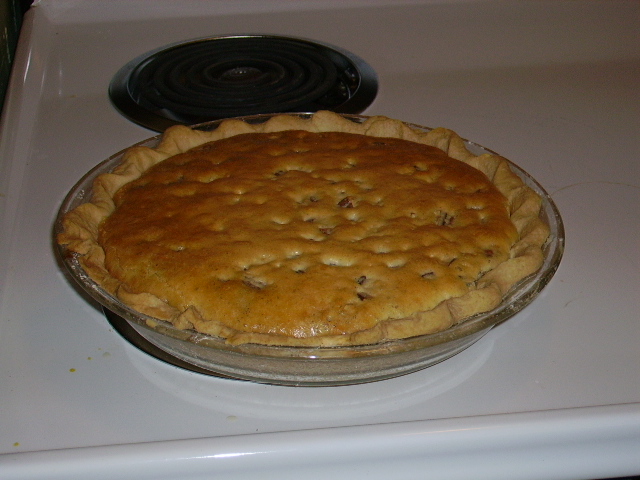
I said I’d post this. Now here it is!
My mother found this recipe somewhere and shared it with me about 30 years ago. It’s a sort of cross between sour cream raisin pie and pecan pie. With coconut. Since I started making it as a family favorite, I have seen it in many collections.
Still, when I bring it to a public function, someone is always amazed.
I feel certain someone out there has perhaps glossed over the recipe and never, ever tasted its wonderfulness.
Have fun.
Good Pie
1 stick butter, melted
1 cup sugar
2 eggs
2 Tbsp. flour
2 Tbsp. top milk
2 Tbsp. vinegar
1 tsp. vanilla
1/2 cup raisins
1/2 cup pecan pieces
1/2 cup coconut
1, 9″ unbaked pie shell
Mix butter and sugar thoroughly. Add eggs and blend in completely. Beat in flour, thoroughly. Stir in milk, vinegar, and vanilla. Add remaining ingredients and stir well. Pour into pie shell and bake at 350 degrees for 45 minutes.
This will rise up but will not overflow. As it cools, it sinks.
For the top milk, I’ve also used either canned evaporated milk or else cream, with equal success.
A pie this rich can easily serve ten or twelve, but we serve it cooled, cut into eighths, and topped with whipped cream. Oh, and with coffee, of course.
My mother used to line muffin tins with pie dough and bake it that way for special events. In that case, the temperature is the same, but probably it would be done in about 20 minutes, or when browned.
ENJOY!
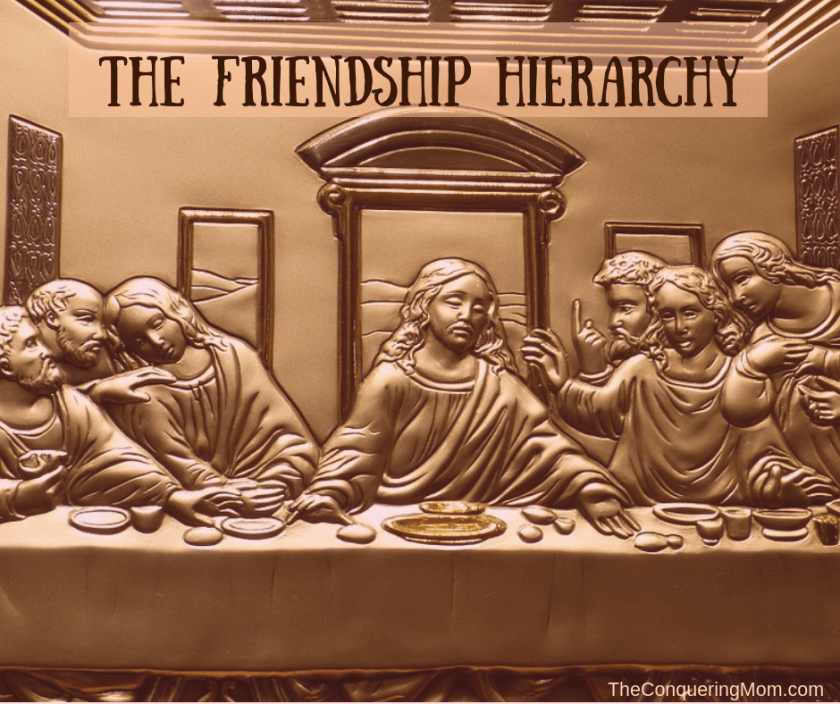
Friendship Hierarchy
A Conclusion
Jesus, while on this earth, befriended thousands, among them:
120 who believed in Him, followed Him – Acts 1:15
72 who did ministry for Him – Luke 10:1, 17
12 whom He discipled, whom He called “friends” – Mark 3:14
3 whom He granted more insight and understanding – Mark 5:37, 9:2, 14:33
AND
The one whom He loved, who leaned upon Him at meals, to whom He entrusted His last revelation.
John 13:33, 21:7, 20, Revelation 1:1-2
 What is a best friend?
Oh, if only we all could be perfect friends! What a world it would be!
But it is not.
The day may come, though, when each of us can realize, “My friend is as close to me as myself. I love this friend like my own life. She is the best friend a person could ever be.”
“Best” friends have existed from the beginning of recorded history. Words for “best friend” appear in many languages. The ancient Hebrew word was alluph meaning “guide, chief friend”. The Greeks grasped this idea, too, with their word peitho meaning “persuade, trust, confidence”. The words appear in Proverbs 16:28, 17:9 and Acts 12:20, where it mentions a man who is “trusted personal servant of the king”.
You know, the one who saddles his horse, pours his wine, and hands him his clothing; the one who stores his seal, adjusts his armor, and sleeps in his doorway. No one gets past this man because he loves his king more than his own life. The king has hand-picked him because of his loyalty. Many may want the job, may even attack the servant with gossip, because of jealousy, but the king has final say and this man is it.
This closest friend has free access to your soul, can tell you off or kiss your cheek without blame. It is the duty and privilege of this closest friend.
You would trust this friend to discipline your own children, to manage your estate, to give you a sponge bath if you had a fever. You would trust this friend to talk you into or out of a huge decision.
You would tell this friend first, if you sinned a huge sin. The wrong person in this slot could completely destroy you.
Pure trust. Pure friendship. It happens once in a lifetime for some, never for others.
No one, no one, should enter into this type of friendship lightly. Such trust must always be earned.
Such trust is not always mutual. One friend may trust more than the other because of differences in caution levels, need levels, or past hurts. Even lack of time can cause one to forego such friendship.
Sometimes it is fleeting. Two men trapped in a fallen mine shaft may trust each other in this way until they are rescued, when those golden hours become a golden memory of the highest humanity can be.
Sometimes we must trust medical professionals this way, for a brief time, and, of course, sometimes that forced trust can seem very awkward.
What joy that for some women, such a friendship develops inside marriage! Many women, though, may feel they need one female friend of nearly equal status to the husband, just to have someone with whom they can discuss the pitfalls and surprises of marriage to a man.
For some of us, our own mothers can be this type of friend. For some of us, our mothers must rely upon us in this manner.
Jonathan risked his life to save David’s. Nehemiah was cupbearer to the king. My sister was my mother’s executrix. Pure trust, rightly placed, is a precious gift.
If you find that opportunity, take it.
Take it very slowly.

Been Unfriended?
People can be complicated.
Friendships can be messy.
Knowing more can be scary.
With the knowing, the deeper truths, and the closer expressions of concern, can come the fears, the denials, and the silence.
 The dark days of friendship.
A couple of friends once asked me if my young teen daughter could arbitrate between their two teens. I could hardly believe my ears. The three of us were close, so I shared my many concerns and said no.
The ramifications were astounding: a seeming total breakdown in all communication.
They literally continued being friends to each other without me and my daughter.
Wow.
A full year later, we were all at an event at a park. One of these friends had a newly-minted, biggest-baddest car-of-the-year and asked me if I would enjoy taking it around the park with her.
The shock!
Still the idea of sitting behind all 4 million horses under that hood was too tempting and we took her for a spin at park speed: 5 mph. Ha.
It was glorious and just destroyed my mini-van, in my eyes.
However, what happened during that drive was more. Far more. This dear friend apologized. She said she was wrong. She had thought I was wrong but she saw differently later. She thanked me for my dedication to truth and to our friendship. I thanked her for the same two things.
We are still friends, the kind that can be apart for a year and then take it up like we were just days apart. Which we did.
This was deep.
This was asking advice on children and giving it.
This was disagreeing and staying cool for a year.
This was trusting an apology would fix it.
This was forgiving wrongs. Deep, deep, deep, like few, few, few friendships ever can be.
The ancients called these types of friendships leb in Hebrew and philos in Greek, implying core understanding, brotherhood. This friend would visit a friend in jail. This friend would give up a year of pleasure for a friend. This friend would help a relative of a friend, if asked; would party and rejoice at a friend’s joy. Read about it in Ruth 2:13 and John 3:29.
But it can backfire.
Big.
All people have at their fingertips the ability to do wrong. This is what we risk in every relationship, but the closer we grow, the more we risk.
The closer we are, the more accurately we can aim our weapons.
And, oh, the more it hurts.
This is a call for caution.
Some people are broken and do not know how to be a friend. Befriending them will always be a lopsided venture, more give than take, like dancing with someone who doesn’t know the steps. Befriending them will always carry risk. Befriending someone who might backfire is a noble calling, not a picnic.
As long as we remember each of us is able to fail, as long as we dedicate ourselves to befriending and not to collecting fun people, we can proceed. We can gently and lovingly share the truth in hope, not that the friendship will one day benefit ME, but that it will one day bring glory to God.
And that is where we all should be.
Comments? Read more?

To Friend or NOT to Friend is NOT the Question
Baskin and Robbins began as brothers-in-law. Holmes was looking for a roommate and Watson, an apartment; a co-acquaintance introduced them. Ben and Jerry met in a junior high gym class. George and Laura Bush met at a barbecue; she was a Democrat at the time.
You just never know!
Once we pass the stage of just smiling, waving, and discussing the weather; once we acknowledge this friendship has gone beyond mere mutual co-existence; once we begin missing someone and caring about his troubles, we slide into the third stage of friendship.
And we’d better have done our homework first.
What the ancients called ahab in Hebrew and hoi soi in Greek is that comfortable belovedness that we call familiar friendship. It’s that willing leaning into the yoke together, a certain smiling oneness that tells us “we like this.” Examples appear in Esther 5:10 and Mark 5:19.
 It’s time for caution.
Friends come and go, but it’s a good idea to hang on to your soul, to make sure someone doesn’t carry off your personality while you’re not looking.
Some friendships are simply dangerous and the deeper we trust someone, the more it is imperative they be trustworthy. Therefore, the closer we draw to anyone, the more appropriate and vital our conversations become. Certain things must be discussed. As we work, play, eat, and rest with a friend, we who care must constantly ask, bit by bit, constantly seek that open door to deeper understanding of each other.
I know, some folks never talk about politics and religion, but really, how can we ever grow closer without that? Life goals, ideologies, and other matters about which we are logically careful, must be open to those with whom we are open. When we allow others to influence the fragile matrix of the core of our being, we must know where we stand, where the lines are drawn.
And yet . . .
What a glorious opportunity presents itself when we share openly with someone who has long desired a way to heal, a way to stand more firmly! Questions again become the food and drink of friendship and we find that if we can be strong, we can hold out a hand to the weak, extend a lifeline to the perishing. Our very presence can signal the hope like a lighthouse in a storm. Lives can spring back to life and new light can thunder in to glorious dawning.
An older man we know has befriended a young man for ages, taking him to public events, connecting at lunch occasionally, sometimes fishing with him. The young man’s marriage recently went through a severe test, but he is learning how to come out of this time in victory. He has drawn closer than ever to his beloved family, so opposite from what the enemy of our souls obviously wanted. Throughout this time, he has not failed to call upon the older man for prayer, advice, and simple acceptance. He is winning. He has come out on the other side, now. He has new strength. He grows daily.
All because of friendship, all from a good old comfortable friend who has touched God.
It’s what we need, what we crave; or it’s what we have, what we long to share; it’s why we aim at friendship in the first place.
Who among us has not been there.
Comment? Read more?

To Befriend or NOT to Befriend . . .
Okay, you know her name and that she has three children and came from Peoria, and she attends your church when she bothers with attending.
You even know what she and her husband argue about. She lives just down the street, after all.
You just do not feel very close. Oh, sure, you’ve given her a ride when her car was in the shop, you watched her children while she painted a room, and you took her some soup when they all had flu. She lives just down the street, after all.
She is what the ancient Hebrew called anesh-shalom and the ancient Greek called hetairos. These words referred to acquaintances that we work with, live with, even depend upon, but yet are not necessarily of our choosing. Examples are Jeremiah 38:22 and Matthew 20:13.
 It would not yet be wise to trust her, but how do you befriend her?
You take food to her, help with her children, and give her rides; that’s how.
While you are at it, show interest. If you are only a helping hand, she will feel like a charity case. A person usually cannot open up to another unless there is a trade, a give and take, like a dance. If, over coffee or tea, you ask to see the paint job, ask her for a ride in return, or ask if her children would feed your cat while you are gone, you will deepen the relationship.
You will earn closeness that allows you to ask better questions than, “How are you today?”.
Questions like:
“You look tired—bad night?”
“So, how do you like the neighborhood? Are you meeting folks?”
“It was good to see you Sunday—Have you decided to join us, or are you still looking?”
Her answers will open doors for new conversations that are more meaningful. Conversations are the building blocks of true friendship. Slip in a hug, when appropriate, and you add the cherry on top: You add value to her person.
Realizing that each person on this earth is needy is the key to all relationships.
We once lived next door to the wealthiest family in town, totally out of our league. The wife one day asked my permission to help plant my rose bushes. The part she really wanted to do was pick the grass roots from the soil, so it would not grow back so quickly. Her daddy, she said, used to make her do that chore and she seldom got a chance to show her expertise at it, anymore.
When we got thirsty, I brought out ice water in my old jelly glass tumblers. We sat on the edge of the terrace, on a railroad tie, and chatted as if we were just a couple of women who liked playing in the dirt, in our grubby clothes. We talked about our mothers-in-law and about the neighbor’s cute grandson. You know, normal stuff.
She needed to feel normal.
And haven’t we all been there.
Comment?

To Be a Friend or NOT to Be . . .
The most important part of undertaking any type of friendship is re-arranging the understanding about what a friend is.
A friend is something you must BE.
It is not something to have, collect, use, or control. People who are kind and loving do not own, collect, use, or control other people. That is not friendship; it is manipulation. A person is not something to collect. We do not have friends, do not own friends. We BE friends.
We befriend.
Given that, we should learn how to befriend. We should care about being a good friend, not collecting friends. So we study the Best Friend we can find and we learn how His words lead us into all truth, even about our earthly friendships.
And His Word tells us and shows us there are five levels of acquaintance, of friendship.
 The most distant acquaintance is the person you recognize from the newsstand or the grocery checkout. You do not know his life or how to be what he needs, but you always smile and wave, acknowledging that fragile link of recognition, of knowing we both don’t even know each other’s name.
The Old Testament ancient Hebrew used words like rea and raa (Proverbs 19:6) to indicate this type of person you might see occasionally, might make a show of friendliness to. In the New Testament, the old Greek words were hoi par autou, (Mark 3:21) for those who just happen to be with you.
Although you might not know this person’s needs, you can reach out to him. The best way to “befriend” such a person, obviously, is to get to know him more. A simple question about place of origin, number of children, or hobbies, in the right context, will add a few almost invisible layers to your acquaintance with this person.
Your continued interest will tell him someone cares, which is such a life-giving thought.
And haven’t we all been there.
 Home's Cool!